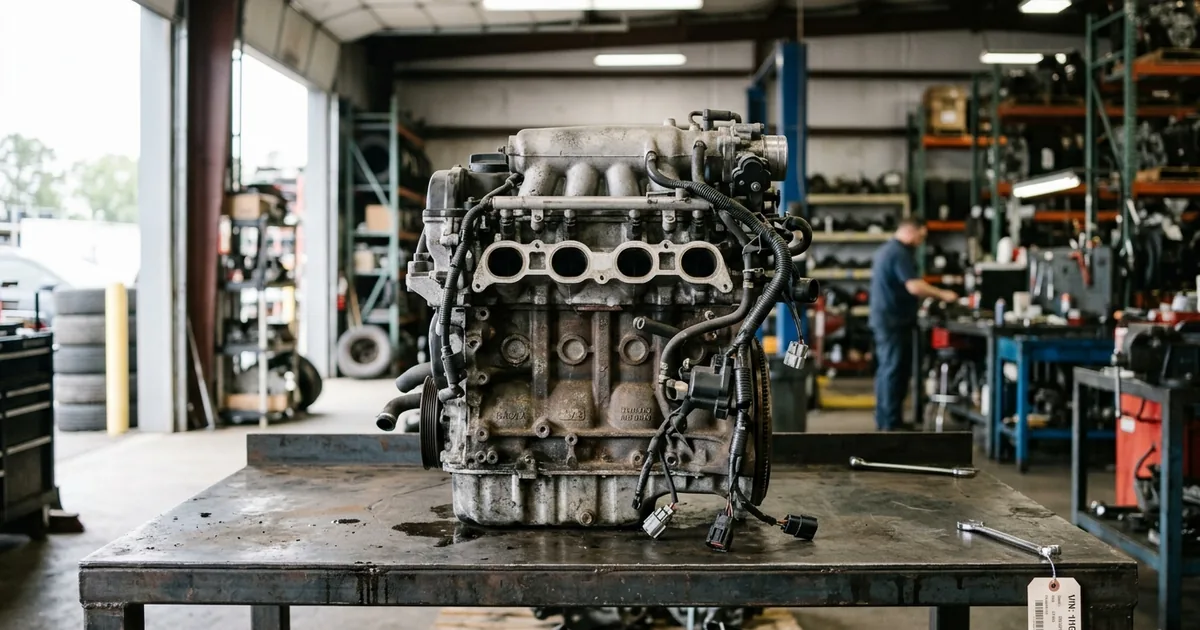
Vehicle price comparison
Dodge Challenger vs Nissan Sentra Engine prices
Price face-off
Median price comparison
Condition comparison
How does the price differ by part grade?
Market analysis
Why does the Dodge Challenger engine cost more?
A used Dodge Challenger engine carries a median asking price of $2,988, which is 498% higher than the Nissan Sentra at $500. Supply also plays a role: Dodge Challenger has 1,880 priced listings versus 774 for Nissan Sentra, and more listings generally mean more choices and more competitive pricing.
The Dodge Challenger average ($4,801) runs 61% above its median ($2,988), indicating a tail of high-priced listings — likely low-mileage or remanufactured units pulling the average up.
Our guide covers 10 model years for the Nissan Sentra (2015–2025) but only 7 for the Dodge Challenger (2017–2023), so the Nissan Sentra data reflects a broader range of generations.
At Grade A (excellent) condition, the Nissan Sentra is 84% cheaper ($510 vs $3,166) — the gap widens compared to the overall median difference.
The Dodge Challenger has 8 known trim variants compared to 4 for the Nissan Sentra, which means buyers need to be more careful about matching the exact engine or drivetrain configuration on the Dodge Challenger.
Buyer's checklist
What to check before buying a used engine
- Confirm the VIN-matched engine code — the same model can use different engines across trims and years.
- Ask for the mileage on the donor vehicle. Under 80K miles is ideal; over 120K usually needs a compression test.
- Look for signs of overheating: warped heads, milky oil on the dipstick or filler cap, and coolant residue around the head gaskets.
- Check whether accessories (alternator, A/C compressor, power steering pump) are included or if you need to swap yours over.
Full price guide
Dodge Challenger Engine
$20 – $25,950 · 1,880 listings
Full price guide
Nissan Sentra Engine
$1 – $2,262 · 774 listings
Common questions
Dodge Challenger vs Nissan Sentra engine FAQ
Is a used Dodge Challenger engine cheaper than a Nissan Sentra?
Nissan Sentra has the lower median by $2,488 (498%). The Nissan Sentra engine ranges from $1 to $2,262 across 774 listings, while the Dodge Challenger ranges from $20 to $25,950 across 1,880 listings.
Can I use a Dodge Challenger engine in a Nissan Sentra?
This comparison describes pricing, not interchangeability. Even when two parts share similar prices, they may require different engines, trims, electronics, or mounting points. Always match the seller's part number against your VIN before purchasing.
How many listings does this comparison cover?
This comparison draws from 1,880 priced Dodge Challenger listings and 774 priced Nissan Sentra listings — 2,654 in total.
How does condition grade affect the price?
Part condition significantly impacts price. Grade A (Excellent): Dodge Challenger $3,166 vs Nissan Sentra $510. Grade B (Good): Dodge Challenger $2,484 vs Nissan Sentra $416. Grade C (Fair): Dodge Challenger $1,600 vs Nissan Sentra $675. Grade A parts are in excellent condition, B is good, and C is fair — always confirm grading criteria with the seller.
Are there different trim variants to choose from?
Yes. The Dodge Challenger engine has 8 trim variants and the Nissan Sentra has 4. Variants differ by engine size, drivetrain, or part number — matching the right variant is critical for proper fitment.
More comparisons