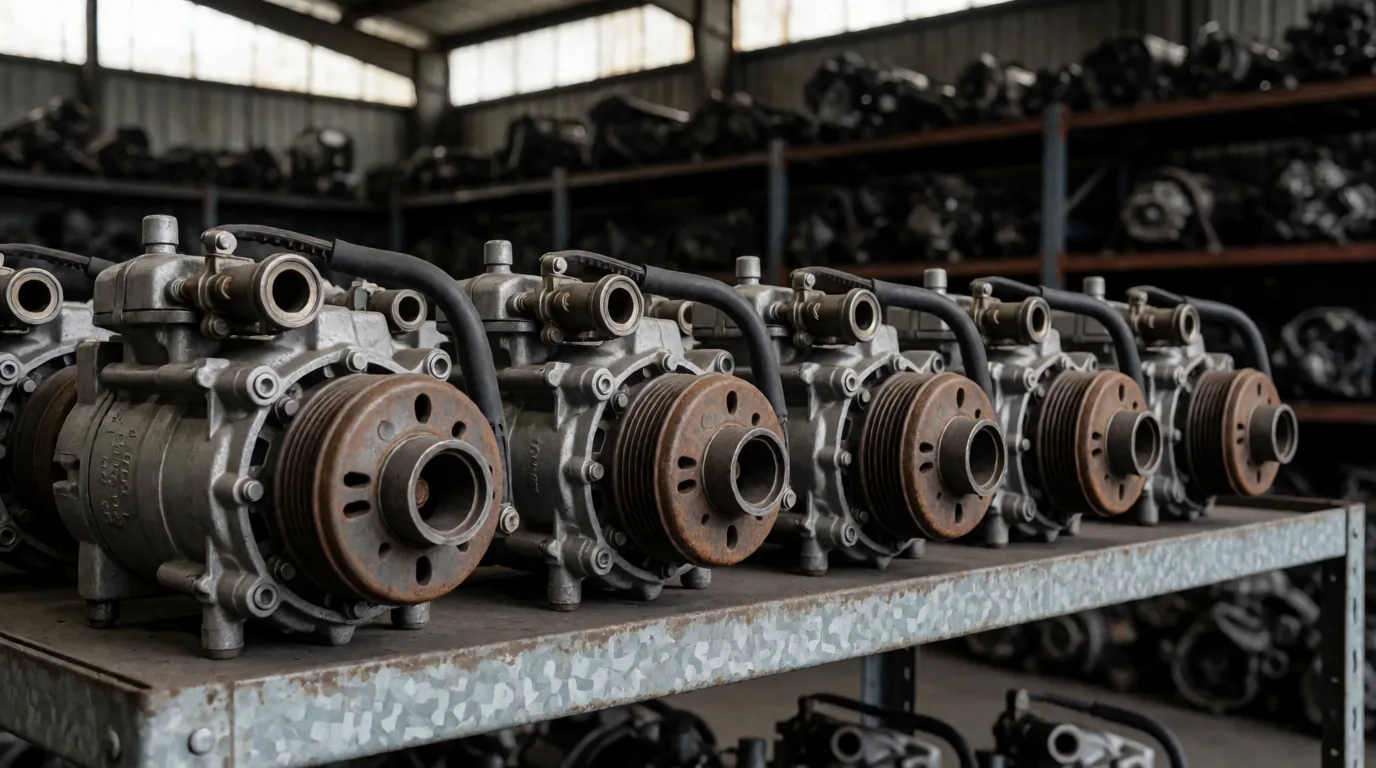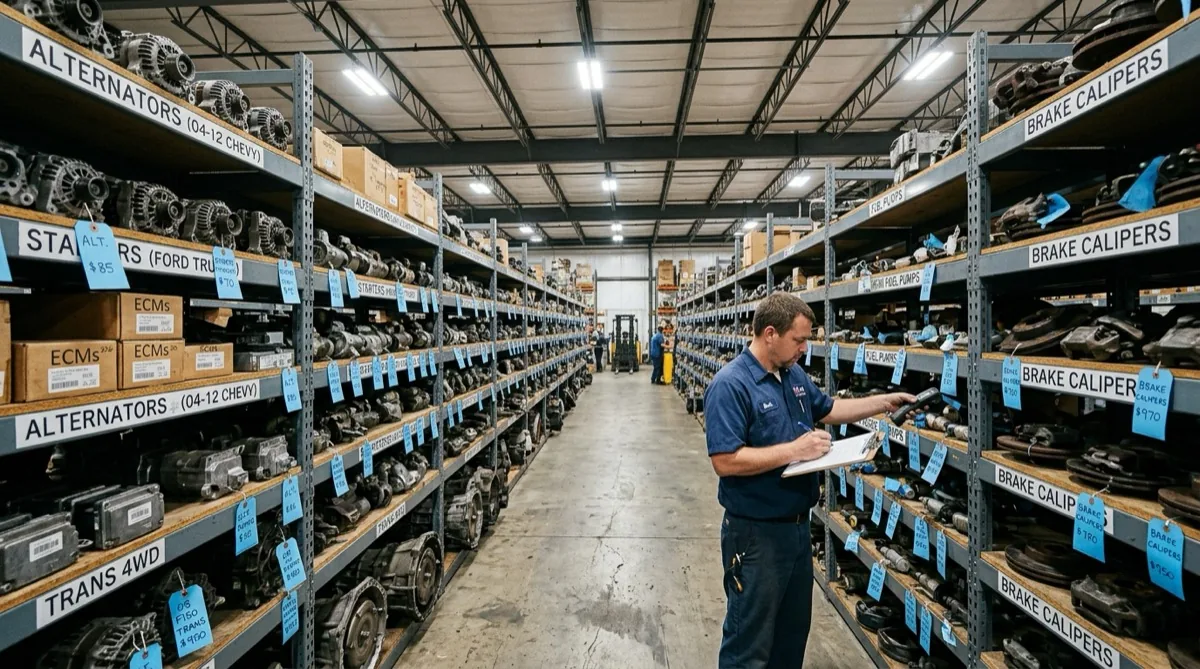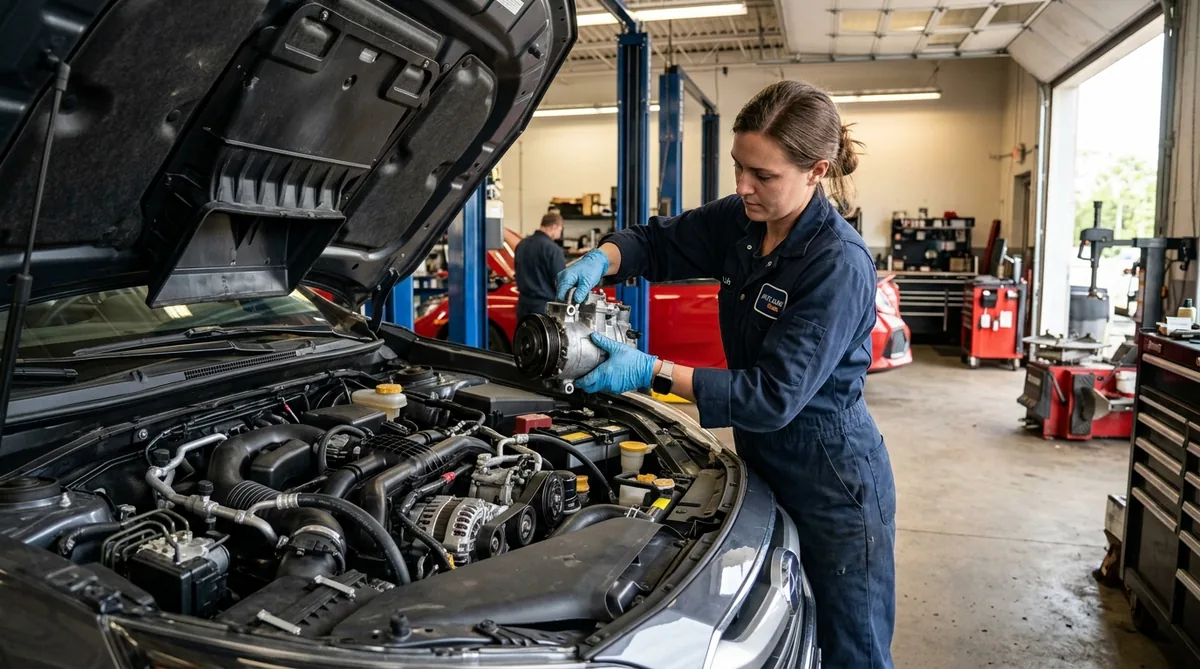
Replacing an AC compressor costs $388 to $1,056 total when you source a used compressor from a salvage yard, including labor and the mandatory refrigerant recharge. A used AC compressor runs $153 median across our index of priced salvage listings spanning 62 vehicle models. New aftermarket compressors cost $150 to $400, and new OEM units run $300 to $800, pushing total job cost to $440 to $1,200 or $590 to $1,600 respectively.
The wide cost range exists because AC compressor replacement is not just a compressor swap. The job includes a receiver/drier, expansion valve or orifice tube, fresh oil, and a full system recharge. Labor runs 2 to 4 hours depending on compressor access, and the refrigerant work requires specialized equipment that adds time and cost regardless of the vehicle.
- Total cost with a used compressor: $388 to $1,056. $98 to $256 part, $190 to $600 labor, $100 to $200 recharge
- New aftermarket total: $440 to $1,200. $150 to $400 part plus labor and recharge
- New OEM total: $590 to $1,600. $300 to $800 part plus labor and recharge
- Used AC compressor median: $153 across 62 vehicle models in the PartPriceGuide salvage index
- Labor runs 2 to 4 hours at $95 to $150/hr depending on engine layout and compressor access
- Supporting parts are mandatory: receiver/drier ($20 to $60), expansion valve ($15 to $50), and PAG oil ($10 to $20) are included in most shop labor quotes
- Dataset: PartPriceGuide.com analysis of salvage yard listings across 62 vehicle models, August 2026
What AC Compressor Replacement Costs
AC compressor replacement has more line items than most repairs. The compressor itself is only one piece of the bill. Labor, supporting parts, and the refrigerant recharge all add up, and none of them are optional.
| Cost Component | Used | New Aftermarket | New OEM |
|---|---|---|---|
| Compressor | $98 to $256 (median $153) | $150 to $400 | $300 to $800 |
| Labor (2 to 4 hrs at $95 to $150/hr) | $190 to $600 | $190 to $600 | $190 to $600 |
| Refrigerant recharge | $100 to $200 | $100 to $200 | $100 to $200 |
| System flush (if needed) | $100 to $200 | $100 to $200 | $100 to $200 |
| Total (without flush) | $388 to $1,056 | $440 to $1,200 | $590 to $1,600 |
The system flush is conditional. If the old compressor seized internally and sent metal debris through the lines, the entire system needs flushing before the new compressor goes in. A leak-only failure typically does not require a flush, which saves $100 to $200.
*Part pricing source: PartPriceGuide.com analysis of salvage yard listings across 62 vehicle models, August 2026.*
For detailed used compressor pricing by vehicle model, see our used AC compressor cost breakdown.
What's Included in the Job
A proper AC compressor replacement is really a partial AC system rebuild. Cutting corners on the supporting parts is one of the most common reasons replacement compressors fail early. Here is what goes into a complete job and why each piece matters.
Compressor
The compressor is the pump that pressurizes refrigerant and circulates it through the AC system. It bolts to the engine block and runs off the serpentine belt via an electromagnetic clutch. When it fails, the refrigerant stops circulating and the system produces no cold air. Replacement involves evacuating the remaining refrigerant, disconnecting the high and low pressure lines, unbolting the compressor from the engine, and reversing the process with the new unit.
Receiver/Drier (or Accumulator)
The receiver/drier sits between the condenser and the expansion valve and filters moisture and debris from the refrigerant. Every compressor replacement requires a new drier because the old one has been exposed to atmospheric moisture once the system is opened. A saturated drier lets moisture reach the compressor, where it forms acids that corrode internal surfaces. The part costs $20 to $60 and takes 15 to 30 minutes to swap. Most compressor warranties are void if you reuse the old drier.
Expansion Valve or Orifice Tube
This component meters refrigerant flow into the evaporator, creating the pressure drop that produces cold air. A clogged or stuck valve restricts flow and puts extra load on the compressor. Replacing it during a compressor job costs $15 to $50 for the part and adds minimal labor since the system is already open. Reusing a partially clogged valve can kill a new compressor within months.
Refrigerant Recharge
After the compressor, drier, and valve are installed, the system gets evacuated with a vacuum pump to remove air and moisture, then recharged with the correct weight of R-134a or R-1234yf refrigerant. This step requires a recovery machine and manifold gauges. The recharge itself costs $100 to $200, with R-1234yf vehicles running toward the higher end because the refrigerant costs 3 to 5 times more per pound than R-134a. Vehicles made after 2017 increasingly use R-1234yf.
Signs of a Failing AC Compressor
AC compressor failure develops gradually in most cases, giving you time to plan the repair before the system stops working entirely. Recognizing these symptoms early also helps distinguish a compressor problem from cheaper fixes like a refrigerant recharge or blend door issue.
Warm air from the vents when AC is set to max cold. The most obvious symptom. If the blower motor pushes strong airflow but the air is not cold, the compressor may not be engaging. Listen for the compressor clutch clicking on when you press the AC button. No click means the clutch is not engaging, often because the system has leaked enough refrigerant to trigger the low-pressure safety switch.
Loud grinding or squealing from the engine bay when AC is on. A failing compressor bearing produces a metallic grinding that gets louder with higher RPM. The clutch bearing can also squeal when the compressor engages. This noise stops when you turn the AC off, which separates it from serpentine belt or alternator noise that persists regardless of AC state.
AC cycles on and off rapidly. Short cycling, where the compressor engages for a few seconds and then disengages, repeats continuously. This usually indicates low refrigerant charge, a failing pressure switch, or internal compressor damage. The AC system has high and low pressure cutoff switches that disengage the compressor to prevent damage.
Visible refrigerant leak at the compressor shaft seal. An oily residue around the front shaft seal or the high/low pressure fittings on the compressor body means refrigerant is escaping mixed with PAG oil. A shaft seal leak is the most repairable failure mode, but most shops replace the entire compressor because a resealed unit often leaks again within a year.
AC works intermittently, cold on some drives but not others. An internally failing compressor may still produce pressure under some conditions but lose efficiency as its internal reed valves or pistons wear. Temperature-dependent symptoms (works on cool mornings, fails in afternoon heat) point to a compressor that is marginal and will fail completely soon.
Used vs New AC Compressor
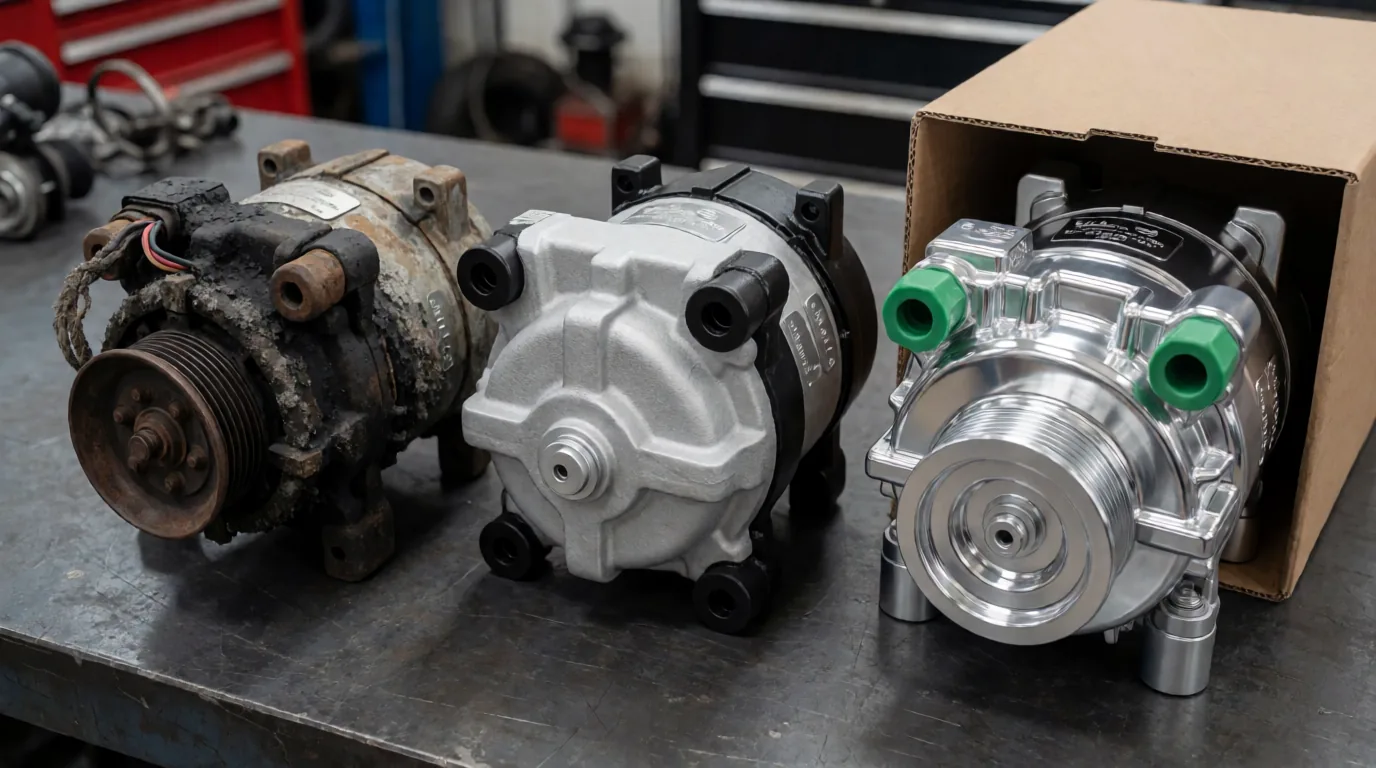
The part cost gap between used and new AC compressors is substantial, but the total-job gap is narrower than the part prices suggest. That's because labor, recharge, and supporting parts are identical regardless of which compressor you install.
| Factor | Used | New Aftermarket | New OEM |
|---|---|---|---|
| Part price | $98 to $256 (median $153) | $150 to $400 | $300 to $800 |
| Warranty | 30 to 90 days | 1 to 2 years | 1 to 3 years |
| Labor warranty coverage | Rarely | Sometimes | Sometimes |
| Total job cost | $388 to $1,056 | $440 to $1,200 | $590 to $1,600 |
Our used vs new AC compressor comparison breaks down the warranty and break-even math in detail.
When used makes sense. Vehicles worth under $10,000, DIY installs where you absorb no labor cost on a second failure, and compressors from low-mileage donors (under 80,000 miles). A used compressor from a donor with 60,000 miles has significant life left and costs roughly what a remanufactured unit's core charge alone would be.
When new makes sense. Vehicles you plan to keep long-term, R-1234yf systems where a second recharge costs $200+, and any shop-installed job where warranty coverage on both parts and labor protects you from a double-labor scenario. If the old compressor seized and contaminated the system with debris, a new compressor with a manufacturer warranty is the safer bet after a flush.
For a broader look at used vs new pricing across all parts, see our used auto parts price guide.
DIY Feasibility
AC compressor replacement is a split job: the mechanical work is moderate, but the refrigerant handling requires equipment most home mechanics do not own.
The mechanical portion involves removing the serpentine belt (or just slipping it off the compressor clutch pulley), disconnecting two refrigerant lines, unbolting 2 to 4 mounting bolts, and lifting the compressor out. On trucks and rear-wheel-drive SUVs, this takes 1 to 2 hours. On transverse-engine vehicles with tight engine bays, accessing the lower mounting bolts can push the job to 2 to 3 hours. The new compressor, drier, and valve install in reverse order. None of this requires specialized knowledge beyond basic wrench work.
The refrigerant portion is the barrier. Federal law (Clean Air Act, Section 608) prohibits venting automotive refrigerant. You need a recovery machine to capture the old charge, a vacuum pump to evacuate air and moisture from the system, and manifold gauges to recharge with the correct weight of refrigerant. This equipment costs $300 to $800 to buy, and not all auto parts stores rent it. R-1234yf adds another layer: the refrigerant costs $40 to $80 per pound (you need 1 to 2 pounds) compared to $5 to $15 per pound for R-134a.
The practical compromise. Many DIYers handle the compressor swap, drier, and valve themselves, then drive to a shop for the evacuation and recharge. This captures most of the labor savings, since the recharge takes 30 to 45 minutes and shops charge $100 to $200 for it, compared to $190 to $600 for the full labor bill. If you install a used compressor at $153 median and pay $150 for a shop recharge, your total out-of-pocket is roughly $250 to $400, less than half the shop-installed total.
Tools you will need for the mechanical portion:
- Socket set (10mm, 12mm, 14mm cover most applications)
- Torque wrench (compressor bolts require specific torque values)
- Line wrenches for refrigerant fitting disconnection
- New O-rings for all refrigerant connections (included with most compressor kits)
- Fresh PAG oil (46 or 150 viscosity, matched to your system)