Replacing a side mirror costs $158 to $1,125 total with a used OEM part, depending almost entirely on what electronics the mirror carries. The used part itself runs $110 to $900 with a $220 median across 62 vehicle models, and labor adds $48 to $225 for what is typically a 0.5 to 1.5 hour job.
That $110 to $900 range is one of the widest in our salvage yard index, and it exists because modern side mirrors are no longer just a housing with a piece of glass. A manual mirror on a 2012 Nissan Versa and a power-folding, heated, blind-spot-monitoring, camera-equipped mirror on a 2024 BMW X5 are fundamentally different parts that happen to mount in the same location. The feature set built into your mirror determines roughly 80% of what you will pay.
- Total cost with used OEM part: $158–$1,125, median around $268–$445 depending on features
- Used mirror part cost: $110–$900, $220 median across 62 vehicle models
- Labor: $48–$225 for 0.5–1.5 hours of shop time
- New aftermarket: $50–$300, reasonable for basic power mirrors but limited for feature-loaded units
- New OEM: $150–$800+, necessary only for current-model-year vehicles with no salvage inventory
- Glass-only replacement: $15–$120 if the housing and electronics are intact
- Biggest cost driver: blind spot monitoring, auto-fold, and integrated cameras can push a mirror from $110 to $900
- Dataset: PartPriceGuide.com analysis of salvage yard listings across 62 vehicle models, August 2026
What Side Mirror Replacement Costs
The full picture across all three sourcing options. Labor stays constant because the shop performs the same removal and installation regardless of where the mirror came from.
| Cost Component | Used OEM | Aftermarket New | New OEM |
|---|---|---|---|
| Part cost | $110–$900 (median $220) | $50–$300 | $150–$800+ |
| Labor (0.5–1.5 hr) | $48–$225 | $48–$225 | $48–$225 |
| Total | $158–$1,125 | $98–$525 | $198–$1,025+ |
Used OEM from a salvage yard is the default choice for any mirror with integrated electronics. The part is identical to what the dealer sells, tested and verified from the donor vehicle, at 30% to 70% of new OEM pricing. Browse current salvage inventory at our side mirror price listings.
*Part pricing source: PartPriceGuide.com analysis of salvage yard listings across 62 vehicle models, August 2026.*
Basic vs Feature-Loaded Mirrors
The feature content of your mirror assembly is the single largest cost variable. Each added technology increases the component count, wiring complexity, and replacement price.
Manual mirrors ($110–$150 used). A housing, a glass element, and a ball-joint pivot that adjusts by hand. No wiring harness, no motor, no electronics. These are found on base-model economy cars and work trucks. Replacement is a bolt-on swap that takes 15 to 30 minutes.
Power mirrors ($120–$200 used). Add a small electric motor and a wiring connector for remote adjustment from the cabin. This is the most common configuration on mid-trim sedans and trucks built after 2010. The motor and connector add modest cost over a manual mirror, and aftermarket replacements are widely available in this tier.
Heated mirrors ($140–$250 used). A heating element behind the glass prevents fog and ice buildup. The element draws current through the same wiring harness as the power motor, adding one or two pins to the connector. Heated mirrors are standard on most vehicles sold in northern climates and common as optional equipment elsewhere.
Mirrors with integrated turn signals ($160–$300 used). A row of LEDs or a small amber lamp in the housing acts as a supplemental turn indicator visible to vehicles in adjacent lanes. The signal adds a dedicated circuit to the harness and a lens molded into the housing. Replacing just the turn signal lens is sometimes possible for $20 to $40, but a cracked housing requires the full assembly.
Blind spot monitoring mirrors ($250–$600 used). A radar sensor or camera module integrated into the mirror housing or the area behind it. When the BSM system detects a vehicle in the blind spot, an indicator lights up on the mirror glass or housing. This sensor must communicate with the vehicle's BSM control module, and a replacement mirror from a different model year or trim may not be compatible even if it physically fits. After replacement, many vehicles require a BSM calibration procedure using a factory-level scan tool, which adds $80 to $150 at a dealer or equipped independent shop.
Auto-fold mirrors ($200–$400 used). A secondary motor folds the mirror assembly flat against the door, activated by a button or automatically when the vehicle locks. Common on luxury vehicles and upper-trim SUVs. The fold motor and its gear mechanism are the most mechanically complex part of a mirror assembly, and a failed fold motor is one of the top reasons for full mirror replacement on vehicles that have this feature.
Camera mirrors ($350–$900 used). A wide-angle camera integrated into the mirror housing feeds a surround-view or cross-traffic display on the dashboard screen. These mirrors carry a camera module, a wiring harness with video signal lines, and sometimes a washer nozzle for the lens. Camera mirrors are vehicle-specific with almost no aftermarket alternatives. A used OEM unit from a salvage yard is the only cost-effective replacement path.
| Feature Level | Used OEM Range | New OEM Range | Aftermarket Available? |
|---|---|---|---|
| Manual | $110–$150 | $150–$250 | Yes |
| Power | $120–$200 | $150–$300 | Yes |
| Power + heated | $140–$250 | $180–$350 | Yes, limited |
| Power + heated + turn signal | $160–$300 | $200–$400 | Some models |
| BSM (blind spot monitoring) | $250–$600 | $400–$700 | Rarely |
| Auto-fold + BSM | $300–$650 | $500–$800+ | No |
| Camera + BSM + auto-fold | $350–$900 | $600–$1,200+ | No |
The practical takeaway: if your mirror has blind spot monitoring or a camera, budget for a used OEM assembly and a possible calibration fee. Aftermarket is not a realistic option at that feature level. For a basic power or heated mirror, aftermarket saves money without sacrificing fit or function.
For a broader look at how salvage yard pricing works across all part categories, see the used auto parts price guide.
Common Causes of Mirror Damage
Side mirrors sit at the widest point of the vehicle and protrude into traffic, making them one of the most frequently damaged exterior parts.
Sideswipe collisions and parking lot contact. The most common cause. A passing vehicle, a tight parking garage pillar, or a mailbox clips the mirror and cracks the housing or shears the assembly off the door. Even low-speed contact can destroy a mirror because the housing is plastic and the mounting bracket is designed to break away rather than transfer force into the door panel.
Hit-and-run damage. Parked vehicles in urban areas lose mirrors to passing traffic, delivery trucks, and cyclists at a rate that body shops describe as routine. Because the mirror is a breakaway part, the rest of the door usually survives undamaged, which makes this one of the cheaper hit-and-run repairs.
Weather and road debris. Hail can crack mirror glass and housings. Road debris kicked up on highways strikes mirrors at the same angle and frequency as windshields but against a much thinner plastic shell. Ice storms can freeze auto-fold mechanisms in the extended position, and forcing a frozen fold motor will strip the internal gears.
Failed fold motors and stuck adjustment. On mirrors with power-fold, the fold motor's plastic gears wear over time. Symptoms include a grinding noise when the fold button is pressed, a mirror that folds out but will not fold back (or vice versa), or a mirror that vibrates at highway speed because the fold mechanism no longer locks. This is a mechanical failure, not an impact event, but it requires the same full assembly replacement.
Faded or delaminating mirror glass. Heated mirrors eventually develop dark spots where the heating element has separated from the glass backing. Auto-dimming side mirror glass (less common than auto-dimming rear view mirrors, but present on some luxury vehicles) can develop a permanent blue or brown tint when the electrochromatic layer fails. Glass-only replacement is an option here if the housing and motors are otherwise sound.
DIY Replacement
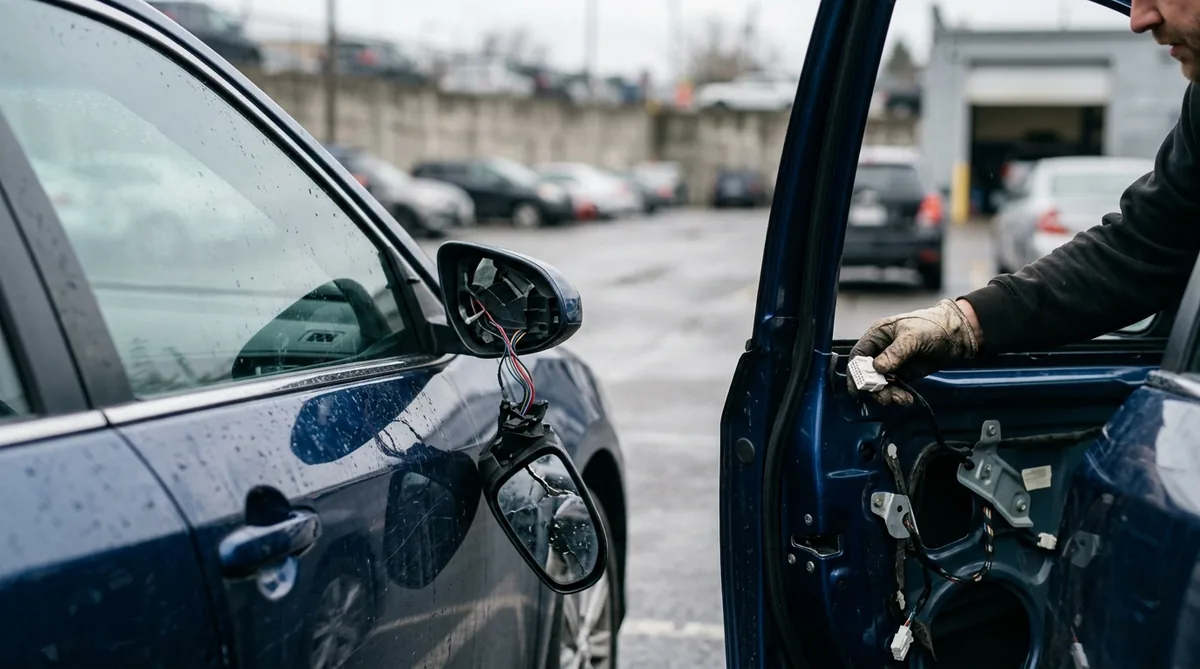
Side mirror replacement is a moderate DIY job. The mirror assembly mounts to the door with two to four bolts or nuts accessible from inside the door panel, and connects through a single wiring harness plug.
What you need: a Phillips screwdriver, a 10mm socket and ratchet (sometimes 8mm or T25 Torx depending on the vehicle), a plastic trim removal tool, and about 30 to 90 minutes.
The general procedure:
- Disconnect the battery if the mirror has heated glass, BSM, or a camera, to avoid accidental short circuits or airbag warnings.
- Remove the interior door panel trim piece that covers the mirror mounting bolts. This triangular panel pops off with a trim tool or pries free with gentle pressure. Some vehicles have a separate sail panel held by one screw.
- Disconnect the wiring harness connector behind the trim piece. Press the release tab and pull the connector apart. Do not yank on the wires.
- Remove the two to four mounting bolts or nuts holding the mirror assembly to the door.
- Pull the old mirror assembly away from the door, feeding the wiring harness through the opening.
- Feed the new mirror's harness through the door opening, align the mounting holes, and start the bolts by hand.
- Tighten the mounting bolts. Do not overtighten: the door skin is sheet metal and the bolt holes can strip or dimple the outer panel.
- Reconnect the wiring harness, snap the trim piece back into place, and reconnect the battery.
- Test power adjustment, heating (spray the glass with water and check for warming after five minutes), turn signals, fold function, and BSM indicator.
Where DIY gets complicated. Mirrors with blind spot monitoring often require a calibration procedure after installation. The BSM radar sensor needs to be aimed relative to the vehicle's body lines, and this calibration requires a factory-level diagnostic tool (or equivalent aftermarket scan tool) that can access the BSM module. Budget $80 to $150 for this step at a dealer or equipped independent shop. Skipping calibration can result in false alerts, missed detections, or a permanent warning light on the dashboard.
Glass-only replacement is a simpler sub-30-minute job when the housing is intact. Heated glass clips into a backing plate with plastic tabs, and a two-pin connector supplies power to the heating element. Pop the old glass off with a plastic tool (never a metal screwdriver, which will scratch the housing), unplug the heater lead, plug in the new glass, and snap it into place. Replacement glass runs $15 to $50 for a standard piece or $30 to $120 for heated or auto-dimming glass.
At the $220 median part cost and $48 to $225 saved in labor, a DIY side mirror swap saves meaningful money, especially on feature-loaded mirrors where the total bill can approach four figures.
For details on sourcing used mirrors at competitive prices, see how much junkyards charge for parts.