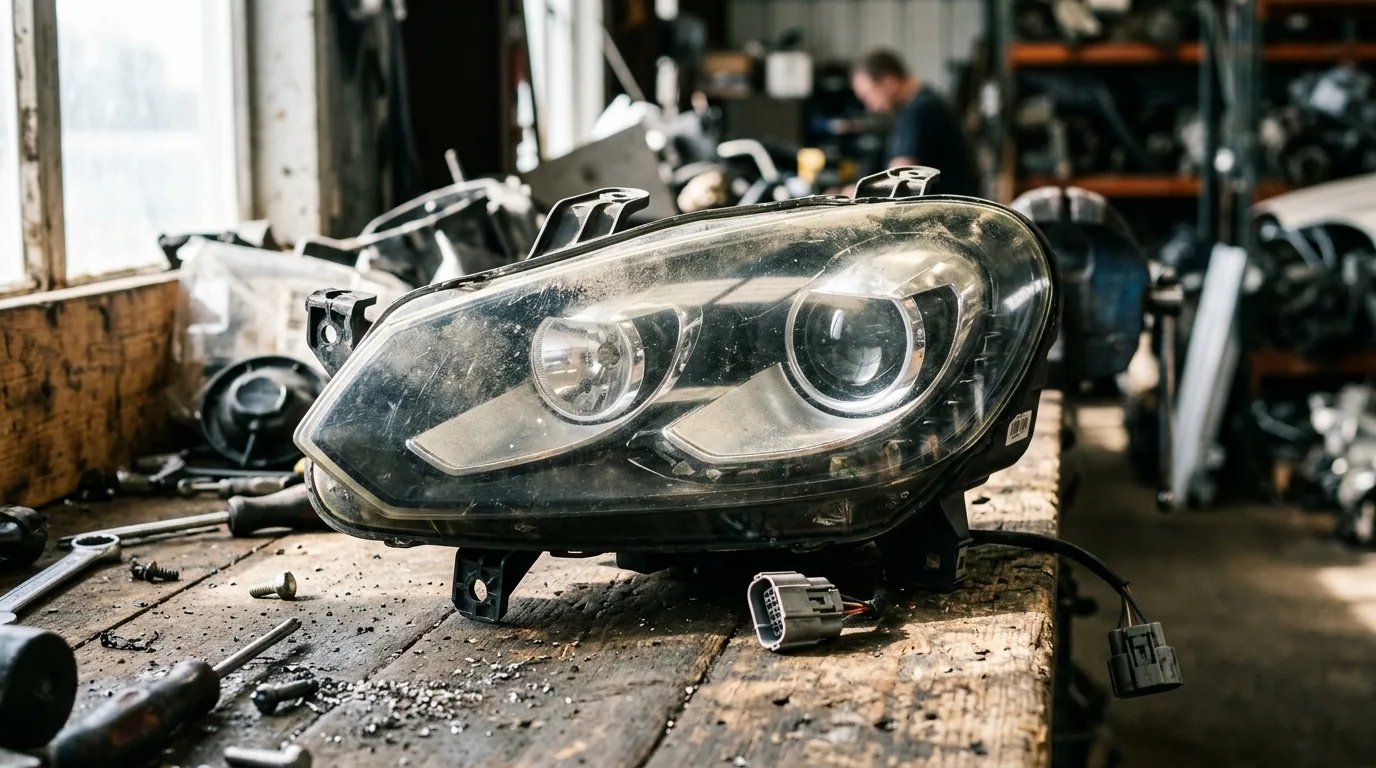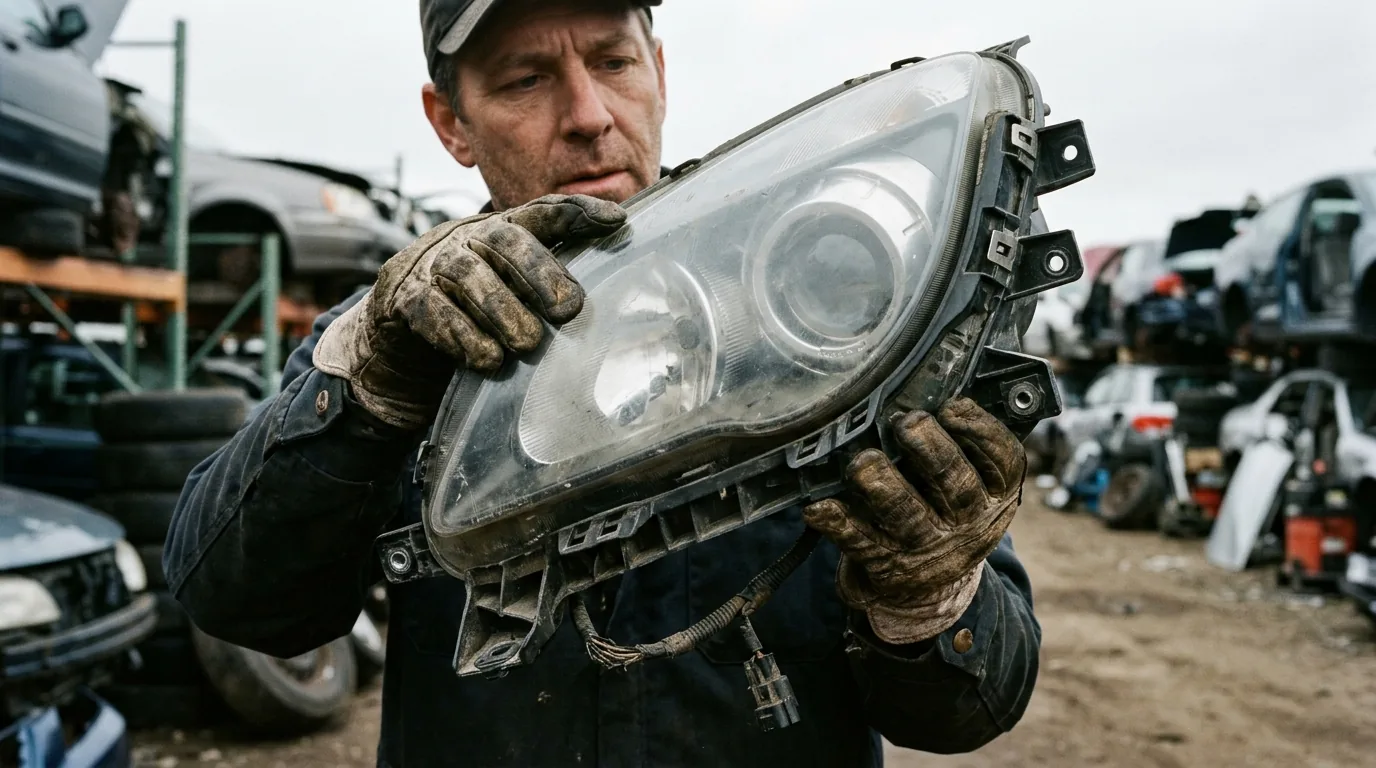
Junkyard headlight assemblies cost between $187 and $1,800 by model, with a national median of $650 across 76,427 priced salvage yard listings. Self-pull yards charge 30 to 50% less than counter-service operations, which puts a typical halogen assembly in the $250 to $450 range if you pull it yourself.
Headlights have the widest price spread of any bolt-on body part at a salvage yard. A Subaru Outback assembly sits at $187 while a BMW X5 unit lists at $1,800, nearly ten times the price for a part that mounts with the same four bolts. The difference is entirely what lives inside the housing.
- Self-pull yards charge 30-50% below counter-service; expect $250-$450 for most halogen assemblies
- Counter-service yards run $187-$1,800 with inspection, a lens condition check, and a 30-90 day warranty
- Technology drives the price, not the vehicle size: LED and adaptive units cost 3-5x a halogen assembly on a similar car
- Removal takes 15-30 minutes, two to four bolts and one electrical connector on most vehicles
- Broken mounting tabs are the #1 problem with junkyard headlights, and they're frequently hidden behind the fender line
What Junkyards Charge for Headlight Assemblies
Headlight pricing behaves less like a body part and more like an electronics part. The housing, lens, and reflector are cheap injection-molded pieces; the light source and its control hardware are what a yard is actually selling. Across our full dataset of 76,427 priced listings covering 52 models:
| Metric | Price |
|---|---|
| Overall median | $650 |
| Cheapest model median | $187 (Subaru Outback) |
| Most expensive model median | $1,800 (BMW X5) |
| Models tracked | 52 |
*Source: PartPriceGuide.com analysis of 76,427 salvage yard listings, August 2026.*
Self-Pull vs Counter-Service Pricing
Where you buy moves the price more than which trim you need.
Self-pull yards (Pull-A-Part, LKQ Pick Your Part, Wrench-A-Part) usually price headlights as a flat category, one price for a standard assembly regardless of model, often $40 to $90 at the low end for older halogen units. The catch is inventory: self-pull yards run older vehicles, so the newer LED-equipped cars whose headlights you actually want are rare on the lot. When you do find one, the discount against counter-service is 30 to 50%.
Counter-service yards pull, inspect, and shelve the unit. Prices run $187 to $1,800 with a 30 to 90 day warranty, and staff verify the part number against your VIN on networks like Car-Part.com, which matters more on headlights than almost any other part, because the same body style ships with halogen, HID, and LED variants that aren't interchangeable. Most of the 76,427 listings in our index come from this channel.
Condition grading affects headlights more than most parts. Two assemblies with identical part numbers can differ by $150 based on lens clarity alone. A yellowed, hazed, or crazed lens isn't a defect a yard will discount much for, but it's one you can often restore yourself with a polishing kit, which makes a "B-grade" listing the best value on the shelf if the internals and tabs are intact.
For a full breakdown of headlight pricing across every source, junkyards, online recyclers, and aftermarket replacements, see our used headlight assembly cost guide.
Junkyard Prices by Vehicle Model
The table below shows what salvage yards charge for the 15 most commonly listed headlight assembly models:
| Vehicle Model | Median Price | Listings |
|---|---|---|
| Toyota RAV4 | $465 | 7,092 |
| Ram 1500 | $470 | 4,177 |
| Ford Edge | $800 | 3,224 |
| Dodge Challenger | $700 | 3,119 |
| Chevy Silverado 1500 | $800 | 2,883 |
| Ford Explorer | $950 | 2,663 |
| Toyota Corolla | $558 | 2,170 |
| Toyota Tacoma | $377 | 2,129 |
| Ford F-150 | $845 | 1,755 |
| Honda CR-V | $444 | 1,697 |
| Toyota Camry | $693 | 1,676 |
| Kia Soul | $350 | 1,551 |
| Jeep Grand Cherokee | $485 | 1,472 |
| Honda Civic | $544 | 1,199 |
| Jeep Wrangler | $272 | 922 |
Expect to pay more for: the Ford Explorer ($950), Ford F-150 ($845), Ford Edge ($800), and Chevy Silverado 1500 ($800). Late-model American trucks and SUVs adopted LED projector headlights across most trim levels, and the assemblies carry integrated DRL light bars and control modules that hold their value.
The RAV4 volume story: the Toyota RAV4 has 7,092 listings, nearly double the next model, and still prices below the median at $465. High production volume plus a long run of halogen and simple LED variants means supply outpaces demand, the opposite of what happens with the Explorer, where fewer listings meet steady collision-repair demand.
Look up the exact price for your vehicle on our used headlight assembly cost analysis.
The Technology Premium
A BMW X5 headlight costs five times a Kia Soul headlight because they aren't the same category of product.
Halogen reflector ($150-$400). A bulb, a chrome reflector bowl, a lens, and a housing. Nothing electronic beyond the bulb socket. This is the Wrangler, the Tacoma, and older Corolla tier.
HID/xenon projector ($350-$700). Adds a projector lens, an igniter, and a ballast, plus an auto-leveling motor on most vehicles that carry them (required by regulation above a certain beam intensity). The ballast alone is a $100+ part new, which is why HID assemblies rarely drop under $350 even at salvage.
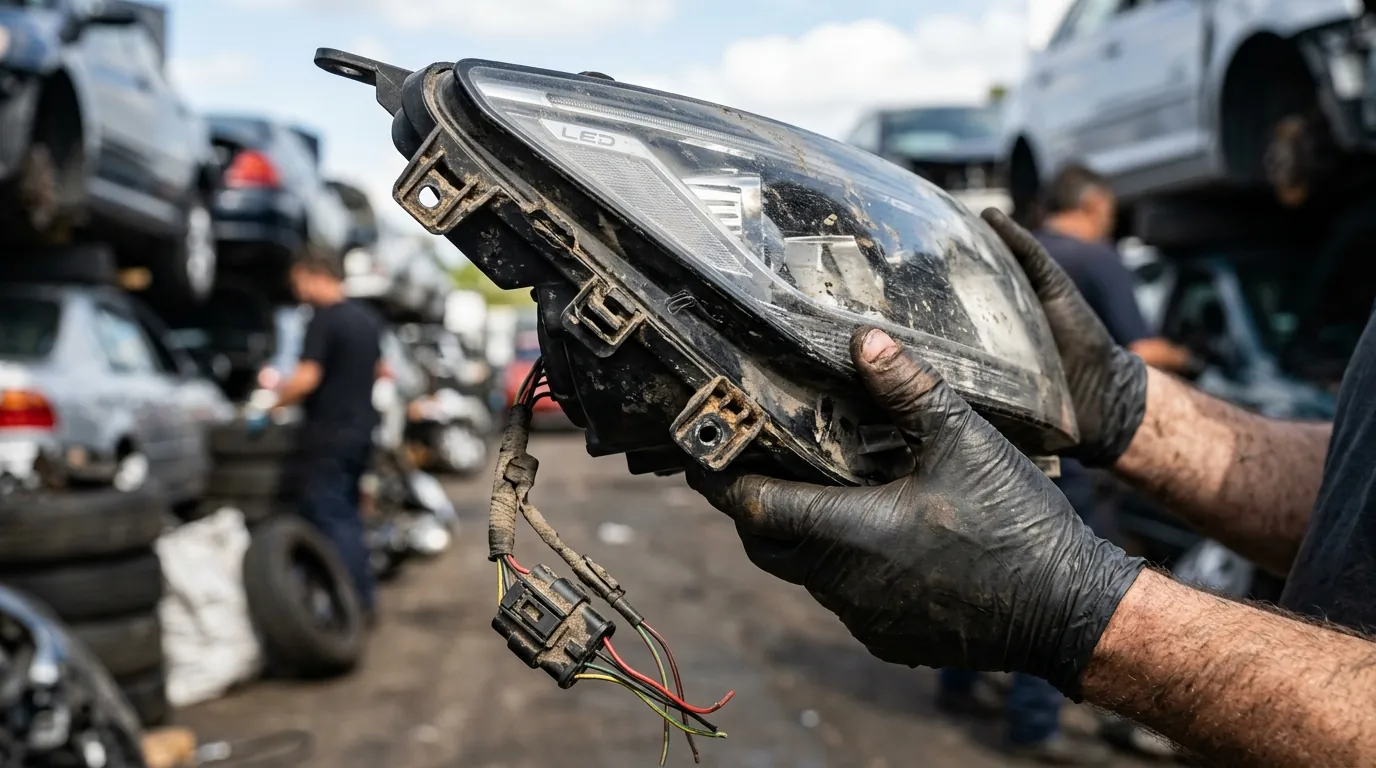
LED projector ($500-$1,100). The light source is bonded to a heat sink and isn't user-replaceable; when an LED array fails, the entire assembly is scrap. That non-serviceability cuts both ways: it pushes new-part prices up, which pulls used prices up with them, and it means a used assembly with any dead diode is worthless. This tier covers most of the Explorer, F-150, Edge, and Silverado listings.
Adaptive/matrix LED ($900-$2,000+). Individually addressable LED segments, cornering actuators, and a dedicated lighting control module inside the housing that communicates on the vehicle bus. The BMW X5's $1,800 median lives here. These often require coding to the vehicle after installation, so budget for a scan tool or shop visit on top of the part price.
The practical takeaway: check which variant your trim uses before you shop. Buying a halogen assembly for an LED-equipped car leaves you with mismatched output and, on many vehicles, a bulb-out warning that never clears. Our used headlight buying guide covers how to decode the part number stamped on the housing.
Headlight Assembly Removal Tips
Pulling a headlight is fast, 15 to 30 minutes on most vehicles, but it's the single easiest part to destroy on the way out.
Tools you'll need: 8-12mm socket set with a short extension, plastic trim removal tools, a Phillips screwdriver for bumper push-clips, and a flashlight.
Step sequence:
- Open the hood and locate the two to four bolts across the top of the assembly, usually 10mm.
- Remove the push-clips along the top edge of the bumper cover and the fender liner screws behind the wheel. On most vehicles the bumper corner must pull away before the assembly clears.
- Unplug the electrical connector; press the release tab fully before pulling. Brittle 10-year-old connectors crack if you pull first and squeeze second.
- Remove any lower or rear mounting bolt hidden behind the bumper corner. This is the one people miss.
- Pull the assembly straight forward, not sideways. Most housings have a locating peg at the inboard edge that only releases along one axis.
Broken mounting tabs are the #1 problem with junkyard headlights. The tabs are thin polycarbonate arms molded into the housing, and they snap when someone pries the assembly out instead of finding the last bolt. A missing tab means the light won't sit flush, will vibrate loose, and can't be properly aimed. Inspect every tab on both the unit you buy and the one you remove, including the ones hidden behind the fender line that you can't see with the assembly installed.
Handle the lens like glass. Set the assembly face-up on cardboard, never face-down on gravel. A scuffed lens is restorable; a gouged one isn't.
Before committing to a used unit, compare it against new aftermarket pricing on our headlight assembly price index by model.