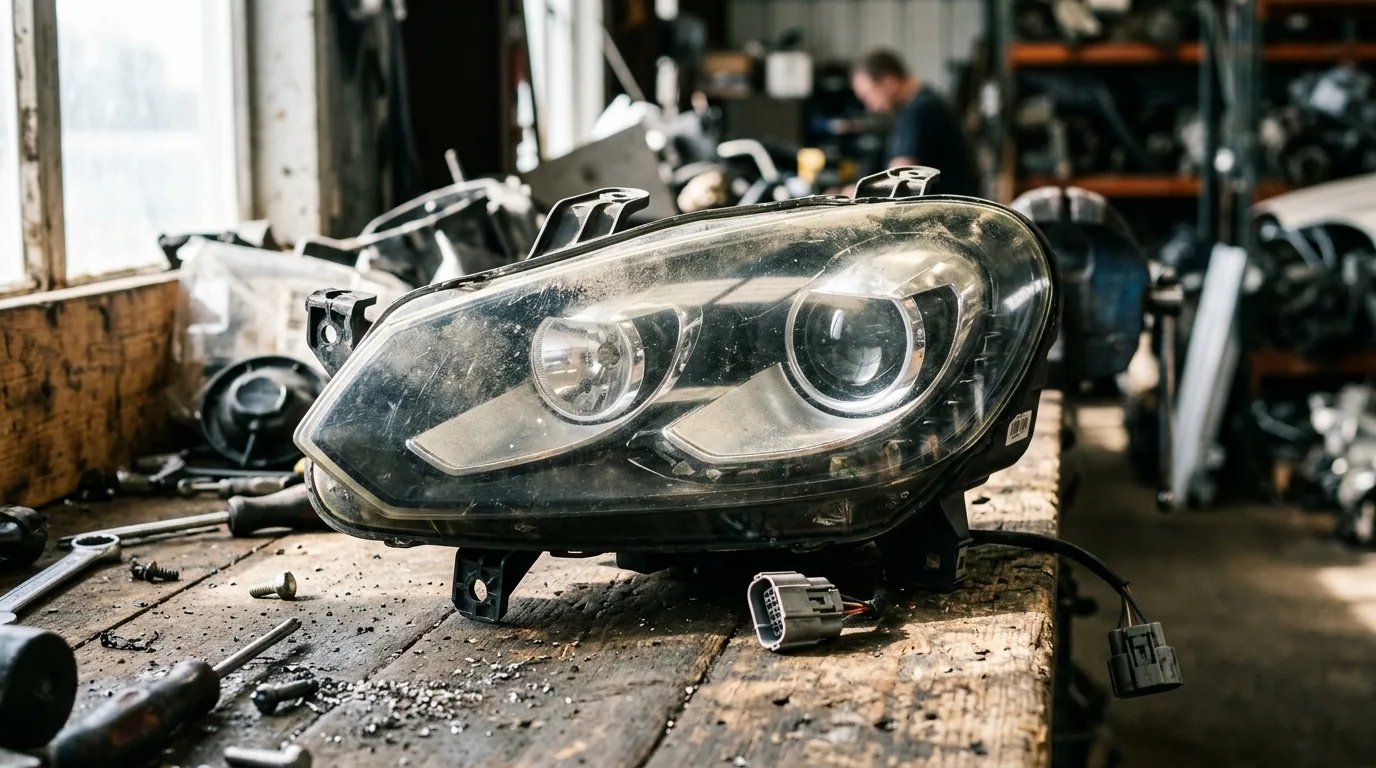
A used headlight assembly costs $650 at the median, with model medians running from $187 to $1,800. That range comes from 76,427 priced salvage yard listings across 52 vehicle models, real asking prices from yards nationwide, not body shop estimates or dealer quotes.
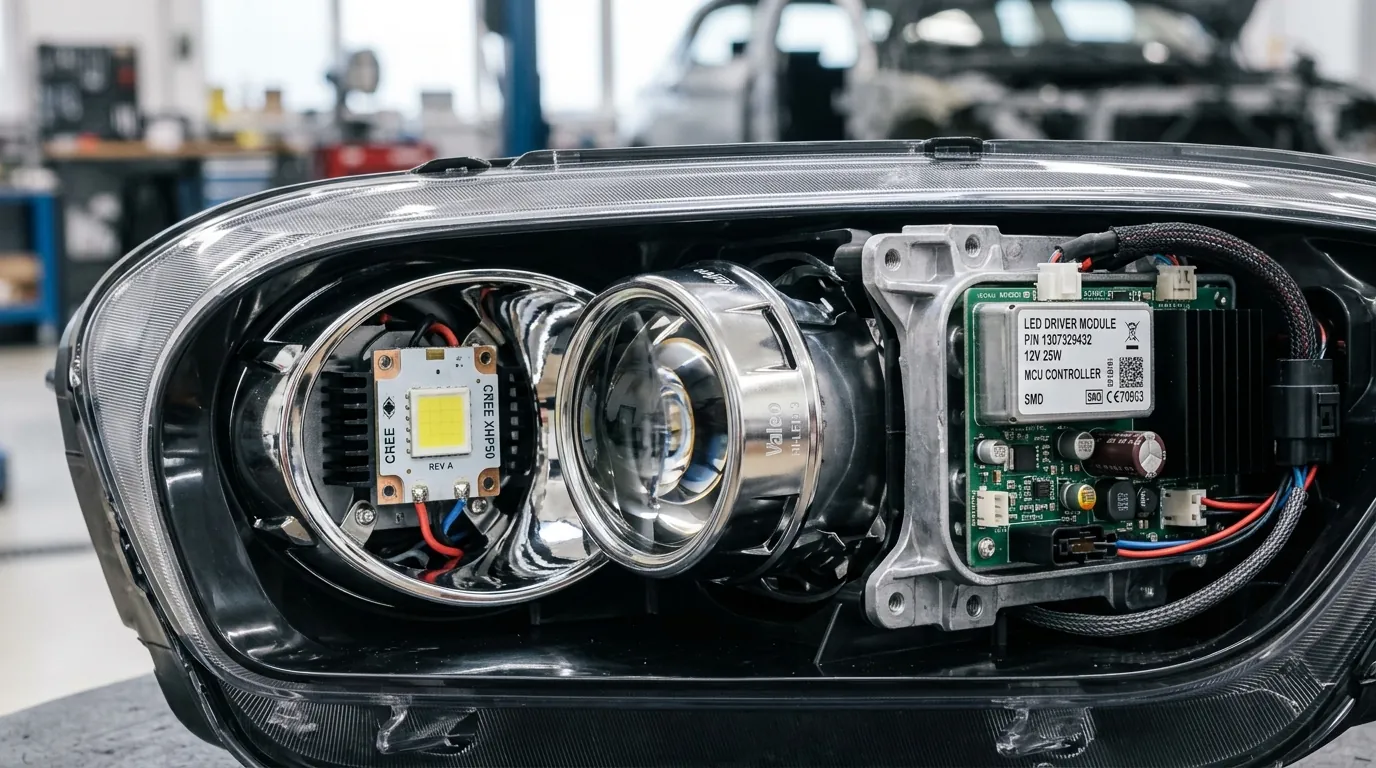
That $650 median surprises most people, and the reason is simple: a headlight is no longer a lamp. On a growing share of vehicles it's a sealed electronics module with LED driver boards, leveling motors, and its own control unit, and salvage pricing reflects that. The 9.6x spread between the cheapest and most expensive model medians is one of the widest we measure on any body part.
- Median used headlight assembly price: $650 across 76,427 priced salvage yard listings, average $661
- Model medians range from $187 to $1,800, a 9.6x spread driven almost entirely by lighting technology, not vehicle value
- Technology sets the tier: halogen housings cluster $200–$500, LED and projector units $500–$1,000, adaptive and matrix LED $1,000+
- Cheapest models: Subaru Outback ($187), Jeep Wrangler ($272), Ford Focus and Kia Soul ($350)
- Most expensive: BMW X5 ($1,800), BMW X3 ($1,190), Mazda 3 ($1,090)
- Headlights are the most-listed part we track, 76,427 priced listings, more than any other component, because front-end collision damage is the single most common reason a vehicle gets parted out
Overall Used Headlight Assembly Pricing
Across all 76,427 priced listings in the PartPriceGuide index, here's what used headlight assemblies actually sell for:
| Metric | Price |
|---|---|
| Median | $650 |
| Average | $661 |
| Lowest model median | $187 (Subaru Outback) |
| Highest model median | $1,800 (BMW X5) |
| Models with data | 52 |
| Priced listings | 76,427 |
The average ($661) sits just 2% above the median ($650). That's the tightest average-to-median relationship of any part in our index. On engines and transfer cases the average runs 40% or more above the median because a handful of exotic units drag it upward. Headlights don't behave that way, and the reason is volume. With 76,427 priced listings, the sample is deep enough that individual mispriced entries get buried. When you see a headlight quoted near $650, you're looking at a genuinely representative price rather than a thin-market guess.
The 9.6x model spread is doing all the work. A $650 median across a range that runs from $187 to $1,800 means the "average headlight price" is close to meaningless for your specific vehicle. A Subaru Outback owner budgeting $650 is overpaying by 3.5x. A BMW X5 owner budgeting $650 is going to be unpleasantly surprised at the counter. This is a part where you must look up your actual model before planning a repair.
Headlights are also the most-listed part in our entire index. That isn't a coincidence: front-end collisions are the most common way a vehicle ends up at a salvage yard, according to IIHS crash data, and the headlights are frequently the highest-value undamaged components left on the front clip. Yards pull them first.
For a practical budget: on a base-trim mainstream vehicle with halogen lighting, plan $200 to $450. On a mid-trim vehicle with projector or LED lighting, plan $500 to $950. On a luxury vehicle with adaptive or matrix headlights, plan $1,000 to $1,800.
*Source: PartPriceGuide.com analysis of 76,427 salvage yard listings, August 2026.*
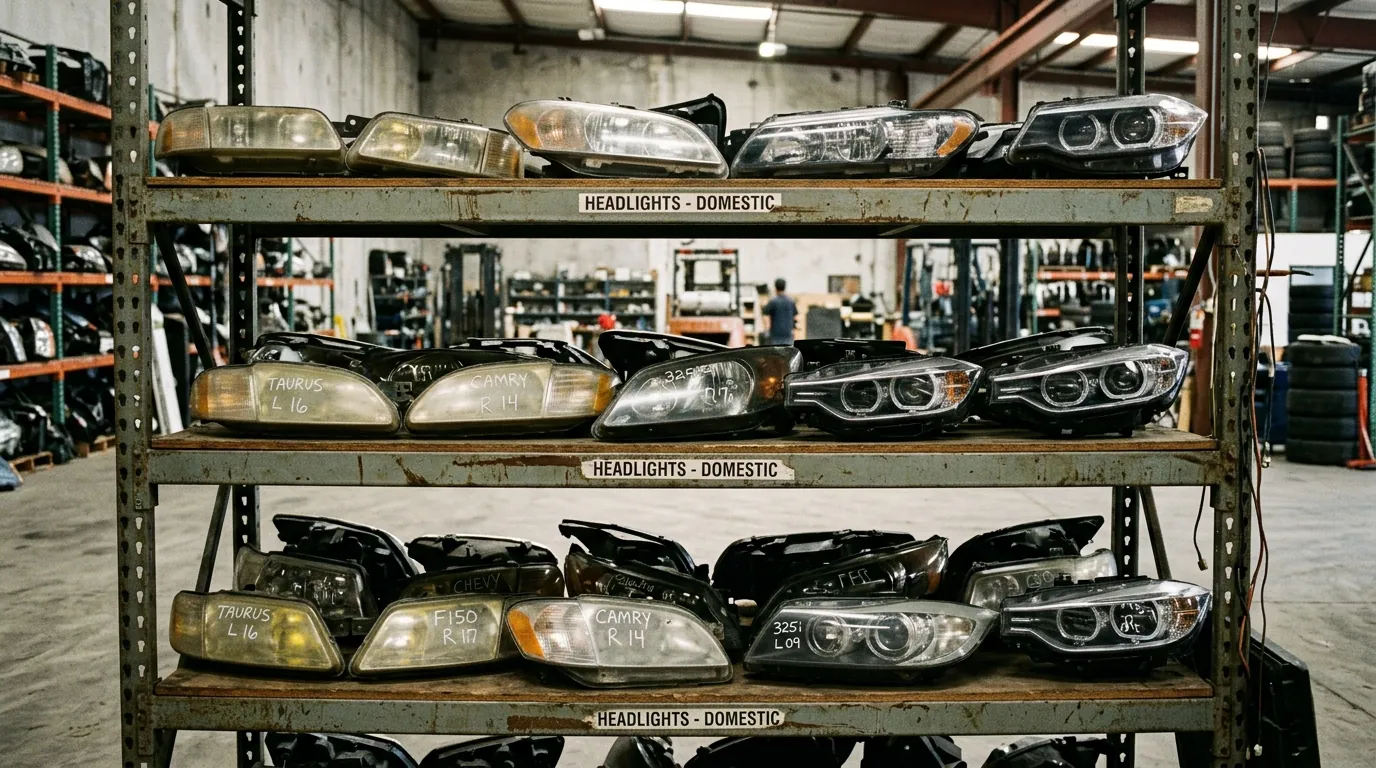
Prices by Vehicle Model
This is where flat-rate estimates fall apart entirely. The table below shows actual pricing for the 20 most-listed headlight assembly models in our index:
| Vehicle Model | Median | Avg | Listings |
|---|---|---|---|
| Toyota RAV4 | $465 | $513 | 7,092 |
| Ram 1500 | $470 | $622 | 4,177 |
| Ford Edge | $800 | $767 | 3,224 |
| Dodge Challenger | $700 | $718 | 3,119 |
| Chevy Silverado 1500 | $800 | $841 | 2,883 |
| Ford Explorer | $950 | $980 | 2,663 |
| Dodge Durango | $540 | $631 | 2,601 |
| Hyundai Elantra | $500 | $622 | 2,326 |
| Toyota Corolla | $558 | $547 | 2,170 |
| Toyota Tacoma | $377 | $418 | 2,129 |
| Nissan Rogue | $650 | $808 | 2,008 |
| Ford F-150 | $845 | $836 | 1,755 |
| Honda CR-V | $444 | $446 | 1,697 |
| Toyota Camry | $693 | $686 | 1,676 |
| Hyundai Sonata | $900 | $975 | 1,612 |
| Mercedes C-Class | $900 | $959 | 1,608 |
| Kia Soul | $350 | $499 | 1,551 |
| Ford Escape | $715 | $706 | 1,502 |
| Jeep Grand Cherokee | $485 | $536 | 1,472 |
| Hyundai Santa Fe | $680 | $844 | 1,445 |
The Toyota RAV4 dominates supply and sits below the median. At 7,092 priced listings, the RAV4 has nearly twice the volume of the next model, and its $465 median runs 28% below the overall $650. Its $513 average against a $465 median tells you the trim mix is doing the work: a large base of cheaper halogen units with a smaller tail of expensive LED assemblies pulling the average up.
Trucks split hard by trim. The Ram 1500 ($470) and Chevy Silverado 1500 ($800) are directly comparable vehicles with a $330 median gap. That isn't a brand premium; it reflects which trims and model years are flowing through salvage. The Ram's $622 average against a $470 median is the widest gap in the table, meaning a large cheap-halogen base plus a meaningful population of expensive LED units. The Silverado's tighter $800/$841 relationship says its supply skews more uniformly to projector and LED housings.
Price does not track vehicle price. The Hyundai Sonata ($900) and Mercedes C-Class ($900) have identical medians. A Sonata is a fraction of the C-Class's cost new, but recent Sonata generations ship full LED assemblies with integrated daytime running light signatures, and those are expensive parts regardless of what badge is on the hood. Meanwhile the Jeep Grand Cherokee ($485) sits below both. If you take one thing from this table, make it this: lighting technology predicts price far better than vehicle segment does.
Watch the average-to-median gaps. The Nissan Rogue ($650 median, $808 average) and Hyundai Santa Fe ($680 median, $844 average) both show averages running 24% above their medians. That signature means split supply, a mix of cheap base housings and expensive LED units in the same model listing pool. When you shop those models, the exact part number matters more than usual, because two listings under the same model name can be genuinely different parts at genuinely different prices.
Check the exact price for your vehicle on our junkyard headlight price guide, which covers pricing by vehicle model and yard type.
Why Headlight Prices Vary So Much
The 9.6x spread between a Subaru Outback headlight and a BMW X5 headlight isn't about brand prestige. It's about what's inside the housing. Modern automotive lighting splits into three technology tiers, and each tier carries its own pricing floor.
Tier 1: Halogen reflector, $200 to $500
A halogen headlight is close to what headlights have always been: a polycarbonate lens, an aluminized reflector bowl, a replaceable bulb socket, and two adjuster screws. There's no electronics module and nothing to code. If the lens is clear and the mounting tabs are intact, the part works.
These are the assemblies on base trims, work trucks, fleet sedans, and older vehicles across every brand. The Subaru Outback ($187), Jeep Wrangler ($272), Ford Focus ($350), and Toyota Tacoma ($377) all sit here. Pricing is driven by supply and physical condition, not content, which means used competes directly with cheap new aftermarket housings, and often loses.
Tier 2: Projector, HID, and basic LED, $500 to $1,000
This tier is where the majority of our 76,427 listings live, and it's why the overall median lands at $650.
A projector assembly replaces the reflector bowl with a lens-and-shield optical system that produces a sharp beam cutoff. HID (xenon) versions add a ballast and igniter. LED versions replace the bulb entirely with a fixed LED array plus a driver board and, frequently, a heatsink and cooling fan. Many also include a leveling motor tied to a suspension ride-height sensor.
Critically, none of these components are user-serviceable and most aren't sold separately. If an LED driver board fails, the dealer's answer is a complete assembly. That sets the pricing floor: a new OEM projector or LED assembly typically lists at $700 to $1,400, so a $650 to $900 salvage unit is priced against that ceiling. Most of the table above lives here, the Ford Edge ($800), Dodge Challenger ($700), Toyota Camry ($693), Ford Escape ($715), and Hyundai Santa Fe ($680).
Tier 3: Adaptive and matrix LED, $1,000 and up
The top tier is where headlights stop being lighting and become an ADAS component. Adaptive systems swivel the beam with the steering angle. Matrix and pixel LED systems have dozens of individually addressable emitters that carve dark corridors around oncoming traffic while keeping the rest of the road lit. Both types carry their own control module on the vehicle's CAN bus.
Three things drive the price:
Module content. A matrix headlight can contain 80 or more individually driven LEDs, a dedicated ECU, stepper motors on two axes, and a cooling system. The bill of materials is closer to an instrument cluster than to a lamp.
Coding requirements. These units must be registered to the vehicle with a factory-level scan tool. A unit that can't be coded is worthless, so only known-good, complete assemblies stay in circulation, at premium prices.
A brutal new-OEM ceiling. New adaptive assemblies commonly list at $1,200 to $2,500 each. When the new part costs that much, a $1,800 used BMW X5 unit is still the cheap option, and yards price accordingly.
The BMW X5 ($1,800) and X3 ($1,190) are the clearest examples in our data. The Mazda 3 ($1,090) is the surprising one, and it illustrates the principle: recent Mazda 3 generations ship adaptive LED headlights with automatic leveling on most trims, and the salvage market prices that content, not the badge.
The single most useful thing to know
Identify your lighting tier before you shop, not after. Two vehicles of the same model and year can carry completely different assemblies depending on trim. Pull the part number off the back of your existing housing, or run your VIN. A quote against the wrong tier will be wrong by 300%.
*Source: PartPriceGuide.com analysis of 76,427 salvage yard listings, August 2026.*
Cheapest and Most Expensive Headlight Assemblies
Five cheapest models
| Model | Median | Why It's Cheap |
|---|---|---|
| Subaru Outback | $187 | Long production run with halogen reflector housings across most trims, enormous salvage supply |
| Jeep Wrangler | $272 | Round sealed-style housings with minimal electronics, huge aftermarket ecosystem suppressing salvage prices |
| Ford Focus | $350 | High-volume compact, base halogen units, discontinued model with abundant donor supply |
| Kia Soul | $350 | Compact halogen housings, high fleet and rental volume feeding salvage channels |
| Toyota Tacoma | $377 | Truck-simple reflector housings on most trims, very high production volume |
The Wrangler's $272 median is held down not just by simple construction but by an unusually large aftermarket. Wrangler headlights are among the most commonly modified parts in the enthusiast market, so new aftermarket LED replacements are available in volume at every price point. That competition caps what a yard can ask for a stock unit.
Five most expensive models
| Model | Median | Why It's Expensive |
|---|---|---|
| BMW X5 | $1,800 | Adaptive laser and matrix LED assemblies with on-board control modules requiring factory coding |
| BMW X3 | $1,190 | Adaptive LED with dynamic cornering, module-level electronics, thin salvage supply |
| Mazda 3 | $1,090 | Adaptive LED with automatic leveling standard on most recent trims; content, not badge |
| Ford Explorer | $950 | Late-model LED assemblies with signature DRL light bars; high demand from a popular platform |
| Mercedes E-Class | $952 | Multibeam LED assemblies with individually addressable emitters and vehicle-side coding |
Electronic content. Every dollar of driver board, control module, stepper motor, and cooling hardware inside the housing is a dollar the yard can charge for. This is the dominant factor and it explains why the Mazda 3 outprices the Ford Explorer.
Non-substitutability. You can't fit a halogen housing to a car wired for adaptive LED, and you often can't fit a left-side unit from a different model year. Headlights are among the most VIN-specific parts on a vehicle. That kills the substitution pressure that keeps prices honest on parts like radiators.
Coding as a supply filter. On adaptive systems, a headlight that has been improperly removed or has a damaged module is unsellable. Yards that can verify and supply a codeable unit price at a premium because their competition can't.
A very high new-OEM ceiling. This is the ultimate anchor. When a dealer quotes $2,200 for a single new assembly, an $1,800 used one still reads as a bargain to the customer, and the yard knows it. On parts where new prices are low, salvage prices get compressed. Headlights are the opposite case.
For the full breakdown of what to inspect and how to verify fitment before you buy, read our guide to buying a used headlight assembly.
Where to Buy a Used Headlight
Used headlights come from three channels, and unlike most parts, the channel you choose changes both the price and the odds the part arrives intact.
Self-service junkyards (Pull-A-Part, LKQ Pick Your Part, U-Pull-It) are the cheapest option, often by a factor of five or more. Many chains price headlight assemblies at a flat $25 to $60 regardless of vehicle, which means a Ford Explorer assembly that costs $950 at a full-service yard might cost you $45 at a self-service lot.
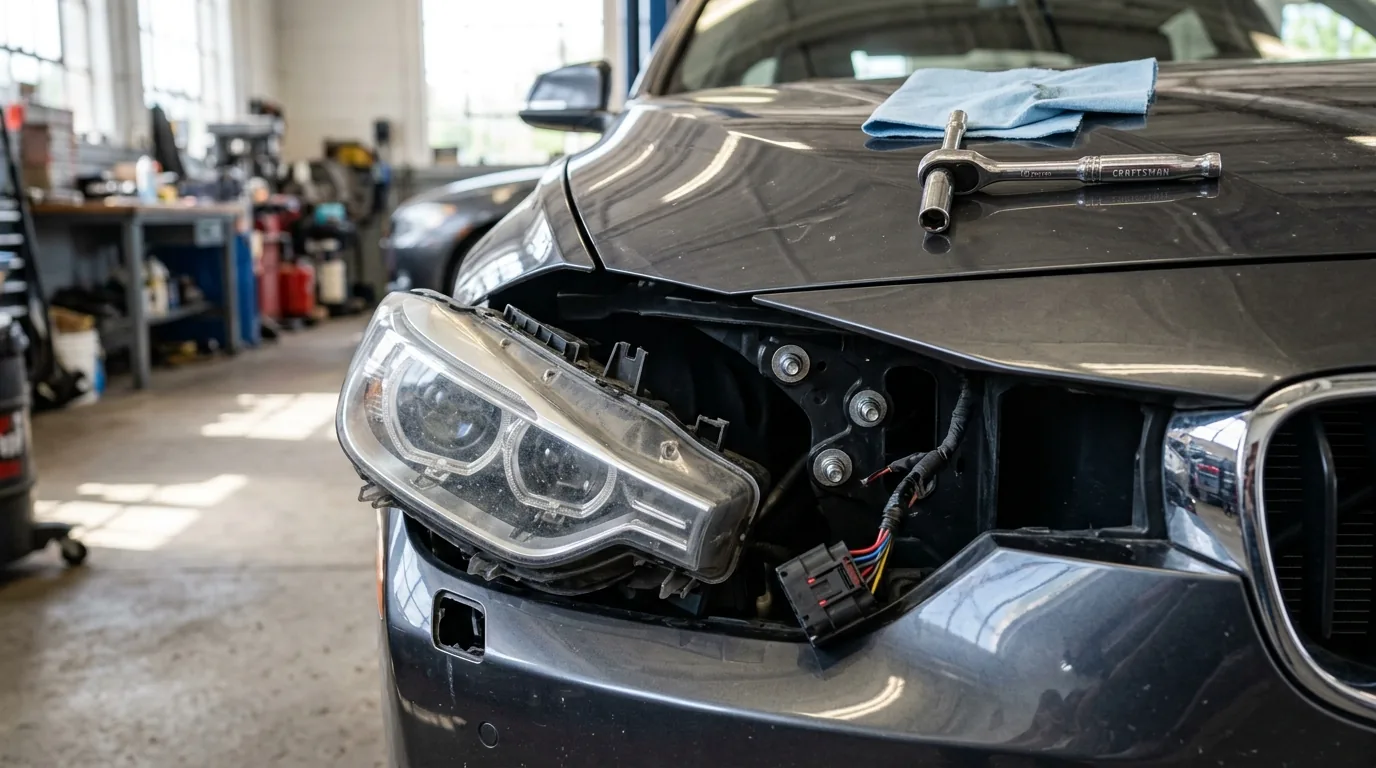
The catch is that pulling a headlight without breaking it is harder than it looks. Modern assemblies mount with three or four plastic tabs that become brittle with age and heat cycling, and they sit behind the bumper cover or grille, so you remove trim, fasteners, and sometimes the bumper itself to get clean access. A snapped tab makes the assembly nearly worthless; no repair survives road vibration and thermal cycling. Budget 30 to 60 minutes and bring a plastic trim tool set.
For chain-by-chain pricing and what to expect at the counter, read our junkyard headlight price guide.
Full-service salvage yards pull, clean, and inspect the unit before it hits the shelf, and this is where the bulk of our 76,427 listings originate. The $650 median reflects this channel. Most offer 30 to 90 day warranties, and better yards will power-test the assembly on request, worth asking for specifically on any LED or adaptive unit, because a failed driver board is invisible until the lights are on. Ask them to cycle low beam, high beam, turn signal, and DRL.
Online recyclers (Car-Part.com, eBay Motors) offer the deepest inventory, which matters enormously given how VIN-specific headlights are. If your trim's assembly isn't in local stock, online is often the only option short of the dealer. Shipping runs $30 to $90, and shipping damage is the real risk; cracked lenses and broken tabs from inadequate packing are the most common complaints in this category. Insist on photos of the actual unit including the mounting tabs and connector, and confirm the seller double-boxes with foam.
Across all three channels, one rule holds: confirm the part number before you pay. Headlight assemblies vary within a single model year by trim, lighting package, and market. Your VIN will resolve which variant your vehicle uses, and the number molded into the back of your existing housing is the definitive answer.
Used OEM vs Aftermarket vs New OEM
Here is where headlights differ sharply from most salvage parts, and the answer depends entirely on which technology tier you're in.
| Factor | Used OEM (Salvage) | New Aftermarket | New OEM |
|---|---|---|---|
| Price range | $187–$1,800 | $60–$400 | $400–$2,500 |
| Median price | $650 | ~$150 | ~$1,100 |
| Warranty | 30–90 days | 1–2 years | 1–2 years |
| Lens clarity | Varies, often hazed | New, clear | New, clear |
| Beam pattern accuracy | Exact (factory optics) | Varies; DOT/SAE marking essential | Exact |
| Fit certainty | Exact, if part number matches | Good on common models, poor on rare ones | Exact |
| LED / adaptive availability | Yes | Rare and often unreliable | Yes |
On projector, HID, LED, and adaptive vehicles, used OEM wins decisively. The aftermarket for these assemblies is thin, and what exists is often poorly made: mismatched color temperature, incorrect beam cutoff, driver boards that fail within a year, and DRL signatures that don't match the other side of the car. Meanwhile new OEM runs $900 to $2,500. A used OEM unit at $650 to $1,200 gives you correct optics, correct DRL signature, and a housing that will actually code to the vehicle. This is the single strongest case for salvage in the entire body-parts category.
When used OEM is the right call:
- Your vehicle has projector, HID, LED, or adaptive lighting. There's frequently no credible aftermarket alternative at all.
- You need a matching DRL signature. Mismatched daytime running lights are immediately visible and hurt resale.
- The vehicle is a lease return or trade-in. Factory optics and correct appearance matter more than warranty length.
- Your model is rare or recently discontinued. Aftermarket tooling follows volume; low-volume platforms often have nothing.
- You need it today. Yards have it on the shelf.
When new aftermarket is the better call:
- Base halogen trim on a high-volume vehicle. The price gap runs 2x to 4x in the aftermarket's favor.
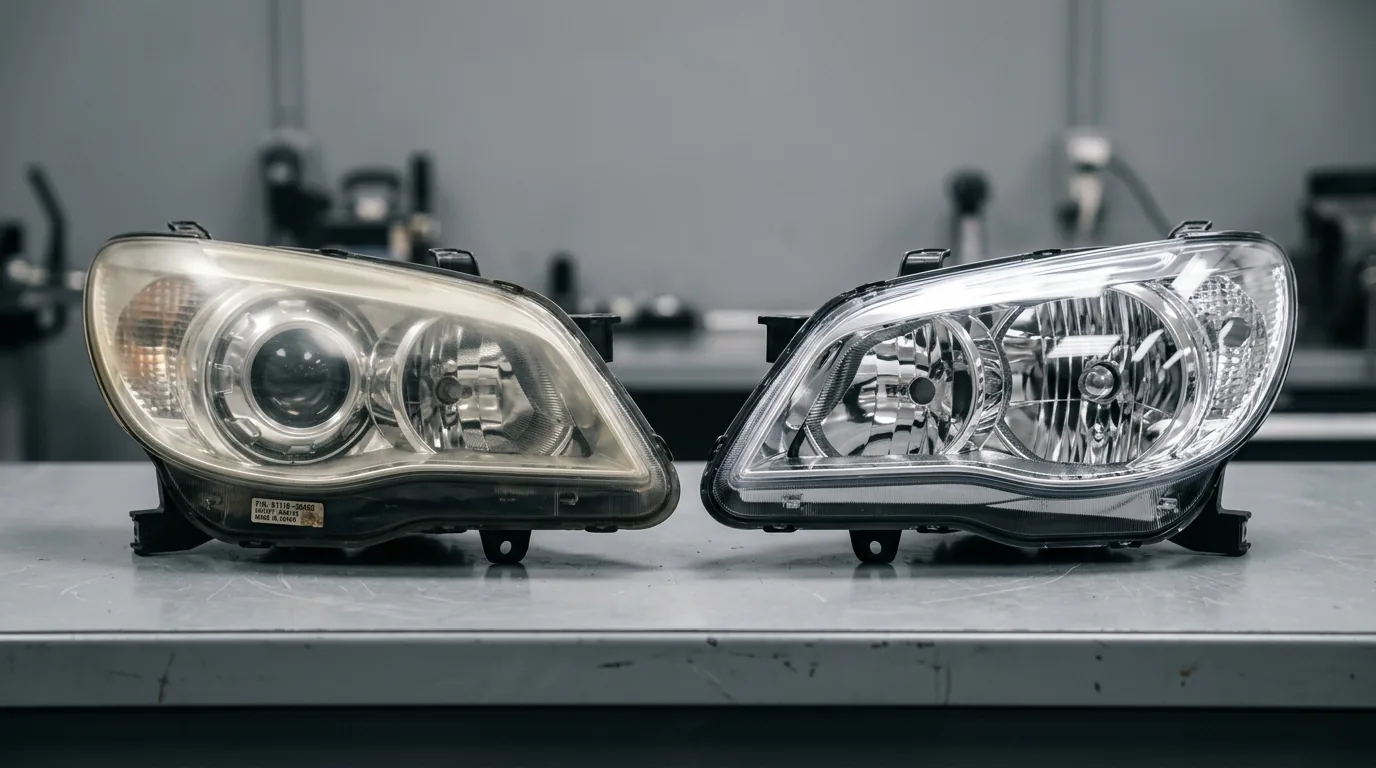
- Your existing lens is hazed and you want both sides to match. Buying two new aftermarket housings for $200 total beats buying two used ones for $700 that are also yellowed.
- You want the warranty. Headlight replacement labor runs $75 to $200 at a shop, and you don't want to pay it twice.
For a full side-by-side including coding costs and beam-pattern testing, read our used OEM vs aftermarket headlight comparison.
One thing to confirm before you buy anything: make sure the assembly is actually the failed component. A dead low beam can trace to a bulb, a fuse, a relay, a corroded connector, a headlight switch, or a body control module, all of which cost far less to fix than a $650 assembly, and none of which a new headlight will resolve. A hazed lens is also a restoration job, not a replacement job, on many vehicles. Our headlight assembly replacement cost guide walks through parts-plus-labor totals and how to isolate the failure before you spend the money.
Browse all 52 models with real pricing data on our headlight assembly price index, or jump straight to your vehicle's model page for its full price distribution.