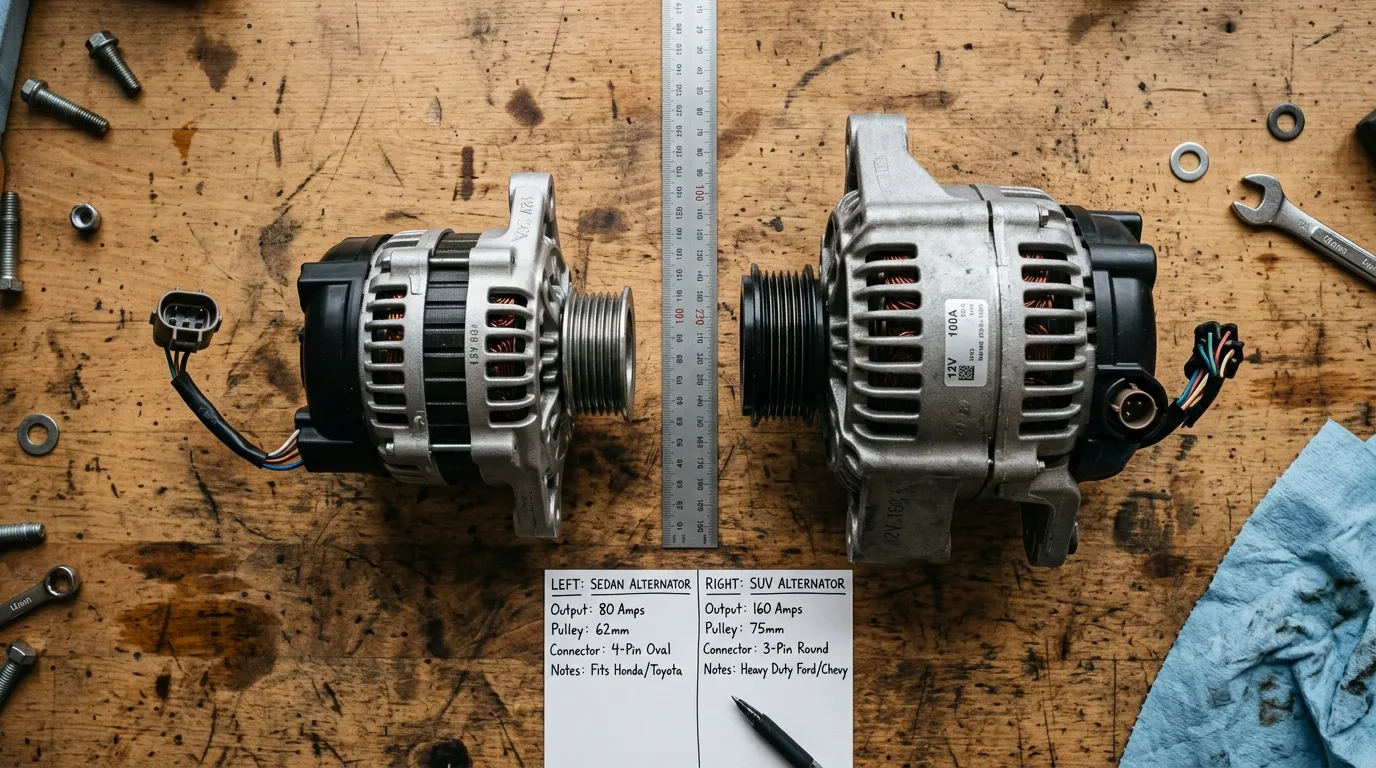
Yes, you can often use an alternator from a different car, as long as the mounting pattern, electrical connector, amperage rating, and pulley type all match. Many vehicles built on the same manufacturer platform share identical alternators, which means a cheaper or more available donor model can save you money on the exact same part.
This matters for pricing because interchange compatibility expands your sourcing options. If your vehicle's alternator has a $200 median price but an interchangeable model costs $80, you just cut your bill by 60 percent for the same part.
- Many alternators interchange across models within the same manufacturer platform
- Four things must match: mounting bolts, electrical connector, amperage, pulley type
- Hollander interchange numbers are the fastest way to confirm compatibility (free at Car-Part.com)
- Higher amperage is fine: the vehicle only draws what it needs
- Interchange expands your options and can significantly lower your cost
The Short Answer
Alternators are not model-exclusive in the way transmissions or engine computers are. Manufacturers reuse alternator designs across multiple vehicles, especially those sharing an engine platform. A Denso alternator designed for a Toyota Camry might fit a Lexus ES, RAV4, and Highlander from the same generation.
The key is confirming compatibility before you buy. A wrong alternator will bolt up but won't charge, or charge but overheat, or just not fit at all.
Four Things That Must Match
1. Mounting Bolt Pattern
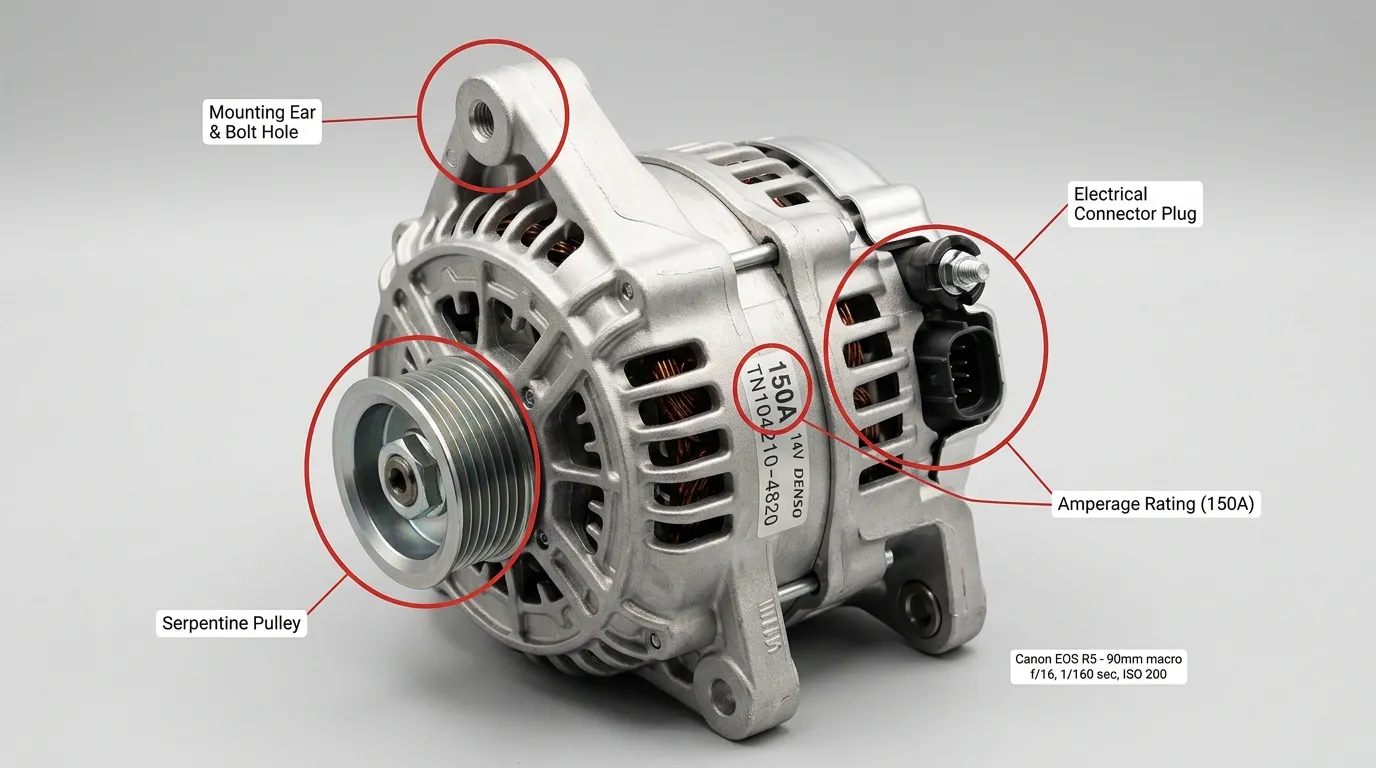
The alternator mounts to the engine block or a bracket with 2 to 3 bolts. The bolt hole spacing, diameter, and orientation must match exactly. There's no adapting this; if the holes don't line up, the alternator doesn't fit.
How to check: Compare the bolt pattern visually or measure center-to-center distances with a caliper. Same OEM part number guarantees a match.
2. Electrical Connector
The plug that connects the alternator to the vehicle's wiring harness must match in pin count, pin layout, and connector shape. Common configurations:
| Connector Type | Pin Count | Common In |
|---|---|---|
| Oval 4-pin | 4 | GM, Ford trucks |
| Square 2-pin | 2 | Older domestics |
| Round 3-pin | 3 | Japanese makes |
| Integrated (no plug) | 0 | Some European |
3. Amperage Rating
The alternator's output rating (measured in amps) must match or exceed your vehicle's original spec. Common ratings:
- Economy cars: 80–110 amps
- Mid-size sedans: 110–150 amps
- Trucks and SUVs: 140–200 amps
- Heavy-duty / towing packages: 200–250 amps
You can always go higher. A 160-amp alternator in place of a 130-amp unit won't damage anything. The vehicle's electrical system only draws what it needs. Going lower risks undercharging the battery under load.
4. Pulley Type and Size
The drive pulley must match the belt system:
- Serpentine pulley (grooved, most modern vehicles)
- V-belt pulley (smooth V-groove, older vehicles)
- Clutch pulley (overrunning clutch, reduces belt vibration)
The pulley diameter also matters, since a different size changes the alternator's effective RPM ratio, which affects charging at idle. Match the original diameter within 2mm.
How to Find Interchanges
Hollander Interchange Numbers
Every salvage yard part gets a Hollander number, a standardized code that groups interchangeable parts across different vehicles. Car-Part.com (the same source behind our price index) uses Hollander numbers to match parts.
How to use it:
- Go to Car-Part.com and search for your vehicle's alternator
- The results will show the interchange number (e.g., 601-58547)
- Search that same interchange number to see all compatible vehicles
- Cross-check prices across compatible models on our alternator price lookup
OEM Part Number Cross-Reference
Your vehicle's alternator has a manufacturer part number stamped on the housing or listed in the service manual. Searching that number on RockAuto or the manufacturer's parts catalog shows which other vehicles use the same part.
Ask the Yard
Salvage yards run interchange lookups constantly. If you call with your VIN, they will tell you which other vehicles in their inventory carry a compatible alternator. That's especially useful at junkyard pricing where a match means same-day pickup.
Common Interchange Groups
These are well-known alternator interchange groups where buying from a cheaper donor model can save money:
GM Trucks (2014-2019): Chevy Silverado 1500, GMC Sierra 1500, Chevy Tahoe, GMC Yukon, and Cadillac Escalade often share the same 150-amp Delco Remy alternator. Sierra has a $126 median while pricing across the group varies.
Chrysler/Dodge (2011-2018): Dodge Challenger, Charger, and Chrysler 300 with the same engine (3.6L Pentastar or 5.7L Hemi) share alternators. Challenger has a $80 median with 612 listings, high supply and low price.
Toyota (2012-2019): Corolla, Matrix, and some Scion models share Denso alternators within the same engine family. Corolla has a $96 median with 752 listings.
Jeep (2011-2021): Grand Cherokee and Durango with matching engines share alternators. Grand Cherokee has the highest supply in our index (1,156 listings, $95 median).
When Interchange Doesn't Work
Different engine in the same model. A 2016 Ford Explorer with a 2.3L EcoBoost and one with a 3.5L V6 use different alternators despite being the same vehicle. Always match by engine code, not just model name.
Mid-generation connector changes. Manufacturers sometimes update the wiring harness connector during a model run without changing the alternator body. The housing fits, but the plug doesn't.
European vehicles. BMW, Mercedes, and Audi use integrated voltage regulators that are model-specific more often than domestic or Japanese alternators. Interchange is possible but requires more careful verification.
Hybrid vehicles. Hybrids often use a motor-generator unit instead of a traditional alternator. These don't interchange with conventional alternators from the same model's non-hybrid version.