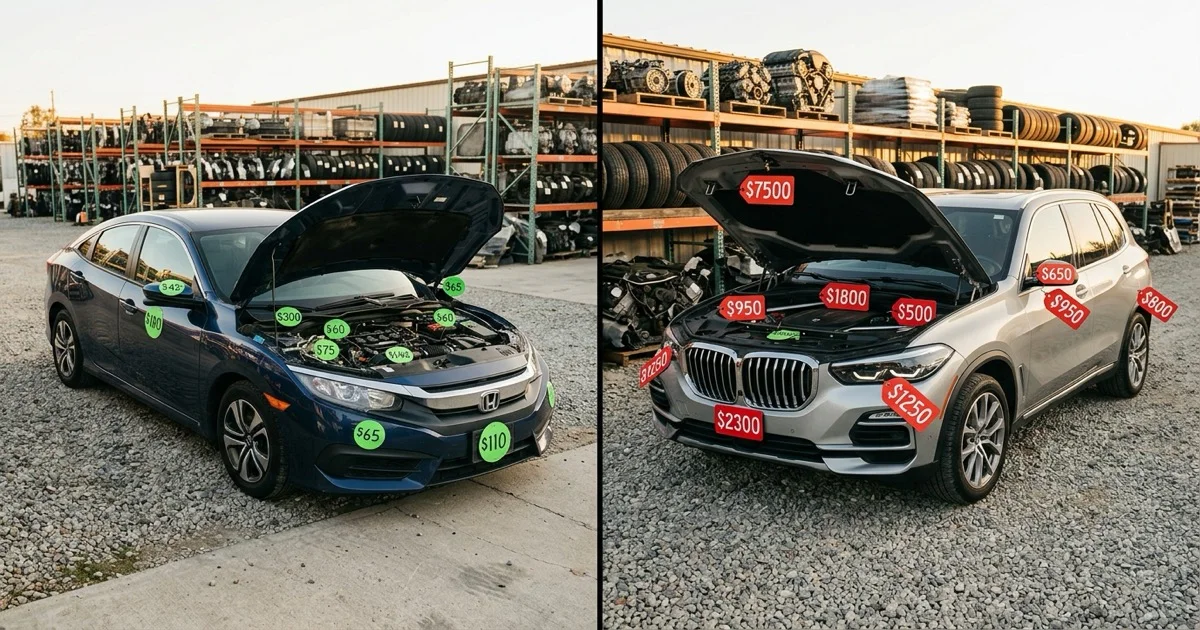
The Ford Fusion, Volkswagen Tiguan, and Nissan Versa have the cheapest used parts of any vehicle in our index, while the Hyundai Palisade, Lexus RX, and Volkswagen Jetta have the most expensive. These rankings come from summing the median salvage yard price of each model's five most-listed parts across PartPriceGuide's database of 90 vehicles.
The spread is dramatic: the cheapest vehicle (Ford Fusion at $511 total) costs less than a quarter of the most expensive (Hyundai Palisade at $2,425) for the same set of commonly needed replacement parts.
- Cheapest vehicle for used parts: Ford Fusion at $511 total for top 5 parts
- Most expensive: Hyundai Palisade at $2,425, nearly 5x the cheapest
- Sedans average $832 across all models, trucks/SUVs average $1,045
- Production volume is the strongest price predictor: high-volume models cluster in the cheapest tier
- Some surprises: Volkswagen Tiguan (#2 cheapest) and Dodge Charger (#8) beat many economy cars
How We Ranked 90 Vehicles
For each of the 90 models in the PartPriceGuide index, we pulled the five most commonly listed parts, the ones buyers need most, and summed their median salvage yard prices into a total parts cost score.
This isn't the cost of every part on the vehicle; it's the combined price of the five parts you're most likely to need from a salvage yard. It's a proxy for how expensive a vehicle is to maintain using used parts for the most common repair categories.
All prices are median asking prices from salvage yards nationwide, not retail, dealer, or aftermarket prices.
Top 20 Cheapest Vehicles for Used Parts
These models deliver the lowest total cost for their five most commonly needed used parts:
| Rank | Vehicle | Total Top-5 Parts Cost | Type |
|---|---|---|---|
| 1 | Ford Fusion | $511 | Sedan |
| 2 | Volkswagen Tiguan | $531 | SUV |
| 3 | Nissan Versa | $574 | Sedan |
| 4 | Jeep Compass | $602 | SUV |
| 5 | Kia Optima | $609 | Sedan |
| 6 | Nissan Sentra | $624 | Sedan |
| 7 | Chevy Malibu | $628 | Sedan |
| 8 | Dodge Charger | $635 | Sedan |
| 9 | Honda Civic | $667 | Sedan |
| 10 | Ford Escape | $678 | SUV |
| 11 | Ford Explorer | $688 | SUV |
| 12 | Mazda 3 | $688 | Sedan |
| 13 | Kia Forte | $699 | Sedan |
| 14 | Subaru Impreza | $701 | Sedan/Hatch |
| 15 | Chevy Equinox | $709 | SUV |
| 16 | Mazda CX5 | $748 | SUV |
| 17 | Nissan Murano | $757 | SUV |
| 18 | GMC Terrain | $760 | SUV |
| 19 | Honda Accord | $774 | Sedan |
| 20 | Toyota 4Runner | $775 | SUV |
Top 20 Most Expensive Vehicles for Used Parts
These models carry the highest combined cost for their most commonly needed used parts:
| Rank | Vehicle | Total Top-5 Parts Cost | Type |
|---|---|---|---|
| 1 | Hyundai Palisade | $2,425 | SUV |
| 2 | Lexus RX | $2,132 | SUV |
| 3 | Volkswagen Jetta | $1,955 | Sedan |
| 4 | Ford Maverick | $1,719 | Truck |
| 5 | Ford Edge | $1,619 | SUV |
| 6 | Ford Bronco Sport | $1,551 | SUV |
| 7 | Toyota Tundra | $1,545 | Truck |
| 8 | BMW X5 | $1,505 | SUV |
| 9 | Kia Sportage | $1,408 | SUV |
| 10 | Kia Sorento | $1,387 | SUV |
| 11 | Toyota Highlander | $1,386 | SUV |
| 12 | Tesla Model 3 | $1,365 | Sedan |
| 13 | Mercedes E Class | $1,363 | Sedan |
| 14 | Toyota Camry | $1,351 | Sedan |
| 15 | Honda Odyssey | $1,343 | Van |
| 16 | Jeep Gladiator | $1,318 | Truck |
| 17 | Nissan Rogue | $1,305 | SUV |
| 18 | Toyota Corolla | $1,255 | Sedan |
| 19 | Toyota Tacoma | $1,251 | Truck |
| 20 | Mercedes C Class | $1,246 | Sedan |
Sedan vs Truck vs SUV: Parts Cost by Segment
The 90-model list splits clearly by body type:
Sedans, average total: ~$832. Sedans benefit from simpler construction, smaller body panels, and lighter components. The Ford Fusion ($511) and Honda Civic ($667) anchor the low end. The VW Jetta ($1,955) is the outlier, driven by expensive German-sourced components.
SUVs/Crossovers, average total: ~$1,045. Larger body panels, heavier drivetrains, and more complex lighting assemblies push SUV parts costs higher. But compact crossovers like the VW Tiguan ($531) and Jeep Compass ($602) compete with sedans on cost.
Trucks, average total: ~$1,180. Full-size trucks like the Toyota Tundra ($1,545) and Jeep Gladiator ($1,318) carry a premium, but the Ford F150 sits around $1,097, benefiting from being the best-selling vehicle in America and having the deepest salvage inventory of any truck.
The segment matters less than you'd expect. A well-supplied compact SUV can be cheaper to maintain than a low-volume sedan. The cheapest trucks compete with mid-range sedans.
Surprising Findings in the Data
A few results caught us off guard:
Volkswagen Tiguan at #2 cheapest. A German brand vehicle beating most Japanese economy cars is unexpected. The Tiguan's high global production volume and shared MQB platform with other VW Group vehicles create abundant, affordable parts supply.
Hyundai Palisade at #1 most expensive. Hyundai is generally considered a value brand, but the Palisade's recent market entry means salvage yard supply hasn't caught up with demand. Vehicle age and production history matter more than brand positioning.
Toyota Camry and Corolla in the expensive half. Two of America's best-selling cars sit at $1,351 and $1,255. Not cheap. Toyota's strong resale values mean fewer totaled vehicles reach salvage yards, so parts prices stay high despite massive production numbers.
Ford spans the widest range. Ford places vehicles in both the cheapest 5 (Fusion at $511) and the expensive 10 (Maverick at $1,719, Edge at $1,619, Bronco Sport at $1,551). That diversity makes generalizing about "Ford parts costs" pointless; model matters more than make.
How to Use This Data
If you're buying a vehicle and care about long-term repair costs, this ranking provides a data point beyond the usual reliability ratings. A vehicle in the cheapest 20 will be significantly less expensive to maintain using salvage yard parts than one in the most expensive 20.
If you're repairing a vehicle on the expensive list, the gap can be partially closed by choosing Grade C parts, which cost 36% less than Grade A on average. On an expensive model, that percentage translates to hundreds of dollars in savings.
If you're comparing brands, see our ranking of most expensive car brands for make-level analysis, or our year-level depreciation guide to understand how model year affects pricing across all vehicles.