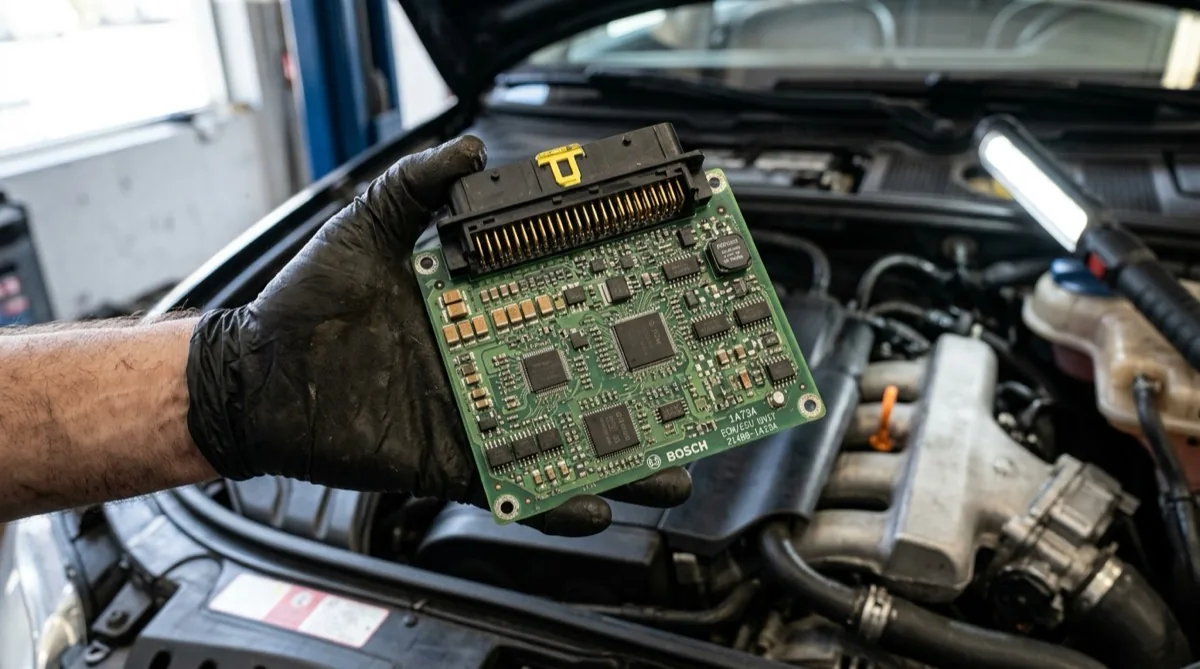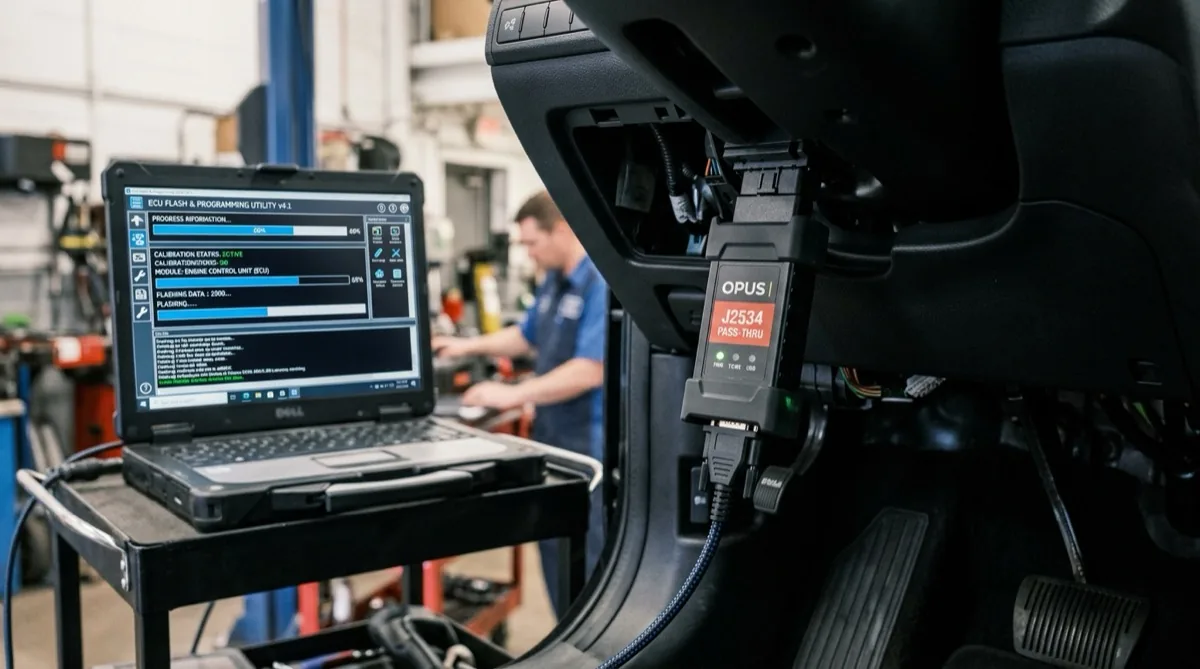
ECU programming costs $75 to $150 at an independent shop or $150 to $300 at a dealership. The price covers the technician's time, the manufacturer's software subscription fee, and the flash process that loads the correct calibration and security data into the module. Programming is mandatory any time you install a used or replacement ECM on a 1996-or-newer vehicle.
The programming charge is what turns a $154-median salvage yard ECM into a $350+ repair. Across 42,536 priced engine computer listings in our index, the module itself is the cheaper half of the job. The programming fee exists because manufacturers charge shops a per-session or annual license to access their calibration servers, and that cost gets passed to the vehicle owner.
[INTERNAL-LINK: ECM replacement cost breakdown → /blog/repair-costs/ecm-replacement-cost]
- Independent shop programming: $75-$150. Shops with J2534 pass-through tools can flash most domestic and Asian makes
- Dealer programming: $150-$300. Required for some European makes and newer security-locked systems
- Programming is mandatory on virtually all 1996+ vehicles when installing a used or replacement ECM
- J2534 pass-through is the industry standard that lets independent shops access manufacturer calibration software
- DIY programming carries real risk. An interrupted flash can brick the module, and the tool and subscription costs often exceed the shop fee
- Used ECM median price: $154 across 42,536 salvage listings, but programming adds $75-$300 on top
What ECU Programming Costs
ECU programming pricing depends on who performs the work, which manufacturer's system is involved, and whether the module is new, used, or remanufactured. The flash process itself is the same in every case: a technician connects a diagnostic tool to the vehicle's OBD-II port and loads the correct calibration file and security credentials into the module.
| Service Provider | Programming Cost | Typical Flash Time | Best For |
|---|---|---|---|
| Independent shop (J2534) | $75-$150 | 15-30 min | Domestic and Asian makes |
| Dealership | $150-$300 | 15-45 min | European makes, security-locked systems |
| Mobile programmer | $100-$200 | 15-45 min | Vehicles that cannot be driven to the shop |
| Remanufactured (pre-programmed) | Included in unit price | N/A | Avoiding the dealer trip entirely |
Dealer pricing is higher partly because of licensing costs. Ford's FJDS subscription runs roughly $40 per programming session or $1,000 annually. GM's TIS2Web, Toyota's Techstream, and Honda's i-HDS carry similar per-session charges. Dealers fold these costs into the programming fee along with their standard labor rate, which ranges from $100 to $200 per hour depending on the market.
*Part pricing source: PartPriceGuide.com analysis of 42,536 priced salvage yard engine computer listings, August 2026.*
Why Every Used ECM Needs Programming
A used ECM pulled from a salvage vehicle arrives with the wrong data for your car. The module contains three categories of vehicle-specific information that must be overwritten before it will function correctly.
VIN and security credentials. Modern vehicles use encrypted communication between the ECM and the immobilizer system. The ECM stores your vehicle's VIN along with transponder key codes, anti-theft identifiers, and CAN bus authentication tokens. A module carrying another vehicle's security data will trigger a crank-no-start condition because the immobilizer will not authenticate it.
Calibration files. The calibration (often called the "cal file" or "tune") contains fuel injection maps, ignition timing tables, idle speed targets, and emissions parameters. Even two vehicles of the same make, model, and year can have different calibrations depending on the engine variant, transmission type, axle ratio, and emissions region. Installing a module with the wrong calibration produces poor driveability, stored fault codes, or failed emissions inspections.
Adaptive learned values. Over time, the ECM learns and stores correction values for fuel trims, idle air control, and knock sensor sensitivity. These adaptive values are specific to the engine they were generated on. Reprogramming clears these learned values and forces the ECM to relearn them for your engine during the first 50 to 100 miles of driving.
This is why the "just swap it in" approach fails on most modern vehicles. Pre-1996 vehicles with simpler engine management systems sometimes allowed direct swaps, but OBD-II compliance and modern immobilizer systems closed that window. If you buy a used ECM from a salvage yard at the $154 median price from our index, budget $75 to $300 for programming on top.
[INTERNAL-LINK: Complete ECM replacement cost guide → /blog/repair-costs/ecm-replacement-cost]
Dealer vs Independent Shop Programming
The choice between dealer and independent shop programming comes down to vehicle make, module type, and local availability. Both use the manufacturer's calibration software, but the tools and access paths differ.
When a dealer is required
Some manufacturers restrict programming access in ways that force a dealer visit.
BMW, Mercedes, and Audi require manufacturer-specific diagnostic platforms (ISTA, Xentry, and ODIS respectively) that go beyond J2534 pass-through capability. These systems use proprietary security protocols and often require an online connection to the manufacturer's engineering server during the flash process. Independent shops with aftermarket J2534 tools generally cannot access these systems.
Security gateway modules. Starting around 2018, Fiat Chrysler (now Stellantis) added a security gateway that blocks third-party tools from writing to the ECM. Chrysler, Dodge, Jeep, and Ram vehicles built after 2017 often require either a dealer visit or a separately purchased AutoAuth subscription ($50 per year) to unlock the gateway for independent programming.
Immobilizer key registration. On some Toyota, Honda, and Hyundai models, registering immobilizer keys as part of ECM programming requires a factory tool. A J2534 interface can flash the calibration, but the key pairing step may still need a dealer-level tool.
When an independent shop works fine
For most domestic and Japanese vehicles, an independent shop with a J2534 pass-through interface can perform the full programming procedure at $75 to $150. Ford, GM, and Chrysler (pre-gateway models) made their programming software accessible through the J2534 standard specifically to comply with EPA right-to-repair requirements for emissions-related calibrations.
Toyota Techstream, Honda i-HDS, and Nissan CONSULT can all work through J2534 interfaces. The shop pays a per-session software fee ($30 to $50 for most makes) and uses the same calibration server the dealer accesses. The result is identical. The module receives the same file, the same VIN write, and the same security initialization.
| Make | J2534 Compatible? | Notes |
|---|---|---|
| Ford | Yes | FJDS/FDRS fully supports J2534 |
| GM | Yes | TIS2Web/GDS2 supports J2534 |
| Chrysler/Stellantis | Partial | Pre-2018: yes. 2018+: requires AutoAuth gateway bypass |
| Toyota | Yes | Techstream works through J2534 |
| Honda | Yes | i-HDS works through J2534 |
| Nissan | Yes | CONSULT works through J2534 |
| BMW | No | Requires ISTA with proprietary interface |
| Mercedes | No | Requires Xentry with proprietary interface |
| Audi/VW | No | Requires ODIS with proprietary interface |
J2534 Pass-Through Programming
J2534 is an SAE standard that defines a universal interface between a PC and a vehicle's diagnostic network. The EPA mandated J2534 access so that independent shops could perform emissions-related ECM reprogramming without being forced to visit a dealer. In practice, most manufacturer programming software now supports J2534 for the full range of module programming, not just emissions calibrations.
How it works
The J2534 device plugs into the vehicle's OBD-II port on one end and connects to a laptop via USB on the other. The technician launches the manufacturer's programming application (Ford FDRS, GM GDS2, Toyota Techstream, etc.), selects the vehicle by VIN, and the software identifies the correct calibration file from the manufacturer's server. The file downloads and flashes through the J2534 interface into the ECM.
The process requires three things working together: the J2534 hardware interface, a subscription to the manufacturer's programming website, and a stable internet connection to download the calibration file. The hardware is a one-time purchase. The software subscription is per-session or annual.
J2534 tool costs
| Tool | Price Range | Supported Protocols |
|---|---|---|
| Drew Technologies CarDAQ-Plus 3 | $1,500-$2,000 | CAN, CAN FD, DoIP, J1850, ISO 9141, KWP 2000 |
| Bosch Mastertech VCI | $1,200-$1,800 | CAN, J1850, ISO 9141, KWP 2000 |
| Drew Technologies Mongoose Pro | $250-$400 | CAN, J1850, ISO 9141 (single-make focus) |
| Autel MaxiFlash Pro | $300-$500 | CAN, DoIP, J1850, ISO 9141 |
Manufacturer subscription costs
| Make | Per-Session | Annual | Website |
|---|---|---|---|
| Ford | $40 | $1,000 | FDRS |
| GM | $40 | $1,000 | TIS2Web |
| Toyota | $30 | $600 | Techstream |
| Honda | $35 | $600 | i-HDS |
| Chrysler/Stellantis | $40 | $1,000 | wiTECH |
| Nissan | $30 | $500 | CONSULT |
OBD-II vs Manufacturer-Specific Protocols
ECU programming uses communication protocols that fall into two categories: the standardized OBD-II protocols that all vehicles share, and the manufacturer-specific extensions that handle the actual calibration and security work.
OBD-II (standardized)
OBD-II is a diagnostic standard, not a programming standard. It defines how a scan tool reads diagnostic trouble codes (DTCs), freeze frame data, and emissions readiness monitors. Every 1996-and-newer vehicle sold in the United States supports OBD-II through a standard 16-pin connector under the dashboard. A $30 Bluetooth OBD-II reader can pull codes from any vehicle.
OBD-II does not handle ECM programming. A generic OBD-II tool cannot flash calibration files, write VINs, or initialize security keys. This is why you cannot reprogram an ECM with a basic code reader or a phone app, even though they connect to the same OBD-II port.
Manufacturer-specific protocols
The actual flash programming happens through manufacturer-specific protocols that run on top of the OBD-II connector but use proprietary commands. These include:
- CAN (Controller Area Network): The primary communication bus on most vehicles built after 2008. Programming data flows over CAN at speeds up to 500 kbps. CAN FD (Flexible Data-rate) doubles the bandwidth on newer vehicles.
- DoIP (Diagnostics over Internet Protocol): Used on newer BMW, Mercedes, and some 2020+ domestic vehicles. DoIP communicates over Ethernet at speeds up to 100 Mbps, which significantly reduces flash times for large calibration files.
- J1850 (PWM and VPW): Older protocol used by Ford (PWM variant) and GM (VPW variant) through the mid-2000s. Slower data rates, but the flash process still works through J2534 interfaces.
- ISO 9141 and KWP 2000: Used by older European and Asian vehicles. These serial protocols operate at lower speeds and are typically found on vehicles built before 2008.
The J2534 standard bridges the gap by supporting all of these protocols through a single interface. The manufacturer's software handles the protocol selection automatically based on the vehicle's VIN and model year.
DIY ECU Programming Risks
DIY ECU programming is possible on most domestic and Asian vehicles, but the cost savings over a shop visit are narrow, and the risk of bricking the module is real. Before attempting it, understand what can go wrong.
What you need
- A J2534-compliant interface ($250 to $2,000)
- A laptop running Windows (most manufacturer software is Windows-only)
- A subscription to the manufacturer's programming website ($30 to $50 per session)
- A battery charger or power supply capable of maintaining 12.5V or higher throughout the flash process
- A stable, wired internet connection (Wi-Fi drops during a flash can corrupt the file)
What can go wrong
Power interruption during flash. If the vehicle's battery voltage drops below 12.0V during the programming process, the flash will fail. A partially written calibration file can leave the ECM in an unrecoverable state. Professional shops use a dedicated battery support unit or a bench power supply to prevent this. If you attempt DIY programming with just the vehicle battery and no charger, a weak battery can sabotage the process.
Wrong calibration file. Manufacturer programming software typically selects the correct file automatically based on the VIN. Overriding this selection or choosing the wrong variant (California emissions vs federal, for example) can load a calibration that causes the engine to run poorly, fail emissions, or trigger limp mode. On some vehicles, writing the wrong file locks out further programming attempts until a dealer resets the module.
Security lockout. Certain manufacturers limit the number of VIN writes allowed on a module. If you flash the wrong VIN or trigger a security fault, the module may lock permanently. BMW and Mercedes modules are particularly sensitive to security-related programming errors.
No undo button. Unlike software on a computer, ECM programming is not reversible by the end user. If the flash fails partway through, you cannot "restore from backup." The module must be sent to the manufacturer or a specialized remanufacturer for recovery, which costs $150 to $400 and adds days or weeks to the repair timeline.
When DIY makes sense
DIY programming is worth considering only if you already own a J2534 interface for other work and you are comfortable with the risk. The per-session software fee ($30 to $50) is genuinely cheaper than a shop's $75 to $150 charge. If you program ECMs regularly (fleet maintenance, shop work, hobby rebuilds), the math favors owning the tools. For a single ECM swap on a personal vehicle, the cost savings of $40 to $100 rarely justify the risk of a bricked $154 module.
How to Save on ECU Programming
Programming costs are relatively fixed because the manufacturer subscription fee is the main expense, but there are practical ways to reduce the total bill.
Buy a pre-programmed remanufactured ECM. Companies like Flagship One, Module Experts, and Solo Automotive sell remanufactured ECMs that arrive flashed with your VIN and calibration. The programming cost is built into the unit price ($250 to $600 total), and you skip the dealer visit entirely. For vehicles where dealer programming runs $200 or more, this path often comes out even or ahead.
Call independent shops first. An independent shop with J2534 capability charges $75 to $150 for the same flash that a dealer charges $150 to $300 for. The calibration file is identical. Ask specifically whether they have J2534 pass-through capability and a subscription to your vehicle's manufacturer software.
Bundle programming with the ECM install. If the same shop performs both the physical swap and the programming, you save the labor overlap of connecting and disconnecting diagnostic equipment. Some shops offer a combined rate that is $30 to $50 less than paying separately for install and programming.
Check for mobile programmers. Mobile ECM programming services charge $100 to $200 and come to your location. This avoids a tow if the vehicle is not drivable after the ECM swap. Search for "mobile ECM programming" or "mobile J2534 programming" in your area.
Compare used ECM prices first. The programming cost is fixed regardless of what you paid for the module. A used ECM from PartPriceGuide.com at $154 median plus $100 programming ($254 total) beats a reman unit at $400 for most common vehicles. For rarer vehicles where used modules cost $300+, the pre-programmed reman path may save money.
[INTERNAL-LINK: How much junkyards charge for parts → /blog/price-analysis/how-much-do-junkyards-charge-for-parts]