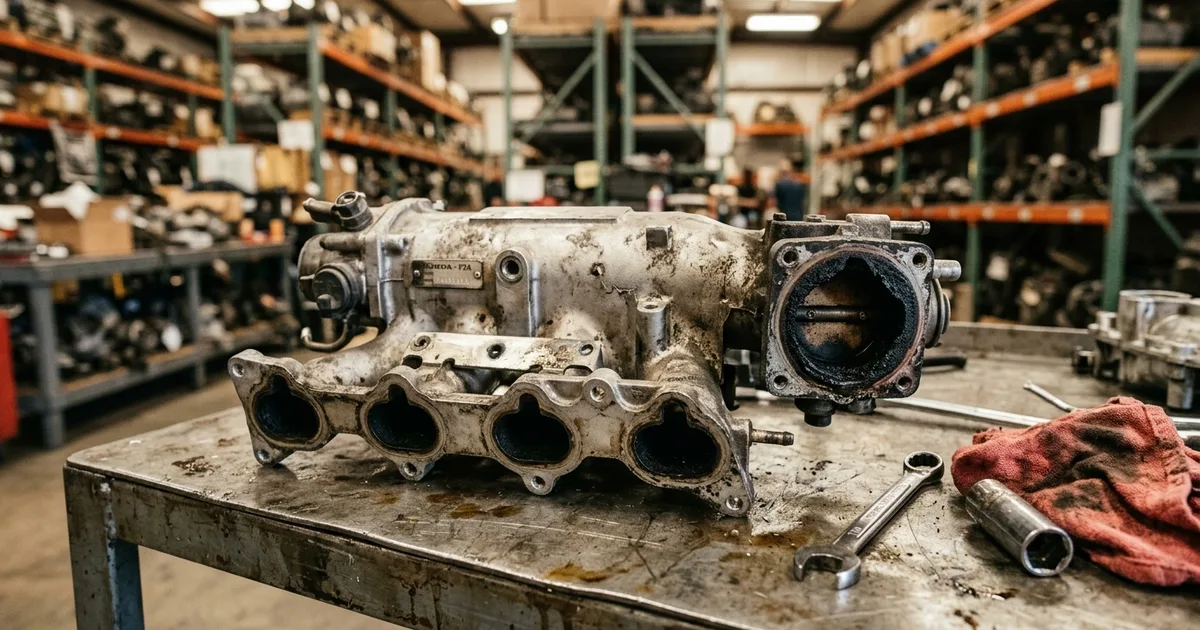
Vehicle price comparison
Chevy Silverado 1500 vs Hyundai Kona Intake Manifold prices
Price face-off
Median price comparison
Condition comparison
How does the price differ by part grade?
Market analysis
Why does the Hyundai Kona intake manifold cost more?
A used Hyundai Kona intake manifold carries a median asking price of $200, which is 42% higher than the Chevy Silverado 1500 at $116. Supply also plays a role: Chevy Silverado 1500 has 1,162 priced listings versus 173 for Hyundai Kona, and more listings generally mean more choices and more competitive pricing.
Grade A (excellent condition) parts make up 83% of Hyundai Kona listings compared to 59% for the Chevy Silverado 1500, so buyers looking for top-condition units will find more options on the Hyundai Kona side.
The Chevy Silverado 1500 average ($141) runs 22% above its median ($116), indicating a tail of high-priced listings — likely low-mileage or remanufactured units pulling the average up.
Our guide covers 8 model years for the Chevy Silverado 1500 (2018–2025) but only 4 for the Hyundai Kona (2018–2025), so the Chevy Silverado 1500 data reflects a broader range of generations.
At Grade A (excellent) condition, the Chevy Silverado 1500 is 45% cheaper ($111 vs $200) — the gap widens compared to the overall median difference.
Buyer's checklist
What to check before buying a used intake manifold
- Inspect composite or metal manifolds for hairline heat cracks, blown runner gaskets, or oil soaking inside the plenum from bad PCV systems.
- Verify throttle body flange bolt pattern, MAP sensor mounting port, and vacuum port locations across model years and engine generations.
- Check variable intake runner flaps (IMTV or DISA valves) and actuator vacuum bladders or electric motors for proper movement without binding.
- Examine head mounting flanges for warping or deep gouges that prevent a vacuum-tight seal against the intake gaskets.
Full price guide
Chevy Silverado 1500 Intake Manifold
$34 – $591 · 1,162 listings
Full price guide
Hyundai Kona Intake Manifold
$50 – $380 · 173 listings
Common questions
Chevy Silverado 1500 vs Hyundai Kona intake manifold FAQ
Is a used Chevy Silverado 1500 intake manifold cheaper than a Hyundai Kona?
Chevy Silverado 1500 has the lower median by $84 (42%). The Chevy Silverado 1500 intake manifold ranges from $34 to $591 across 1,162 listings, while the Hyundai Kona ranges from $50 to $380 across 173 listings.
Can I use a Chevy Silverado 1500 intake manifold in a Hyundai Kona?
This comparison describes pricing, not interchangeability. Even when two parts share similar prices, they may require different engines, trims, electronics, or mounting points. Always match the seller's part number against your VIN before purchasing.
How many listings does this comparison cover?
This comparison draws from 1,162 priced Chevy Silverado 1500 listings and 173 priced Hyundai Kona listings — 1,335 in total.
How does condition grade affect the price?
Part condition significantly impacts price. Grade A (Excellent): Chevy Silverado 1500 $111 vs Hyundai Kona $200. Grade B (Good): Chevy Silverado 1500 $116 vs Hyundai Kona $225. Grade A parts are in excellent condition, B is good, and C is fair — always confirm grading criteria with the seller.
Are there different trim variants to choose from?
Yes. The Chevy Silverado 1500 intake manifold has 4 trim variants and the Hyundai Kona has 2. Variants differ by engine size, drivetrain, or part number — matching the right variant is critical for proper fitment.
More comparisons