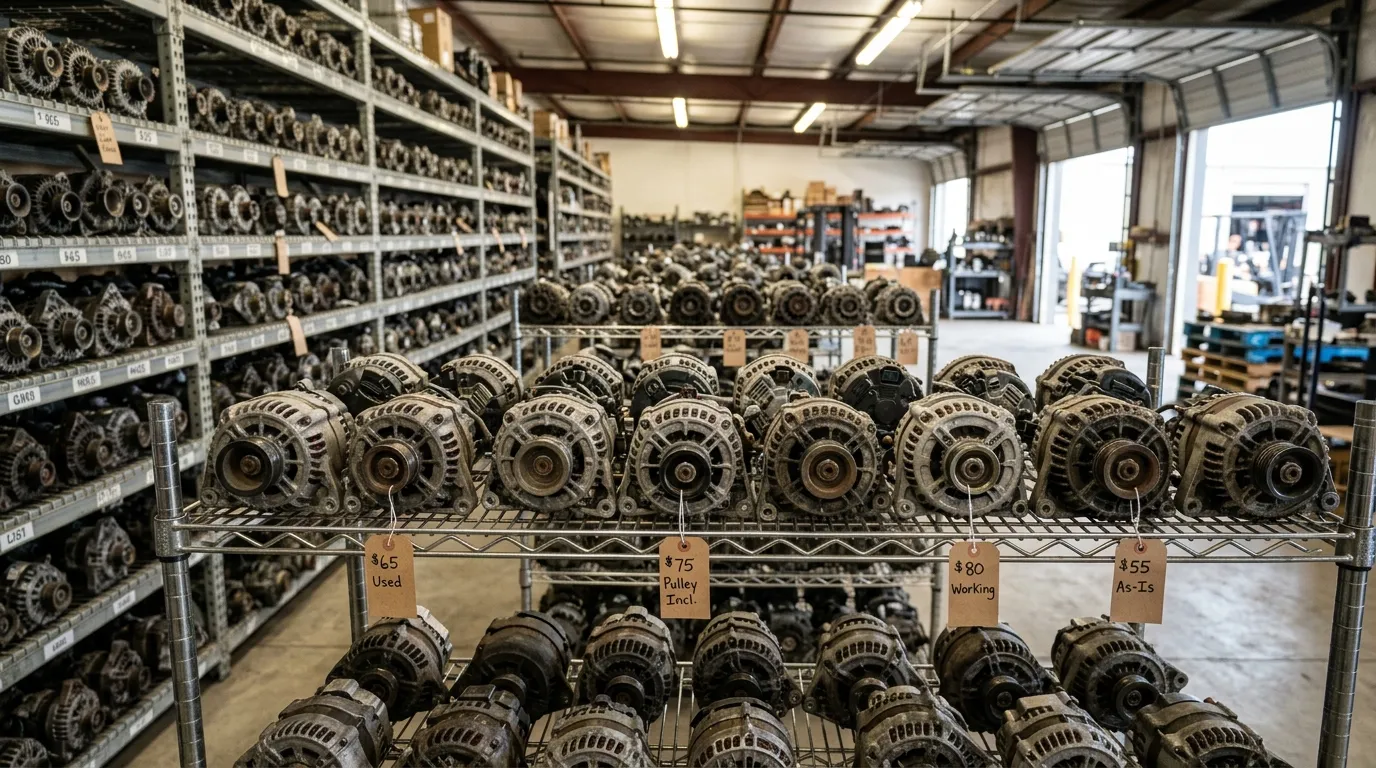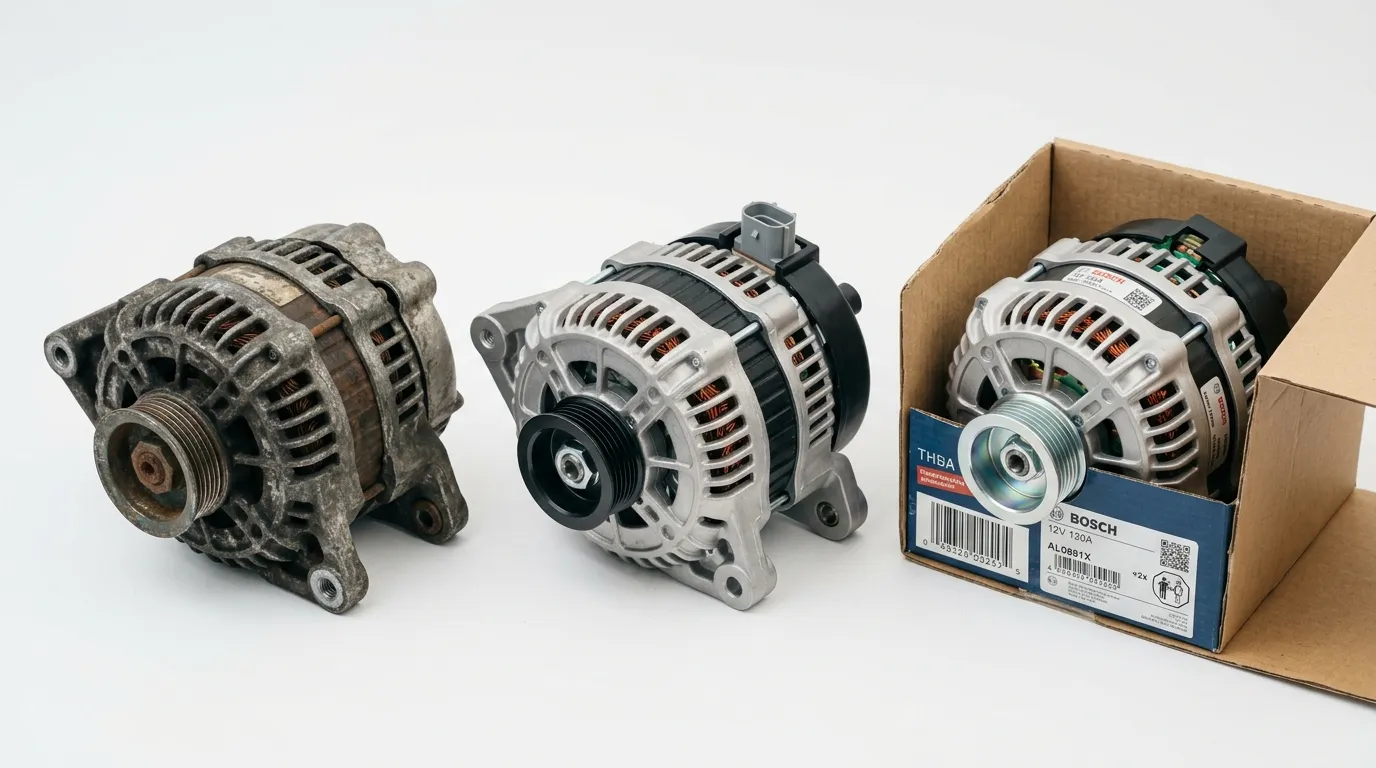
Yes, used alternators are worth it for most vehicles. They save 40 to 80 percent over remanufactured and new alternatives, and a properly inspected Grade A unit typically lasts 80,000 to 150,000 miles. At a median price of $96, the per-mile cost of a used alternator is nearly identical to a remanufactured unit costing $150.
The risk is real but manageable. Used alternators come with shorter warranties (30 to 90 days vs 1 to 3 years for reman), and you can't know exact mileage on the original part. The five-point inspection below catches the most common failure modes before you hand over any money.
- Used alternators save 40–80% over reman and new (median $96 vs $150 reman, $350 new)
- Expected lifespan: 80,000–150,000 miles for Grade A units
- Five things to check: pulley spin, connector condition, housing integrity, internal rattle, bench test
- Worth it when: vehicle under $8,000, common model, you can install it yourself
- Skip used when: vehicle is newer than 5 years, alternator is hard to access, or model is rare at yards
Are They Worth It?
The math is straightforward. Here is the per-mile cost comparison:
| Option | Median Price | Expected Life | Cost Per 10k Miles |
|---|---|---|---|
| Used | $96 | ~100k miles | $9.60 |
| Reman | $150 | ~150k miles | $10.00 |
| New OEM | $350 | ~200k miles | $17.50 |
The calculation shifts if labor is expensive. If your shop charges $200 to swap an alternator and the used unit fails after 60,000 miles, you have paid $296 total ($96 part + $200 labor). A reman that lasts 150,000 miles at $350 total ($150 + $200) costs less per mile over that span. DIY installation eliminates this variable entirely.
For a detailed side-by-side comparison, see our used vs reman analysis.
How Long Used Alternators Last
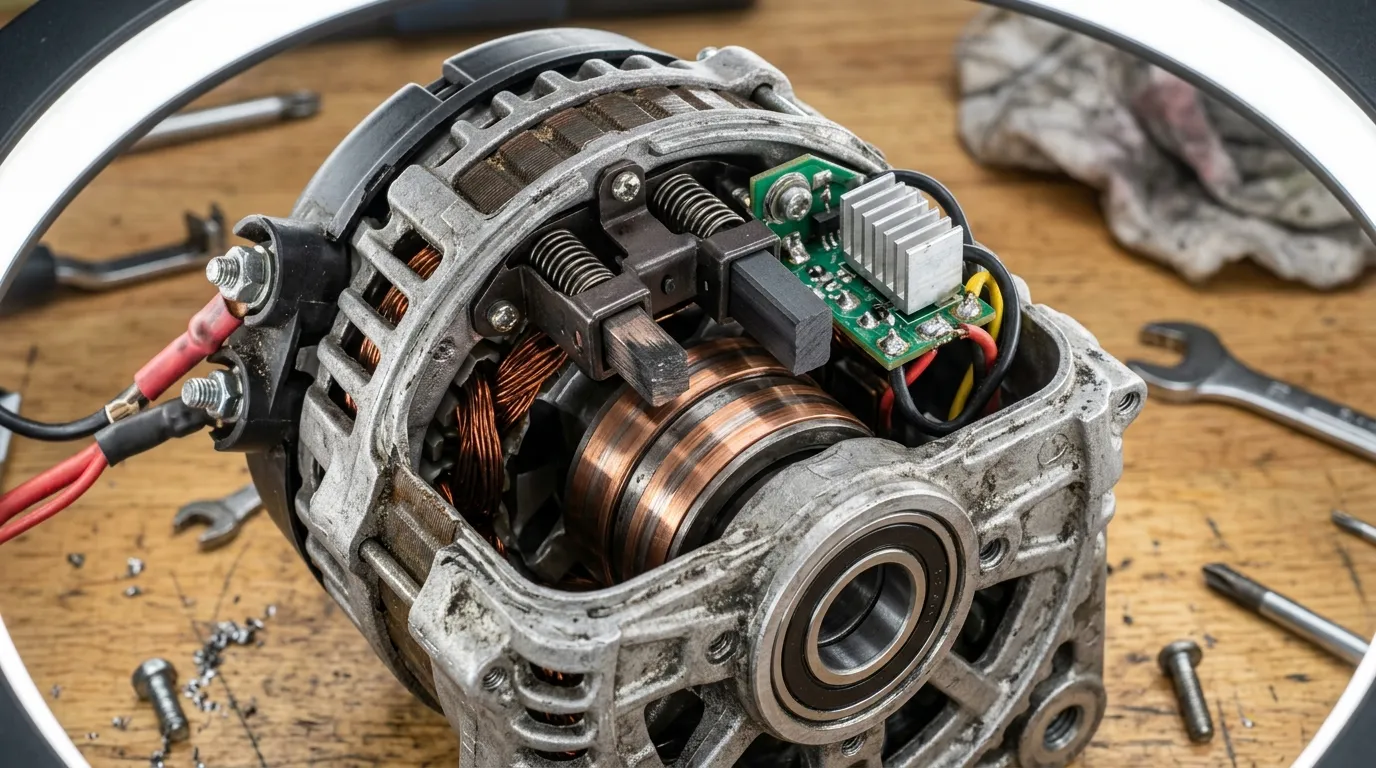
Used alternators don't have a fixed lifespan. They have remaining lifespan. The three components that wear out are:
Bearings: the most common failure. When bearings wear, you hear a grinding or whining noise. A used alternator with smooth bearings has significant life remaining; one with any roughness is near end of life. This is the single most important check.
Brushes: carbon contacts that transfer current to the rotor. New brushes are about 12mm long. Below 5mm, the alternator has limited time left. Some designs allow brush replacement, extending the part's life for $5 to $15.
Voltage regulator: controls charging output. Regulator failure causes overcharging (boiling battery, burning bulbs) or undercharging (dead battery, dim lights). There's no visual test, so the bench test is the only way to catch this.
Realistic expectations by grade:
| Grade | Typical Remaining Life | Why |
|---|---|---|
| Grade A | 100k–150k miles | Low-mileage donor, inspected |
| Grade B | 80k–120k miles | Mid-mileage, tested working |
| Grade X | Unknown | Not inspected, buyer beware |
| Grade C | 40k–80k miles | Higher wear, shorter warranty |
The 5-Point Inspection
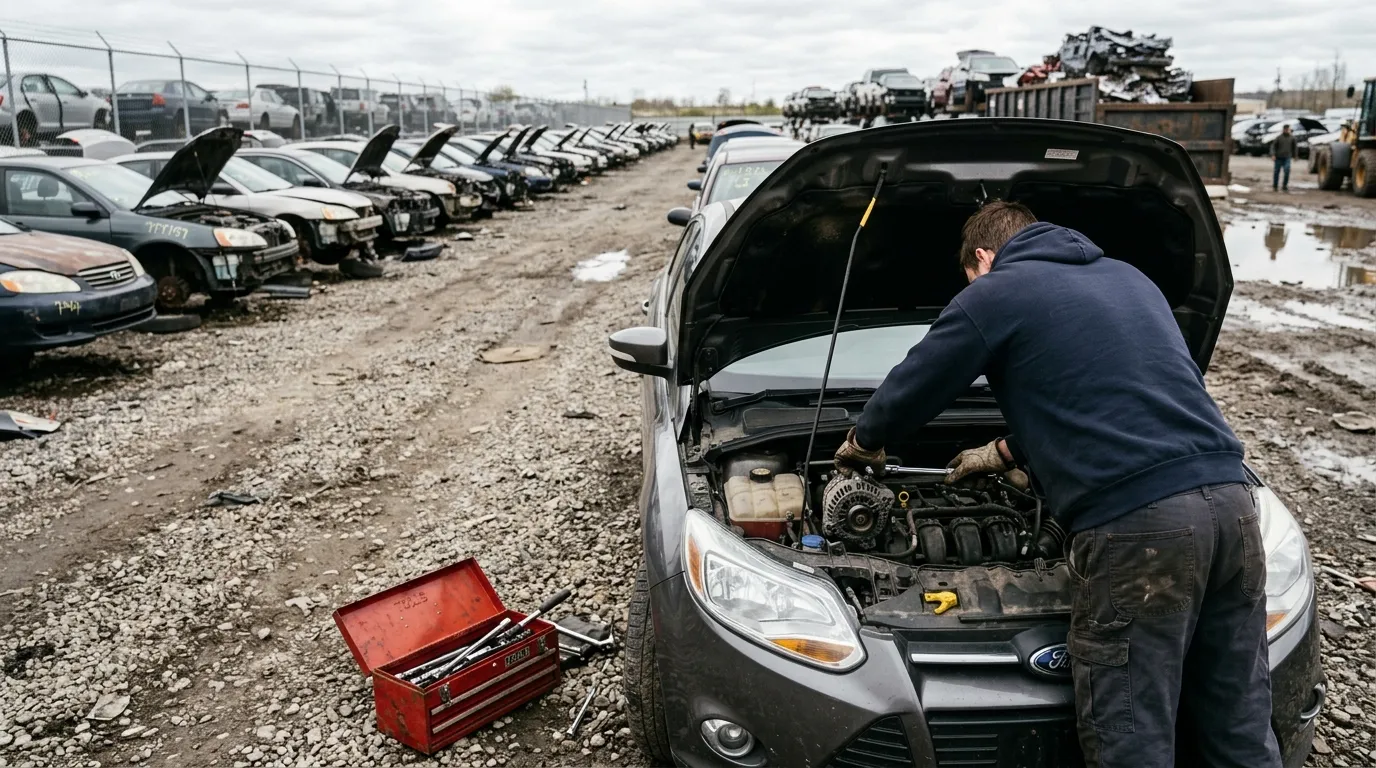
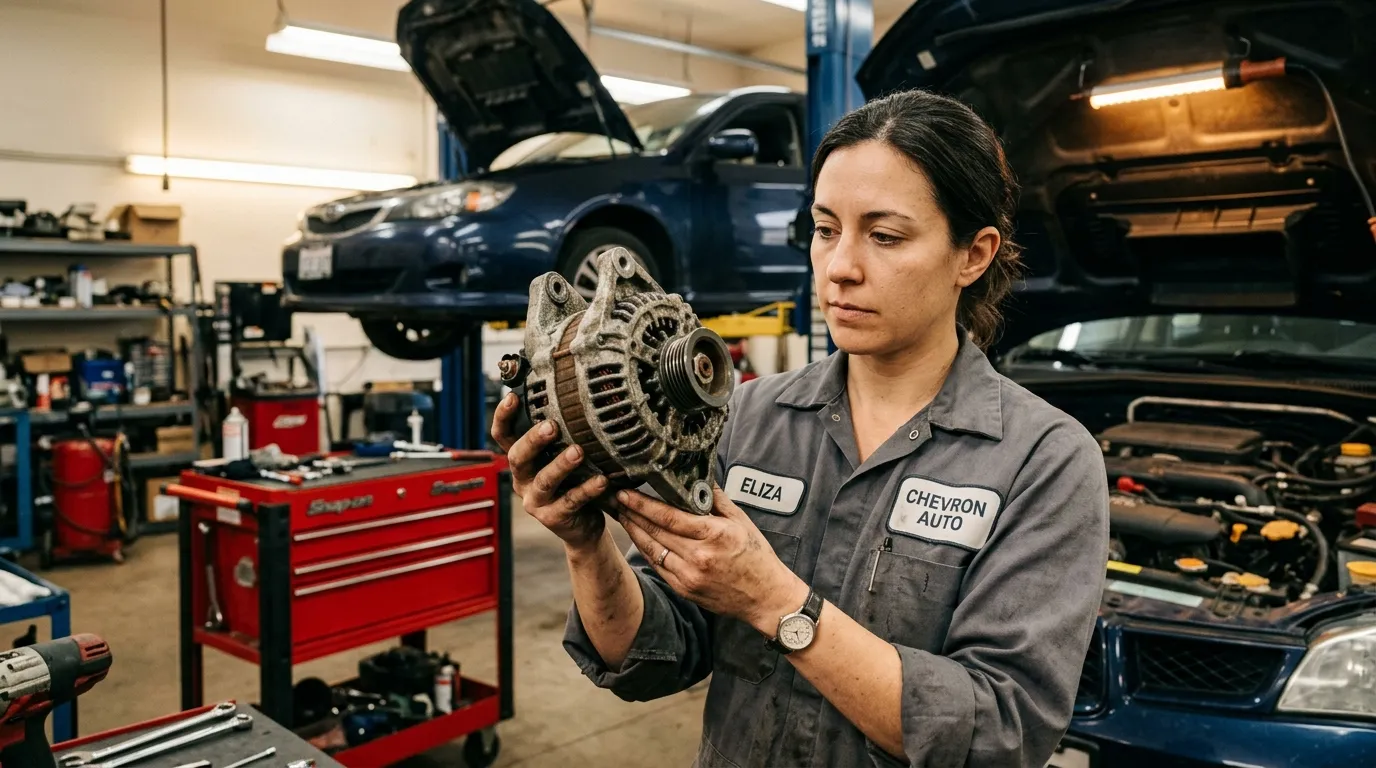
This takes five minutes and catches 90 percent of bad units. Do this at the junkyard before you pay, or at a counter-service yard before you leave.
1. Spin the Pulley
Grip the front pulley and rotate it by hand. What you want: smooth rotation with slight magnetic resistance (the magnets in the rotor resist motion, and that's normal).
Walk away if: the pulley grinds, catches, or feels rough at any point in the rotation. This is worn bearings, and no amount of hope will fix them without disassembly.
2. Inspect the Electrical Connector
Look at the plug on the back of the alternator. Pins should be clean, straight, and gold or silver colored.
Walk away if: you see green or white corrosion, bent pins, melted plastic, or heat discoloration. A bad connector causes intermittent charging, one of the hardest problems to diagnose after installation.
3. Check the Housing
Look over the entire aluminum case. Feel for cracks, especially around the mounting ears where the bolts go through.
Walk away if: the housing is cracked (structural failure risk), soaked in oil (gasket leak contamination), or shows dark heat discoloration (previous overheating).
4. Shake Test
Hold the alternator with both hands and shake it firmly side to side and front to back.
Walk away if: anything rattles inside. Loose magnets, broken diodes, or a failed bearing cage all produce internal noise.
5. Ask for a Bench Test
Counter-service yards should have a bench tester. The alternator is spun at operating RPM and its output is measured.
Pass: 13.5 to 14.5 volts at the battery terminal connection, with stable output under load. Fail: voltage below 13.0 or above 15.0, or output that fluctuates more than 0.5V under steady load.
Self-pull yards usually can't bench-test. In that case, steps 1 through 4 are your only pre-purchase checks. Consider carrying a portable multimeter if you're a frequent yard shopper.
Warranty Expectations
| Source | Typical Warranty | What to Expect |
|---|---|---|
| Self-pull yard | None to 30 days | Exchange only, same part type |
| Counter-service yard (Grade A) | 60–90 days | Refund or exchange |
| Counter-service yard (Grade B) | 30–60 days | Exchange only |
| Online recycler | 30–90 days | Return shipping may be your cost |
Keep your old alternator. Some yards require a core return to honor the warranty. Even if they don't, having the old part simplifies a warranty claim if you need to prove the replacement was defective.
When to Skip Used
Used is not always the right call. Skip it when:
The vehicle is worth more than $15,000. The alternator cost is a tiny fraction of vehicle value. A reman with a 3-year warranty protects a more valuable asset for minimal premium.
The alternator is buried. Some transverse V6 engines require removing the intake manifold to reach the alternator, adding 3 to 5 hours of labor. If the used unit fails at month 4, you're paying that labor again. A reman with a longer warranty reduces that risk.
Your model is rare at salvage yards. If our price index shows fewer than 50 listings for your model, supply is thin and you may not find a quality used unit locally. Reman is more reliably available through auto parts stores.
You need guaranteed cold-weather performance. Used alternators from southern climates may have belt-side bearing damage from heat exposure that isn't detectable during a shop-temperature spin test. If you're in a cold climate and depend on the vehicle in winter, a reman with tested cold-start performance is safer.
For everything else (daily drivers, second cars, vehicles under $8,000, common models with high yard supply), used is the better value.