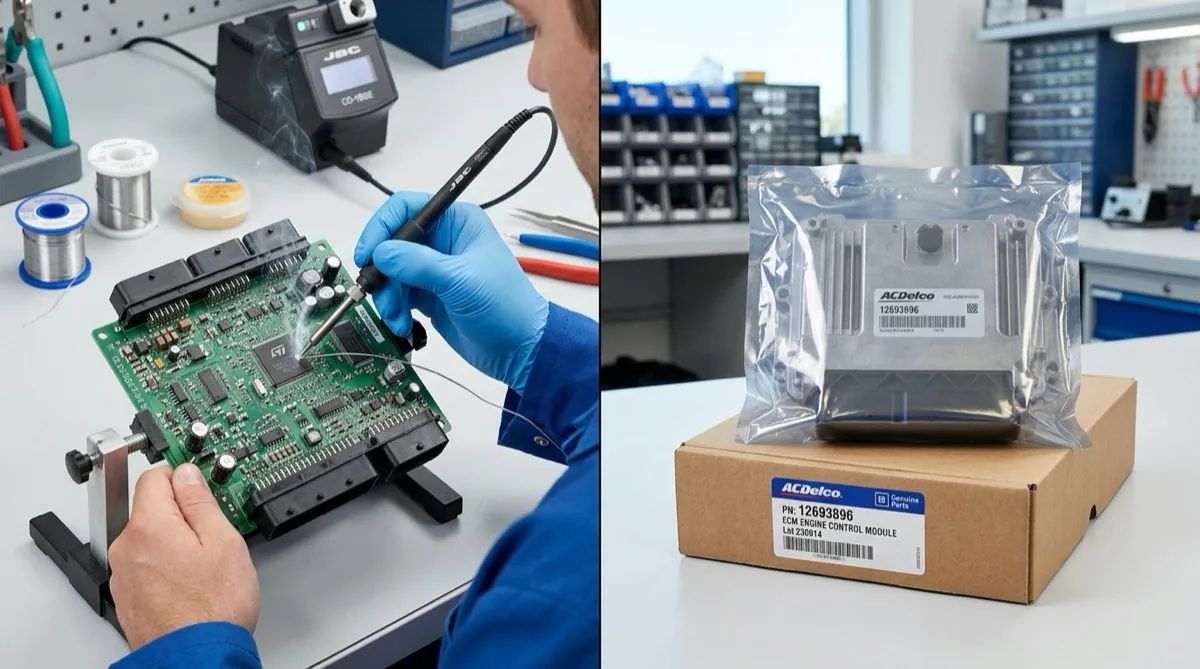
ECM repair costs $200 to $600 when the failure is a fixable component like a leaking capacitor or a cracked solder joint. Full replacement costs $298 to $825 with a used or remanufactured module including programming, or $800 to $2,200 with a new OEM unit from a dealer. The right choice depends on what failed inside the module, how much a replacement costs for your specific vehicle, and how quickly you need the car back on the road.
Repair makes sense when the failure is localized to a component that a skilled electronics technician can replace on the bench. Replacement makes sense when the processor, memory, or internal bus has failed, because those components cannot be swapped without specialized manufacturing equipment. For common vehicles where used ECMs are available at $100 to $254 from salvage yards (with a $154 median across 42,536 listings in our index), replacement almost always costs less than repair. For European luxury vehicles and diesel trucks, where used modules run $400 to $1,200, repair can save hundreds.
[INTERNAL-LINK: Full ECM replacement cost breakdown → /blog/repair-costs/ecm-replacement-cost]
- ECM repair: $200-$600. Only viable for capacitor, solder, connector, and driver circuit failures
- Replacement with used ECM + programming: $298-$825. The module runs $154 median plus $150-$300 programming and $48-$225 labor
- Replacement with new OEM: $800-$2,200. Trucks and diesels can reach $5,000
- Repair turnaround: 3-10 business days since you ship the module to a repair service and wait for return
- Replacement is faster and usually cheaper for common domestic and Japanese vehicles
- Repair saves money on European, diesel, and rare vehicles where replacement modules are expensive or hard to source
Repair vs Replacement Cost Comparison
The cost math depends heavily on the vehicle. A Honda Civic ECM that costs $125 median from a salvage yard is almost always cheaper to replace than repair. A BMW X5 ECM at $350+ median makes repair competitive.
| Approach | Cost Range | Turnaround | Best For |
|---|---|---|---|
| ECM repair service | $200-$600 | 3-10 business days | European, diesel, rare vehicles |
| Used ECM + programming | $298-$825 | 1-3 days (local yard) | Common domestic/Japanese vehicles |
| Remanufactured (pre-programmed) | $298-$825 | 2-5 days (shipped) | Avoiding the dealer programming trip |
| New OEM (dealer) | $800-$2,200+ | Same day (if in stock) | Warranty coverage, newer vehicles |
When repair costs less
Repair wins on cost when the replacement module is expensive. Consider a 2019 BMW X5 ECM: the used module alone runs $350 to $500, programming requires BMW ISTA at a dealer for $200 to $400, and labor adds $95 to $225. Total replacement cost: $645 to $1,125. An ECM repair service charging $350 to $500 for a capacitor or driver circuit fix saves $150 to $625, and the original module retains all of the vehicle's VIN, security keys, and calibration data, so no reprogramming is needed.
When replacement costs less
For a 2020 Toyota Camry, a used ECM from our index runs $130 median. Add $100 to $150 for independent shop programming and $48 to $150 for installation labor. Total: $278 to $430. An ECM repair service charging $200 to $350 for the same vehicle offers marginal savings at best and takes longer because you ship the module out and wait for its return.
*Part pricing source: PartPriceGuide.com analysis of salvage yard listings, August 2026.*
When ECM Repair Is Possible
ECM repair is viable only when the failure is in a discrete, replaceable component. A specialized repair service receives your module, diagnoses the specific failure point on the circuit board, replaces the failed component, and bench tests the unit before shipping it back.
Repairable failure types
Capacitor failure. Electrolytic capacitors on the ECM board degrade over time, especially in high-heat environments like engine bays. Symptoms include intermittent stalling, erratic idle, and random misfires that worsen with temperature. A repair technician identifies the bulging or leaking capacitor, desolders it, and replaces it with a new unit rated for the same voltage and capacitance. Cost: $200 to $350.
Cracked solder joints. Thermal cycling (the constant heating and cooling cycle in an engine bay) causes solder joints to crack over time. These cracks create intermittent connections that produce sporadic symptoms: the engine runs fine for days, then suddenly misfires or stalls, then runs fine again. Reflowing or resoldering the cracked joints fixes the problem. Cost: $200 to $300.
Damaged connectors and pins. The multi-pin connectors that attach the wiring harness to the ECM can suffer bent pins, corrosion, or broken latches. If the damage is to the connector on the ECM housing rather than the harness side, a repair service can replace the connector. Cost: $150 to $300.
Driver circuit failures. The ECM uses driver circuits (transistors and MOSFETs) to control outputs like fuel injectors, ignition coils, and solenoids. A failed driver circuit typically produces a code for a specific cylinder or output. Replacing the failed driver IC on the board costs $300 to $500.
Corroded traces. Water intrusion or condensation can corrode the copper traces on the circuit board. If the corrosion is limited to a few traces and has not damaged the underlying substrate, a technician can clean the corrosion and repair the traces with conductive epoxy or jumper wires. Cost: $250 to $450.
What the repair process looks like
- You remove the ECM from the vehicle (or have a shop remove it)
- Ship the module to the repair service with a description of symptoms
- The service diagnoses the specific failure (1 to 3 business days)
- They contact you with a repair quote and estimated turnaround
- After approval, they perform the repair and bench test the module (1 to 5 business days)
- The repaired module ships back, ready to reinstall
- No reprogramming is needed since the original VIN and calibration data remain intact
The "no reprogramming" benefit is significant. A repaired ECM goes back into your vehicle with all of its original data intact. You reinstall it, and the engine starts without a dealer visit. That saves $150 to $300 in programming fees compared to installing a different used module.
When Replacement Is the Only Option
Some ECM failures destroy components that cannot be replaced on a bench. When the failure involves the processor, memory, or the module's internal communication bus, repair is either impossible or costs more than replacement.
Processor failure. The main microprocessor on the ECM board is a custom automotive-grade chip that is soldered directly to the board with hundreds of connections. If the processor fails (due to electrical surge, overheating, or manufacturing defect), no repair service can replace it. The chip is not available as a standalone part, and the soldering requires factory-level equipment. A failed processor produces a completely dead ECM: no communication, no codes, no response to the scan tool.
Memory chip corruption. The ECM uses flash memory (EEPROM or NOR flash) to store calibration data and learned values. If the memory chip itself fails rather than the data on it, the module cannot be reflashed. Symptoms include an ECM that accepts a programming session but immediately corrupts the data, producing a failed flash every time. Memory chip replacement is theoretically possible but rarely cost-effective because the chip must be matched to the processor and the replacement requires specialized soldering equipment.
Internal bus failure. The ECM's internal communication bus connects the processor to the input/output circuits. If this bus fails (due to a cracked substrate, a shorted via, or a manufacturing defect), the processor cannot communicate with its own circuits. The module powers on but cannot read sensors or control outputs. This type of failure is not repairable.
Severe water or fire damage. If the ECM board has been submerged in water, exposed to fire, or suffered extensive corrosion across multiple layers of the circuit board, repair is not practical. The damage is too widespread to isolate and fix individual components.
Physical board damage. A cracked circuit board from impact damage (an accident that distorted the ECM mounting bracket, for example) cannot be repaired if the crack runs through the substrate layers where traces are embedded.
When replacement is necessary, the most cost-effective path for common vehicles is a used ECM from a salvage yard plus shop programming. A used Ford F-150 ECM runs $175 median across 1,377 listings in our index. Add $100 to $150 for programming and $48 to $200 for labor, and the total lands at $323 to $525.
[INTERNAL-LINK: ECU programming and reprogramming costs → /blog/repair-costs/ecu-programming-reprogramming-cost]
Common ECM Failure Symptoms
ECM failure is uncommon because the module has no moving parts. When it does fail, the symptoms overlap with sensor, wiring, and other electrical failures, which makes accurate diagnosis critical before committing to a repair or replacement.
Crank-no-start. The engine turns over but does not fire. The ECM is not triggering fuel injectors or ignition coils. This is the most dramatic ECM failure symptom, but it also describes a bad crankshaft position sensor, a failed fuel pump relay, or a blown fuse. Do not replace the ECM based on this symptom alone.
U0100 or U0101 diagnostic trouble codes. These codes mean "lost communication with ECM/PCM" and "lost communication with TCM." They appear when other modules on the CAN bus cannot reach the ECM. If U0100 returns immediately after clearing, the ECM hardware is likely the cause. If it clears and stays away, the problem was a wiring or connector issue.
Multiple unrelated fault codes. A failing ECM may set codes across multiple systems simultaneously: misfires, oxygen sensor faults, transmission shift errors, and throttle position errors all appearing at once. Individual sensor failures produce isolated codes. When unrelated systems all fault at the same time, the common link is usually the ECM.
Erratic idle or random stalling. The engine idle speed swings unpredictably, or the engine stalls without warning at idle or while driving. These symptoms worsen with temperature if the cause is a cracked solder joint or a failing capacitor, because thermal expansion opens the crack wider.
Intermittent electrical failures. Systems controlled by the ECM (fuel injection, ignition timing, idle air control, emissions solenoids) work sometimes and fail other times with no pattern. Wiggling the ECM connector may temporarily resolve or worsen symptoms, pointing to a connection issue at the module rather than a sensor problem downstream.
[INTERNAL-LINK: Car won't start causes and costs → /blog/part-guides/car-wont-start-causes-repair-cost]
Before you commit to repair or replacement
Have a technician perform these checks before condemning the ECM:
- Check power and ground circuits. The ECM needs clean, stable voltage on its power pins and solid ground connections. A corroded ground wire or a bad relay can produce every symptom listed above. This check takes 15 to 30 minutes with a multimeter.
- Inspect the wiring harness. A chafed wire touching the engine block or a rodent-chewed harness produces intermittent ECM communication failures that mimic a bad module. Check the harness from the ECM connector back to the fuse box.
- Verify CAN bus communication. A scan tool that can read CAN bus traffic will show whether the ECM is responding to requests. If the ECM responds intermittently, the problem may be the connector rather than the module itself.
- Try reseating the connector. Disconnect the ECM connector, clean the pins with electrical contact cleaner, and reconnect. If symptoms resolve, the problem was a dirty connection, not a failed module. A $5 can of contact cleaner just saved you $200 to $800.
Remanufactured vs Refurbished ECM
If you choose replacement, you will encounter two categories of rebuilt ECMs that sit between used salvage modules and new OEM units. The terminology matters because the processes, pricing, and warranties differ significantly.
Remanufactured ECMs
A remanufactured ECM is disassembled to the bare board, cleaned, inspected under magnification, and rebuilt with new components wherever the original parts show wear or risk of failure. All electrolytic capacitors are replaced as a matter of course, regardless of whether they have failed yet. Solder joints are reflowed or replaced. The module is then bench tested against factory specifications and programmed with your VIN before shipping.
- Cost: $250 to $600
- Warranty: 12 to 24 months (standard), lifetime from some suppliers
- Programming: Typically included (pre-programmed to your VIN)
- Suppliers: Flagship One, Module Experts, Solo Automotive, CardOne
The main advantage is convenience. A remanufactured, VIN-programmed ECM arrives ready to install. You bolt it in, complete a key-cycle relearn, and drive. No dealer visit, no programming fee, no second appointment.
Refurbished ECMs
A refurbished ECM is tested, cleaned, and has only the specific failed component replaced. If the module has a leaking capacitor, that capacitor is replaced but the remaining capacitors are left as-is. The module is tested to confirm the repair resolved the fault, but it does not go through a full component-by-component rebuild.
- Cost: $150 to $400
- Warranty: 6 to 12 months
- Programming: May or may not be included (check before ordering)
- Suppliers: Smaller repair shops, eBay sellers, some auto electronics specialists
Refurbished units cost less because the labor involved is minimal compared to a full remanufacture. The tradeoff is that other aging components on the same board may fail within months, leading to a second failure. For a vehicle you plan to keep for years, a remanufactured unit with a longer warranty is the safer investment.
Which to choose
| Factor | Remanufactured | Refurbished | Used (Salvage) |
|---|---|---|---|
| Cost | $250-$600 | $150-$400 | $100-$254 (median $154) |
| Warranty | 12-24 months | 6-12 months | 30-90 days (varies by yard) |
| Programming | Usually included | Varies | Requires separate programming ($75-$300) |
| Rebuild scope | Full component replacement | Failed part only | None (original condition) |
| Best for | Long-term ownership | Budget repairs, older vehicles | Common vehicles with cheap modules |
[INTERNAL-LINK: Junkyard parts pricing overview → /blog/price-analysis/how-much-do-junkyards-charge-for-parts]
How to Diagnose ECM Failure
Accurate diagnosis is the single most important step in the repair-vs-replace decision. Replacing an ECM that was not actually faulty is a $300 to $800 mistake that does not fix the original problem.
Step 1: Read diagnostic trouble codes
Connect a scan tool to the OBD-II port and read all stored and pending codes from every module, not just the engine. U-codes (network communication) are the most relevant. U0100 (lost communication with ECM/PCM) is the primary code that points to an ECM hardware failure. P-codes from the engine may indicate what the ECM is doing wrong, but they do not confirm whether the ECM itself has failed or is responding to bad sensor input.
Step 2: Check ECM power and ground
The ECM needs stable 12V power and a clean ground to function. Use a multimeter to verify:
- Battery voltage at the ECM power pins (should read 12.2V or higher with the engine off, 13.5-14.5V with the engine running)
- Ground circuit resistance (should read less than 0.5 ohms from the ECM ground pin to the battery negative terminal)
- Fuse continuity for all ECM-related fuses
A bad ECM relay, a blown fuse, or a corroded ground connection produces the same symptoms as a failed ECM. These checks take 15 to 30 minutes and cost nothing beyond the technician's time.
Step 3: Inspect connectors and harness
Remove the ECM connector and inspect for:
- Bent or pushed-back pins
- Green corrosion on pin surfaces
- Water or moisture inside the connector housing
- Melted or discolored plastic (indicating a heat-related short)
- Chafed or damaged wires in the harness within 12 inches of the connector
Clean the connector with electrical contact cleaner and reconnect. If symptoms change after reseating the connector, the problem is the connection, not the module.
Step 4: Verify CAN bus integrity
Use a scan tool or oscilloscope to check CAN bus communication. The CAN high and CAN low wires should show a characteristic differential signal. If the CAN bus is shorted or open, the ECM may appear dead even though it is functional. A CAN bus fault affects all modules on the network, so if multiple modules are offline simultaneously, the problem is likely the bus itself rather than any individual module.
Step 5: Swap test (if available)
If you have access to a known-good ECM from the same vehicle (a shop loaner, a salvage unit, or a unit from an identical vehicle), temporarily installing it is the most conclusive test. If the known-good module resolves all symptoms, the original ECM is confirmed bad. The test module does not need to be programmed for a quick diagnostic check. It will not start the engine (the immobilizer will block it), but the scan tool should be able to communicate with it and verify that the module powers on, reads sensors, and responds to commands.
[INTERNAL-LINK: Check engine light diagnostics and cost → /blog/part-guides/check-engine-light-cost]