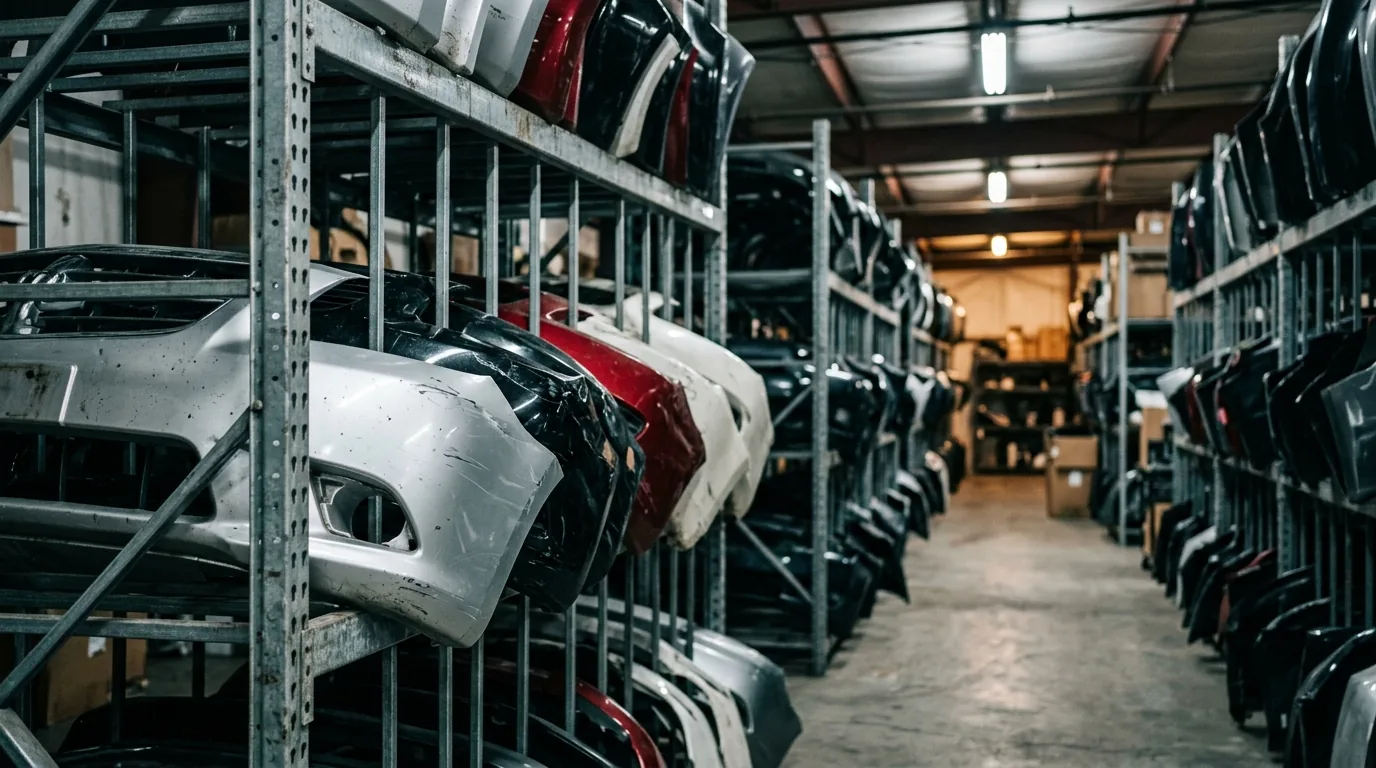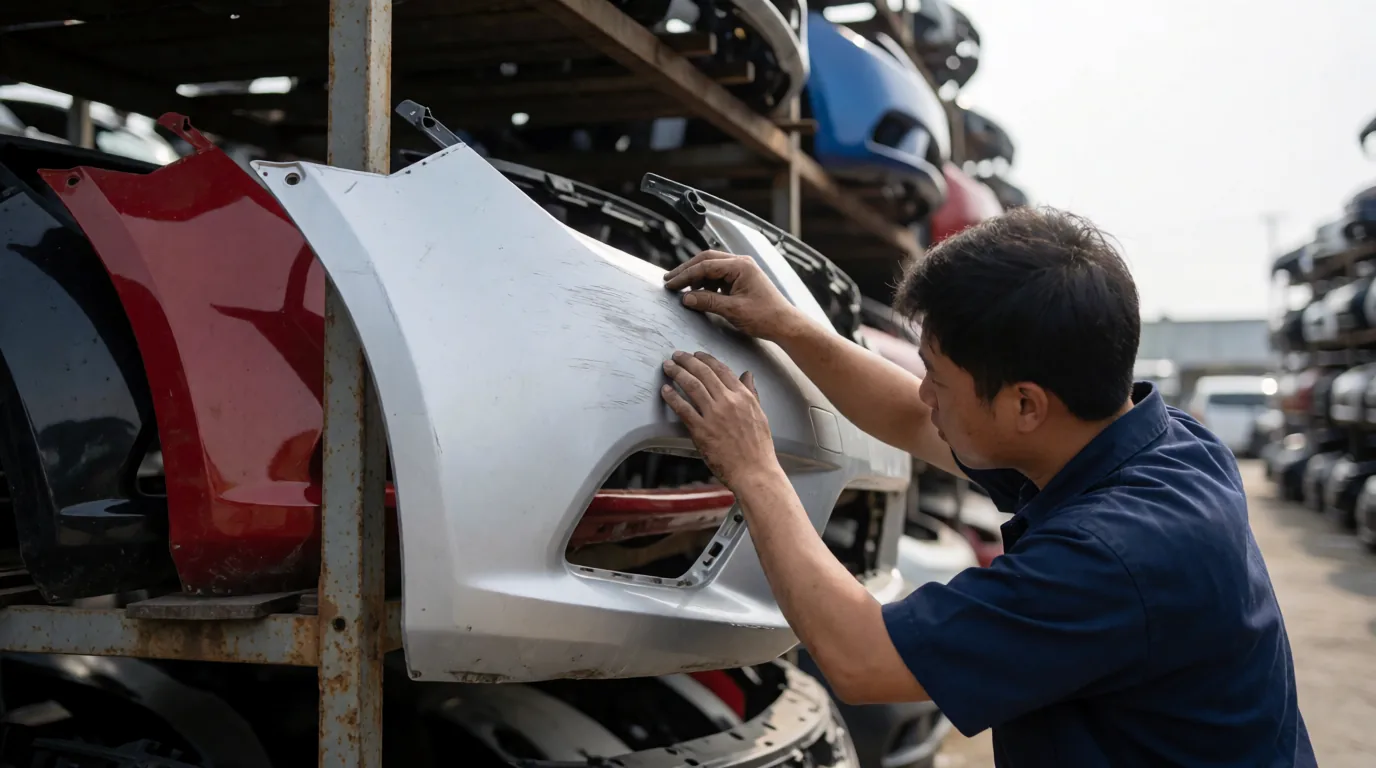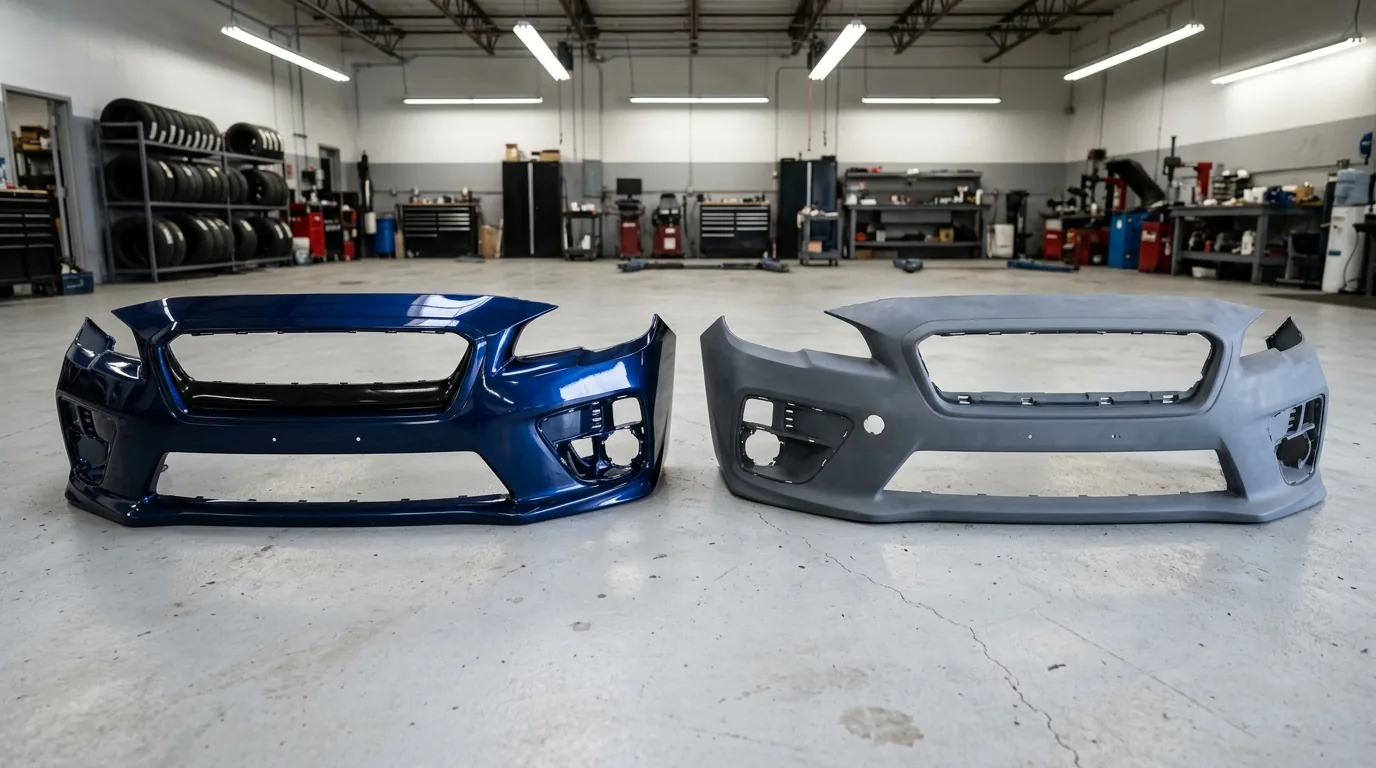
For most front-end repairs, a used OEM bumper cover beats a new aftermarket one. Used OEM covers median $260 across 17,627 priced salvage listings, arrive in a factory color, and hit factory panel gaps because they came off factory tooling. Aftermarket covers start lower at $150 to $400, but they ship in primer, so the $300 to $700 paint bill lands on you either way.
The safety question people actually mean when they ask about aftermarket bumpers is usually about the wrong part. The cover is decorative plastic. What matters structurally is the reinforcement bar and energy absorber sitting behind it, and that's where certification is worth checking.
- Used OEM median: $260 across 17,627 priced salvage yard listings covering 51 vehicle models
- Installed cost flips the ranking. Color-matched used OEM lands near $275 to $400 all-in, aftermarket lands near $500 to $900 once paint is included
- The cover isn't a crash structure. The reinforcement bar and absorber behind it are, and those are where CAPA certification matters
- CAPA verifies manufacturing equivalence, not crash performance. It checks material, fit, weight, and corrosion resistance against the OEM part
- Aftermarket wins on rare colors and old vehicles, where a repaint is happening anyway and salvage supply is thin
The Short Comparison
| Factor | Used OEM | New Aftermarket |
|---|---|---|
| Part price | $120–$655 (median $260) | $150–$400 |
| Finish as delivered | Factory paint, donor color | Gray primer |
| Paint cost to add | $0 if color matches, else $300–$700 | $300–$700, always |
| Typical installed total | $275–$400 color-matched | $500–$900 |
| Panel gap accuracy | Factory tooling | Reverse-engineered, brand dependent |
| Sensor and fog light cutouts | Exact for that trim | Usually correct, verify by trim |
| Material match | Identical | CAPA-certified parts verified, others vary |
| Condition risk | Scuffs, cracks, broken tabs | New, no cosmetic risk |
| Availability | Same day at yards, color limited | 2–5 day shipping, any quantity |
| Warranty | 30–90 days typical | 1 year to lifetime, brand dependent |
Real Price Comparison
The sticker price comparison favors aftermarket. The installed cost comparison usually doesn't.
Here's how the math runs on a mainstream crossover:
| Scenario | Part | Paint | Clips/misc | Labor (DIY) | Total |
|---|---|---|---|---|---|
| Used OEM, color matched | $260 | $0 | $40 | $0 | $300 |
| Used OEM, wrong color | $180 | $500 | $40 | $0 | $720 |
| New aftermarket | $200 | $500 | $25 | $0 | $725 |
| New OEM | $750 | $500 | $25 | $0 | $1,275 |
Model matters too. On a Toyota RAV4, where used covers median $120 across 1,534 listings, salvage is the obvious answer and aftermarket barely competes. On a BMW X5 at a $595 median across 410 listings, the gap narrows enough that a well-reviewed aftermarket cover is worth pricing out. Our used front bumper cost breakdown has the full model-by-model table.
Fit and Panel Gaps
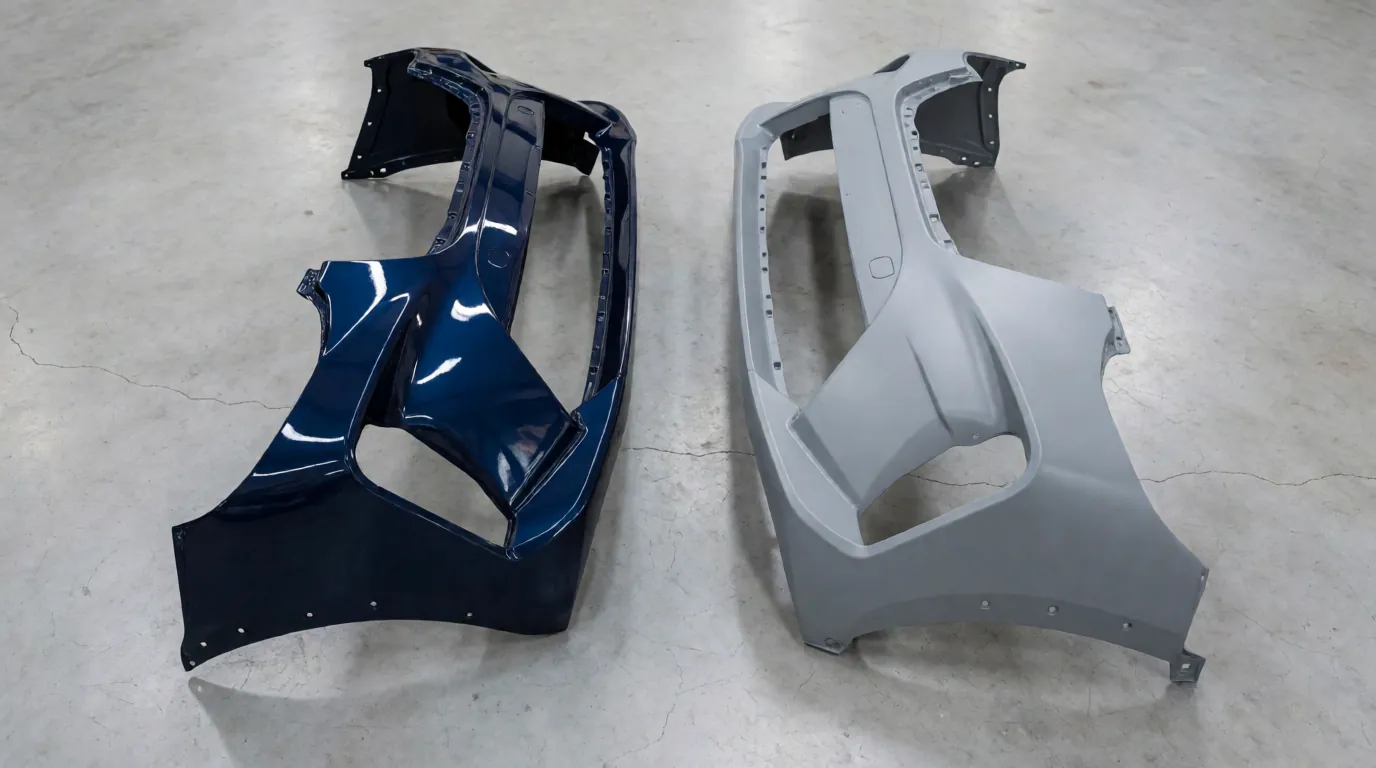
Used OEM covers fit right because they are the same part your car left the factory with. Aftermarket fit ranges from indistinguishable to visibly wrong, and the variation is between manufacturers rather than between price tiers.
Aftermarket collision parts are reverse-engineered. A manufacturer buys an OEM cover, scans or measures it, and builds tooling from that copy. Every step of that process introduces tolerance drift, and the drift shows up at the seams where the cover meets fixed panels.
Where fit problems show up first:
- Fender-to-cover seam. The most visible gap on the car. A cover that's 2mm narrow at the top corner reads as damage to anyone walking past.
- Headlight edge. The cover has to wrap the headlight lens cleanly. Gaps here trap water and road grit.
- Hood-to-grille line. A cover that sits proud of the hood edge catches light differently at every angle.
- Lower mounting tabs. These attach to a splash shield or subframe bracket. If the tab spacing drifts, the installer either forces it or leaves fasteners out.
A body shop can massage most of these with shims and heat, but that's labor you're paying for, which eats into the price advantage that made aftermarket attractive.
The counterpoint is real, though: a used OEM cover with a warped mounting flange from its previous collision fits worse than a good aftermarket part. OEM tooling guarantees the shape it was made in, not the shape it's in now. That's why the salvage yard inspection checklist focuses so heavily on the back side of the cover, where the tabs and flanges live.
Safety and CAPA Certification
A bumper cover is not a crash structure. It's a thermoplastic fascia that manages airflow, houses lights and sensors, and makes the car look finished. Behind it sit the parts that actually manage impact energy: a foam or honeycomb absorber and a steel or aluminum reinforcement bar bolted to the frame rails.
So the honest answer on aftermarket bumper safety is that the cover itself barely moves the needle. The concern is legitimate when a collision repair replaces the reinforcement bar or absorber with non-certified parts, because those components are engineered to crush in a specific sequence at a specific load. A bar made from thinner-gauge steel or a different alloy can change how the front structure behaves, including how the crash pulse reaches the airbag sensors.
What CAPA certification actually verifies. The Certified Automotive Parts Association is an independent nonprofit that tests aftermarket collision parts against their OEM counterparts. Certification checks material composition, dimensional fit against a reference vehicle, weight, thickness, and corrosion resistance for metal parts. Certified parts carry a numbered yellow-and-blue seal, and CAPA runs ongoing factory audits plus random retesting.
What CAPA does not verify. Certification is not a crash test. CAPA confirms that a part is manufactured equivalently to the OEM version, which is a meaningful but narrower claim than "this part performs identically in a collision."
The practical rule: if a repair touches only the cover, aftermarket versus used OEM is a fit-and-finish decision, not a safety decision. If the repair touches the reinforcement bar, absorber, or any bracketry, insist on OEM or CAPA-certified parts and get it in writing on the estimate.
Sensors, Radar, and ADAS Calibration
This is where the comparison has shifted hardest in the last decade, and it's the argument that most often decides in favor of used OEM.
Modern front covers are sensor real estate. A typical 2020-and-newer vehicle mounts some combination of ultrasonic parking sensors, a forward radar unit, a camera aperture, and active grille shutters through or behind the front fascia. Each of those has a position tolerance measured in millimeters and degrees.
Three things to verify before you buy either type:
- Cutout pattern matches your trim, not just your model year. Base trims often have smooth plastic where higher trims have sensor bores. You can't add a bore accurately with a hole saw, because sensor aim depends on the mounting boss angle behind the hole, not just the hole location.
- Radar bracket geometry. If your vehicle's forward radar mounts to the cover or to a bracket that indexes off the cover, a dimensional variance of a few degrees changes where the beam points. This is the single strongest technical argument for OEM geometry.
- Calibration requirement. Many vehicles need a static or dynamic ADAS recalibration after front fascia work regardless of part origin. Budget $150 to $400 for it and confirm your shop has the target boards, because skipping it leaves adaptive cruise and automatic emergency braking mis-aimed.
A used OEM cover pulled from the same trim level clears all three by definition. An aftermarket cover usually does, but "usually" is doing more work than it did on a 2010 vehicle.
When Aftermarket Is the Right Call
Used OEM isn't the answer every time. Aftermarket makes clear sense in four situations:
Your paint is unusual and you're painting anyway. If your car wears a low-volume color, salvage odds of a match are poor. Once a repaint is guaranteed, a new cover in primer with zero scuffs is a better starting canvas than a used cover you have to sand and fill.
Salvage supply for your model is thin. Some models in the index carry fewer than 100 priced listings, meaning your local options may be zero. Aftermarket ships from a warehouse.
The vehicle is old and the goal is functional, not perfect. On a fifteen-year-old commuter, a $150 aftermarket cover that seats within a couple of millimeters is a reasonable outcome.
You need a warranty. Salvage yards typically offer 30 to 90 days. Aftermarket manufacturers commonly offer one year to limited lifetime coverage against defects, which matters if the part fails from UV degradation or a bad mold release.
When used OEM clearly wins: your paint code shows up in local salvage inventory, your vehicle has front radar or parking sensors, you plan to keep the car and care how the seams look, or your model has deep salvage supply. Start with the front bumper price index to see what your model's supply looks like.
What Insurance Will and Won't Cover
Insurers have preferred this question settled in their favor for decades, and the default answer in most policies is not OEM.
Standard auto policies typically authorize "aftermarket, reconditioned, or recycled parts of like kind and quality" for vehicles past a threshold age, commonly three to seven years depending on carrier and state. Recycled OEM, which is what a salvage yard cover is, generally qualifies under that language and is often the insurer's preferred option because it's cheaper than new OEM and better regarded than aftermarket.
Three things worth knowing before you file:
- Disclosure rules vary by state. Several states require the estimate to identify non-OEM parts in writing. Read the estimate line items rather than the total.
- An OEM endorsement exists. Most carriers sell an OEM parts rider for a modest premium increase. If you drive a newer or leased vehicle, it's usually worth the cost.
- You can pay the difference. If the estimate specifies aftermarket and you want OEM, most shops will let you cover the delta out of pocket.
On a repair you're paying for yourself, none of this applies and the calculation is purely the installed-cost math from earlier in this post.
Ready to price the part for your vehicle? Check the front bumper price index, then read the salvage yard buying guide for the paint code lookup and inspection steps.