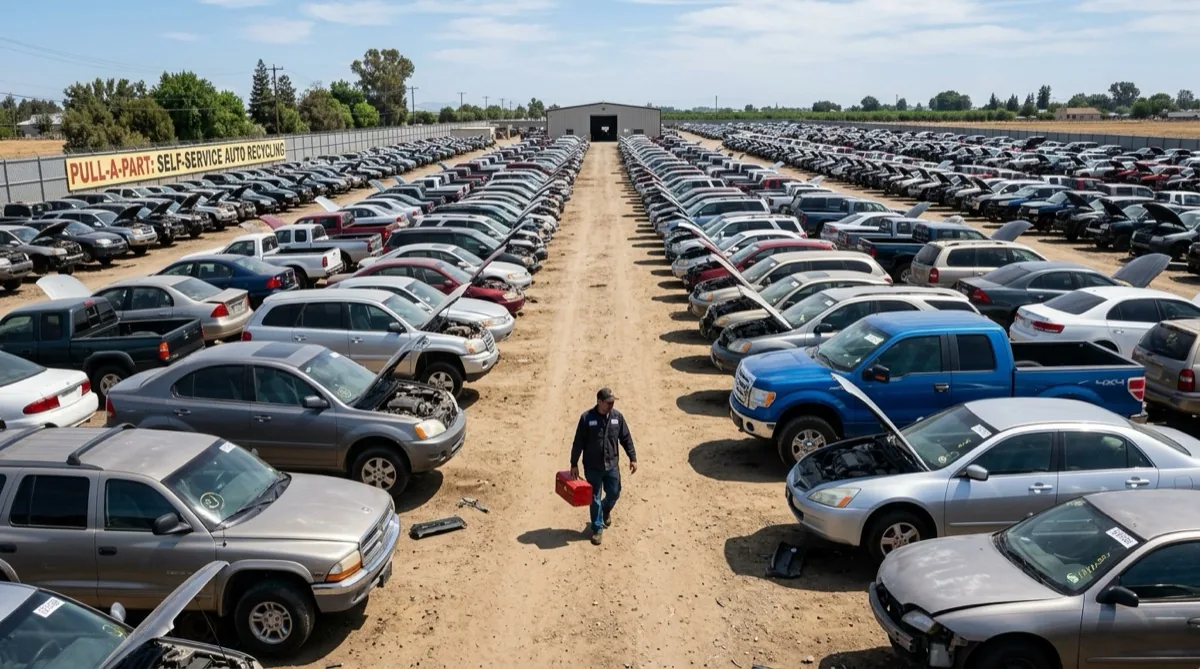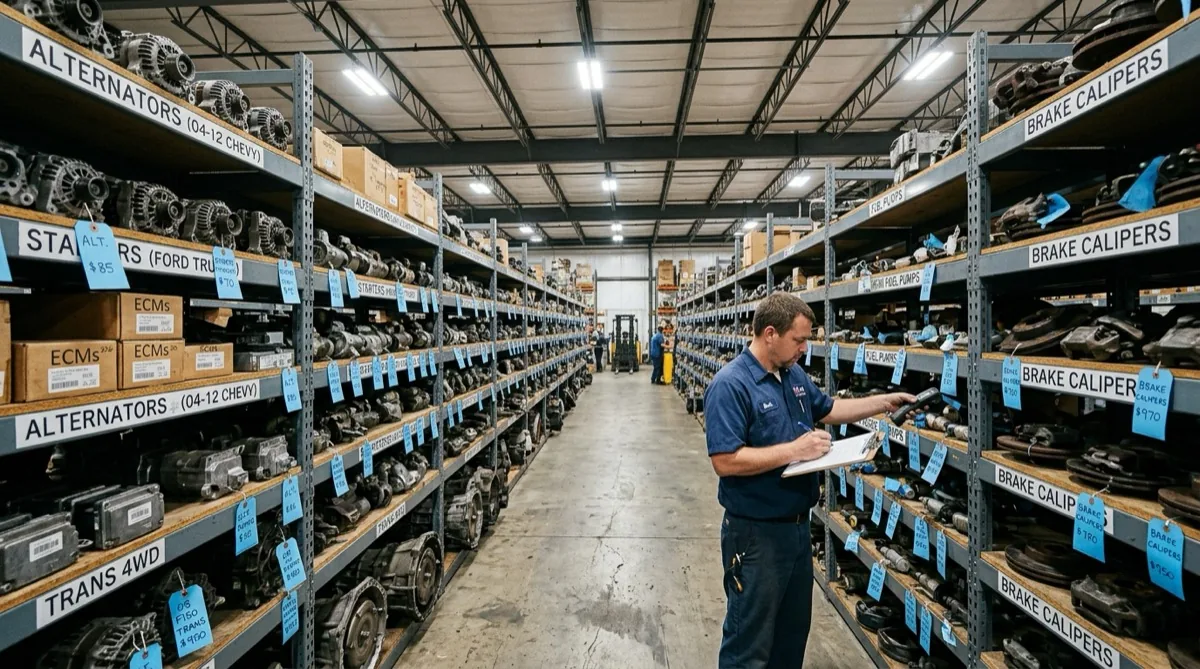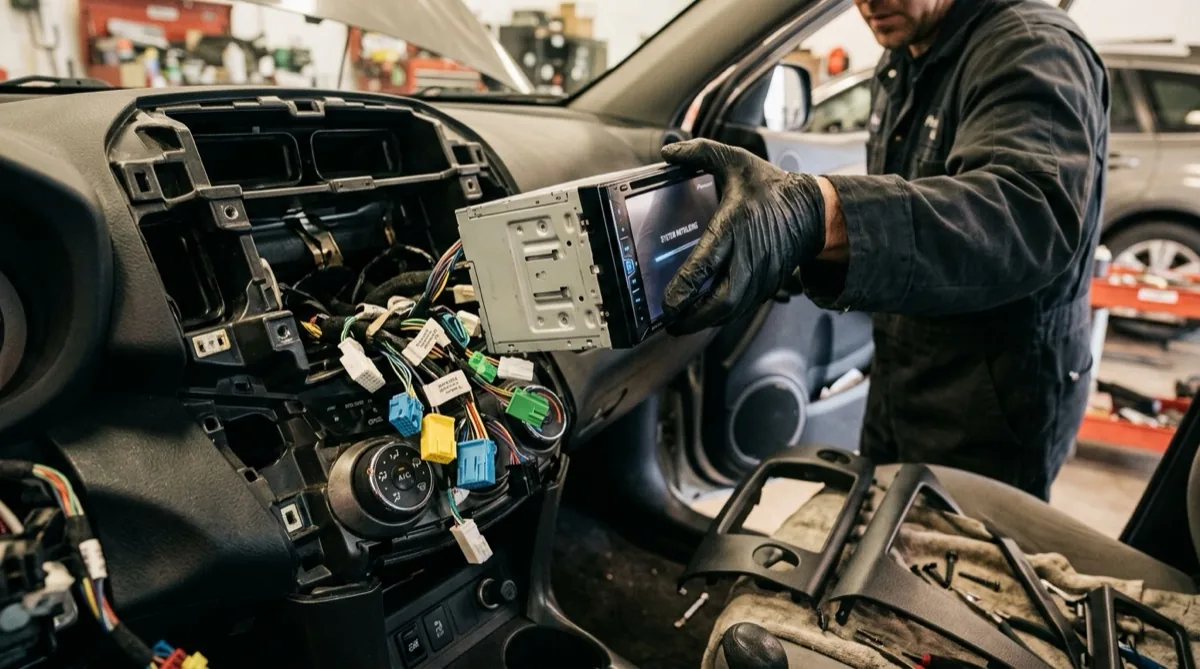
Replacing a car radio costs $158 to $958 total when you install a used head unit from a salvage yard, with the part running $202 median across our index of 63 vehicle models. Going aftermarket with a new Pioneer or Kenwood unit lands between $148 to $800 total, while a new OEM replacement, especially for integrated touchscreen systems, pushes the bill to $248 to $1,500 or more.
The wide cost range comes down to one question: does your vehicle have a standard radio slot or an integrated infotainment system? A 2010 Honda Civic with a basic double-DIN radio is a 30-minute swap. A 2022 Toyota RAV4 with a touchscreen that controls climate, backup camera, and vehicle settings is a different job entirely.
- Total cost with a used head unit: $158 to $958. $202 median part plus $48 to $300 labor
- New aftermarket (Pioneer, Kenwood, Alpine): $100 to $500 for the unit, plus $48 to $300 labor
- New OEM replacement: $200 to $1,200+ for the part, higher for integrated touchscreen infotainment
- Labor runs 0.5 to 2 hours at $95 to $150/hr, with most standard radio swaps under an hour
- Dataset: 60 radio models across 63 vehicle models, August 2026
What It Costs
Car radio replacement breaks into the part and the labor. Labor varies more by vehicle generation and dash design than by the radio itself, so a simple swap in a 2008 truck and a complex replacement in a 2023 crossover are different jobs at different prices.
| Cost Component | Used OEM | New Aftermarket | New OEM / Integrated |
|---|---|---|---|
| Part cost | $110 to $658 (median $202) | $100 to $500 | $200 to $1,200+ |
| Labor (0.5 to 2 hrs) | $48 to $300 | $48 to $300 | $48 to $300 |
| Dash kit + harness adapter | $0 (OEM fit) | $30 to $90 | $0 (OEM fit) |
| Total | $158 to $958 | $178 to $890 | $248 to $1,500+ |
*Part pricing source: PartPriceGuide.com analysis of salvage yard listings across 63 vehicle models, August 2026.*
Factory Radio vs Aftermarket Head Unit
The choice between a factory replacement and an aftermarket head unit depends on what your vehicle needs from its radio.
Factory (OEM) replacement is the simpler path when it works. The radio plugs directly into the existing harness, fits the dash opening without adapters, and retains all factory functions: steering wheel controls, backup camera feed, OnStar or similar telematics, and any CAN bus features tied to the audio system. A used OEM unit from a salvage yard for $110 to $658 drops into the same slot the old one came from. The catch is that used OEM radios may be VIN-locked or require an anti-theft code from the original vehicle.
Aftermarket head units from Pioneer, Kenwood, Alpine, and Sony offer better features per dollar: Apple CarPlay, Android Auto, higher-wattage amplifiers, and better touchscreen resolution than many factory units, often for $100 to $300. The tradeoff is integration work.
To install an aftermarket unit in a factory slot, you need:
- Dash kit ($15 to $50): a plastic frame that adapts the aftermarket radio's standard DIN dimensions to your vehicle's dash opening
- Wiring harness adapter ($15 to $40): converts the vehicle-specific plug to the universal ISO or aftermarket connector
- Steering wheel control interface ($30 to $100): needed if you want to keep volume, track skip, and voice buttons on the steering wheel functional
- Backup camera retention harness ($20 to $60): routes the existing backup camera signal to the new head unit's video input
On vehicles built before roughly 2012, these adapters are straightforward and widely available. On newer vehicles where the radio shares a CAN bus with climate control, parking sensors, or driver assist systems, aftermarket replacement gets complicated or impractical. Check current car radio pricing by make and model before deciding between OEM and aftermarket.
Modern Infotainment Complications
Vehicles built after 2015 increasingly use integrated infotainment systems that bundle audio, climate control, navigation, backup camera, and vehicle settings into a single touchscreen. This integration creates several cost problems when the unit fails.
The radio is no longer just a radio. On a 2023 Honda CR-V, the 7-inch touchscreen controls HVAC temperature and fan speed, displays the backup camera, shows tire pressure readings, and handles phone pairing. When this screen dies, you lose access to all those systems, not just the music. Replacing it requires an OEM unit because no aftermarket radio can replicate all those CAN bus functions.
Used infotainment units cost more. Where a basic used car radio runs $110 to $250, a used integrated touchscreen infotainment unit ranges from $400 to $658 in our salvage data, and some luxury models command even higher prices on the secondary market. The hardware includes a high-resolution LCD, GPS antenna, multiple CAN bus interface modules, and sometimes a separate amplifier board.
Software pairing adds labor time. Many integrated infotainment systems need to be paired or programmed to the vehicle's body control module (BCM) after installation. This requires a dealer-level scan tool, OEM software access, or a trip to the dealership. Programming alone costs $50 to $150 on top of the physical installation.
Apple CarPlay and Android Auto retrofits are a partial workaround. If the factory screen still functions but lacks wireless phone projection, a CarPlay retrofit module ($100 to $250 installed) adds the feature without replacing the entire unit. This only helps when the screen works but lacks features, not when the unit has failed.
For vehicles where the factory infotainment has failed entirely, the realistic options are a used OEM replacement from a salvage yard or a new OEM unit from the dealer at $800 to $1,200+. Aftermarket replacements exist for some popular models (Toyota, Honda, Hyundai) as Android-based units that mimic the factory screen layout, but compatibility varies and installation is a 2 to 4 hour job.
Anti-Theft Codes and Pairing
Many factory radios include an anti-theft system that locks the unit when battery power is interrupted. This matters when you install a used radio from a different vehicle, or even when you reinstall your own radio after a battery replacement.
How it works. The radio stores a numeric code (usually 4 to 6 digits) and enters a locked state when it detects a power loss. Without the correct code, the radio displays "CODE" or "LOCKED" and won't function. Honda, Acura, and Volkswagen are the most common brands with this system, but Ford, Chrysler, and several European manufacturers use variations of it.
Getting the code for your own radio is usually free. Honda owners can retrieve it online through the Honda Radio Code website using the VIN and radio serial number. Most other brands provide the code through the dealer service department with proof of ownership.
Used radios from other vehicles are where anti-theft codes become a cost factor. The code is tied to the unit, not the vehicle. If the previous owner didn't provide the code, the salvage yard may not have it. Dealer reprogramming to clear the code and assign a new one costs $50 to $150, depending on the brand.
VIN-locked units go a step further. Some newer vehicles, particularly from GM and Ford, pair the radio's serial number to the vehicle's VIN at the factory. Installing a used radio from a different vehicle triggers a mismatch that requires dealer-level programming to resolve. This programming typically costs $75 to $150 and requires the vehicle to be at the dealership.
Before buying a used radio, confirm with the seller whether the anti-theft code is included. Some salvage yards provide the code when available, while others sell the unit as-is. Factor in $50 to $150 for dealer programming if the code is unknown. Check our used auto parts pricing guide for more on what to expect when sourcing parts from salvage yards.
DIY Installation
A car radio swap is one of the more accessible automotive DIY jobs, especially on vehicles with standard single-DIN or double-DIN radio slots. The labor savings of $48 to $300 often make it worth the effort.
Tools needed. A plastic trim removal set ($8 to $15), a Phillips screwdriver, and a set of DIN removal keys if your vehicle uses them (about $5). Some vehicles use hidden spring clips instead of screws, and the DIN keys release these clips through small holes in the radio face plate.
The basic process:
- Disconnect the negative battery terminal
- Pry off the surrounding dash trim panel using the plastic trim tool (start at a corner, work around the edges)
- Remove the four screws or release the spring clips holding the radio in place
- Slide the radio out and unplug the wiring harness and antenna cable from the back
- If installing an aftermarket unit, connect the wiring harness adapter and mount the dash kit first
- Plug in the new unit, slide it into place, and secure with screws or the mounting sleeve
- Reattach trim panels and reconnect the battery
Time estimate. A straightforward swap on a vehicle with an accessible radio slot takes 30 to 60 minutes for a first-timer. Vehicles with layered dash trim, hidden fasteners, or multiple trim pieces can push to 90 minutes. The job rarely exceeds 2 hours even on complex dashboards.
What to watch for. Fragile trim clips are the main risk. Older vehicles (10+ years) have brittle plastic clips that snap easily. Replacements cost a few dollars at the dealer parts counter but add a trip if you break one mid-job. Use a plastic pry tool, never a metal screwdriver, to pop trim panels.
When to skip the DIY. If your vehicle has an integrated infotainment system that requires dealer programming after installation, the physical swap is still manageable, but the software pairing step means a dealership visit regardless. On these vehicles, having the shop do the full job avoids paying for programming on top of your own installation time.
The wiring harness adapters and dash kits are vehicle-specific. Crutchfield provides a fitment tool that identifies the exact adapter kit for your make, model, and year, and includes it free with aftermarket radio purchases.