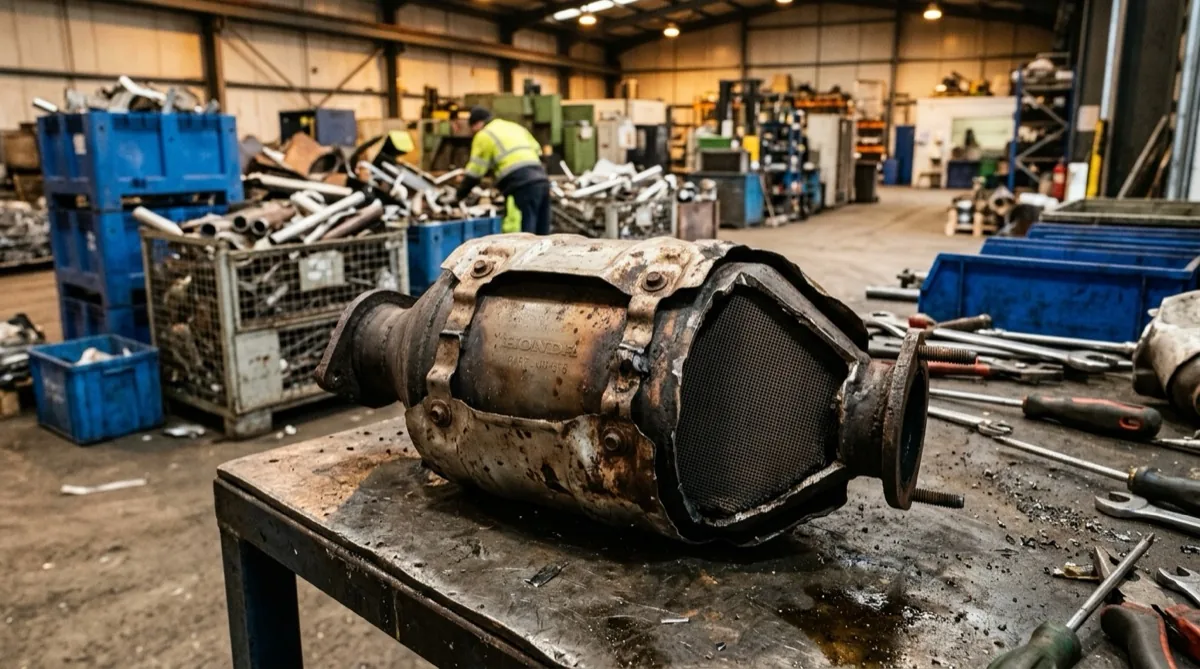
Most catalytic converters are worth $50 to $800 in scrap, with rare OEM units from high-value vehicles occasionally exceeding $1,000. The value comes entirely from the precious metals inside: platinum, palladium, and rhodium. Recyclers extract these metals through smelting and refining, then sell them on commodity markets.
That wide range reflects an equally wide gap in precious metal loading. A cheap aftermarket converter might hold under a gram of catalyst material and fetch $10 to $50. An OEM converter from a Toyota Prius, which packs some of the highest rhodium and palladium concentrations of any production vehicle, can bring $300 to $800 depending on current spot prices.
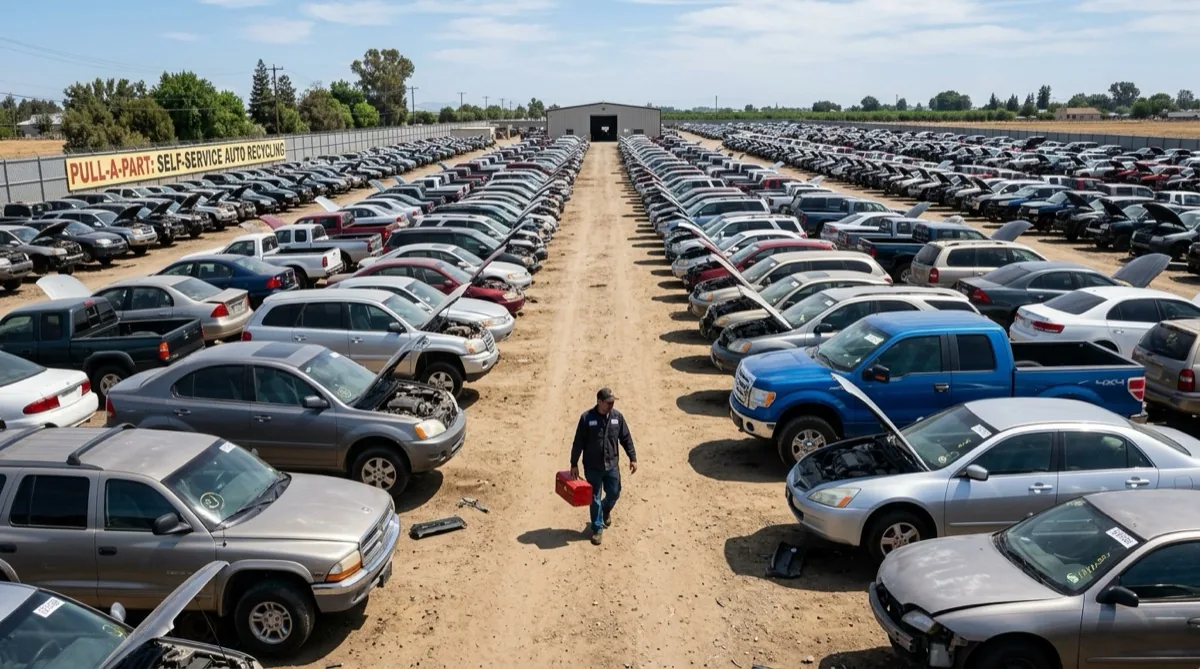
Unlike most auto parts, catalytic converters are not available at salvage yards. Junkyards sell the precious metals to recyclers rather than reselling the converters as used parts. If you need a replacement, aftermarket EPA-compliant converters are the standard budget option.
[INTERNAL-LINK: "catalytic converter replacement cost" -> /blog/repair-costs/catalytic-converter-replacement-cost]
- Most converters scrap for $50-$800. Rare OEM units from hybrids or large trucks can exceed $1,000
- OEM converters are worth 5-20x more than aftermarket because they contain significantly more precious metal
- Rhodium is the primary value driver, trading at $4,500-$5,500 per ounce as of mid-2026
- Toyota Prius and large Ford/GM truck converters command the highest prices due to high precious metal loading
- Serial number identification is critical for accurate pricing, as recyclers maintain code-based pricing databases
- Most states now regulate converter sales with ID requirements, proof of ownership, and waiting periods
Scrap Value Ranges by Converter Type
Scrap value depends primarily on whether the converter is OEM or aftermarket, and secondarily on the vehicle it came from. OEM converters contain substantially more precious metal than aftermarket replacements because automakers engineer higher catalyst loading for durability and emissions compliance across the converter's full service life.
| Converter Type | Typical Scrap Value | Precious Metal Content |
|---|---|---|
| OEM, hybrid vehicles (Prius, Camry Hybrid) | $300-$800 | 5-7 grams PGMs, high rhodium ratio |
| OEM, large trucks/SUVs (F-250, Silverado HD) | $200-$600 | 4-7 grams PGMs, large substrate |
| OEM, standard passenger vehicles | $100-$350 | 3-5 grams PGMs |
| OEM, small/compact vehicles | $50-$200 | 2-4 grams PGMs |
| Aftermarket direct-fit (EPA) | $15-$50 | 1-2 grams PGMs |
| Universal/generic | $5-$20 | Under 1 gram PGMs |
Vehicles with dual exhaust systems often have two or more converters. A full-size truck with four catalytic converters can yield $800 to $2,000 in combined scrap value, which explains why these vehicles are frequent theft targets.
What Determines a Catalytic Converter's Scrap Value
Three factors control what a recycler will pay for a converter: precious metal spot prices, the converter's metal loading, and substrate condition. Metal spot prices fluctuate daily and set the ceiling for what any converter can be worth.
Precious Metal Spot Prices
The three platinum group metals inside every catalytic converter trade on global commodity markets. Their prices set the baseline for all converter scrap values.
| Metal | Mid-2026 Spot Price (per troy ounce) | Role in Converter | Share of Scrap Value |
|---|---|---|---|
| Rhodium | $4,500-$5,500 | Reduces nitrogen oxides (NOx) | 50-70% |
| Palladium | $950-$1,100 | Oxidizes hydrocarbons and carbon monoxide | 20-35% |
| Platinum | $950-$1,050 | Oxidizes hydrocarbons and carbon monoxide | 10-20% |
Rhodium dominates converter scrap value despite being present in the smallest quantity by weight. Its extreme per-ounce price means that even a fraction of a gram significantly impacts what a recycler will pay. When rhodium spiked above $25,000 per ounce in March 2021, scrap converter prices roughly tripled, and converter theft rates rose in tandem.
Precious Metal Loading
OEM converters contain more catalyst material than aftermarket units because automakers design for the full 100,000 to 150,000 mile emissions warranty period. An OEM converter for a Toyota Prius contains roughly 5 to 7 grams of platinum group metals, while an aftermarket EPA-compliant replacement for the same vehicle contains 1 to 2 grams.
Hybrid vehicles have the highest loading of any production category. Because a hybrid's gasoline engine cycles on and off, the converter operates at lower average temperatures. Manufacturers compensate by increasing the precious metal concentration so the converter can still catalyze exhaust reactions efficiently during shorter, cooler operating windows.
Substrate Condition
The ceramic honeycomb inside the converter holds the precious metals. If the substrate is cracked, melted, or missing fragments, the recoverable metal decreases and so does the scrap value. Recyclers discount converters with visible substrate damage by 20 to 40 percent. A converter that has been gutted (substrate removed) has no scrap value.
Highest-Value Catalytic Converters
Certain vehicle models produce converters that consistently command premium scrap prices. The common thread is high precious metal loading, driven by either emissions engineering requirements or large converter volume.
| Vehicle / Converter | Approximate Scrap Value | Why It's Valuable |
|---|---|---|
| Toyota Prius (2004-2022) | $300-$800 | Highest rhodium concentration of any mainstream vehicle |
| Ford F-250/F-350 Super Duty | $250-$600 | Large-body converter with high total PGM content |
| Chevrolet Silverado 2500HD/3500HD | $200-$550 | Heavy-duty diesel converters with substantial substrate |
| Toyota Tundra | $200-$500 | Large truck converter with above-average loading |
| Honda Accord (2008-2020) | $150-$400 | High palladium concentration relative to size |
| BMW X5 / X3 | $150-$400 | European emissions standards require higher catalyst loading |
| Ford Mustang GT (V8) | $150-$350 | Dual converters with moderate individual loading |
Large diesel truck converters rank high for a different reason: sheer volume. While their per-gram precious metal concentration may be lower than a Prius converter, the physical size of the substrate means more total recoverable metal.
[INTERNAL-LINK: "high-theft vehicles" -> /blog/repair-costs/catalytic-converter-replacement-cost#high-theft-vehicles-and-prevention]
How Recyclers Grade and Price Converters
Certified precious metal recyclers use a systematic process to determine what they will pay for a converter. Understanding this process helps sellers set realistic expectations and recognize fair offers.
Serial Number Identification
Every OEM catalytic converter has a serial number or stamp code on the heat shield or converter body. Recyclers maintain proprietary databases that map these codes to expected precious metal content. Providing the serial number is the fastest way to get an accurate quote, and most recyclers will not offer a price without one.
The serial number tells the recycler which automaker, vehicle platform, and production era the converter came from. A 2010 Prius converter and a 2018 Prius converter have different stamp codes and different precious metal profiles, so their scrap values differ even though they fit the same vehicle family.
Visual Grading
After identifying the converter by serial number, recyclers inspect the physical condition. They check for substrate completeness (no missing chunks), heat damage (melted or discolored areas), and signs of contamination (oil fouling, coolant intrusion). A converter in clean, complete condition receives full book value. Damaged units receive a graded discount.
Assay-Based Pricing
For high-value converters or large lots, recyclers offer assay-based pricing. An assay involves cutting open the converter, sampling the substrate, and sending it to a lab for X-ray fluorescence (XRF) or inductively coupled plasma (ICP) analysis. The lab reports the exact platinum, palladium, and rhodium content in parts per million.
Assay pricing is the most accurate method but takes 2 to 4 weeks for results and is only cost-effective for converters worth $200 or more individually, or for bulk lots. Most individual sellers receive serial-number-based pricing, which is faster and sufficiently accurate for common converter types.
Recycler Margins
Recyclers typically pay 70 to 85 percent of the recoverable metal value. The margin covers smelting costs, refining losses (2 to 5 percent of metal is lost in processing), lab fees, and business overhead. A converter containing $500 worth of precious metals at spot prices might yield a $350 to $425 payout to the seller.
[CHART: Bar chart - Scrap value breakdown showing spot metal value vs. typical recycler payout vs. seller net after processing fees - source: industry recycler margin analysis]
Where to Sell a Catalytic Converter
Four main channels exist for selling scrap catalytic converters. They differ in price, convenience, and regulatory compliance.
Certified Precious Metal Recyclers
Certified recyclers (IRAS-accredited or state-licensed) offer the highest payouts because they process converters in-house rather than reselling to middlemen. They use serial number databases and, for high-value units, assay-based pricing. Expect 75 to 85 percent of recoverable metal value.
Reputable recyclers include PMR (Precious Metal Refining), SK Precious Metals, and regional IRAS-member operations. Most accept shipments nationwide and provide prepaid shipping labels for lots above a minimum value.
Scrap Metal Yards
Local scrap yards buy converters but typically pay less than certified recyclers, offering 50 to 70 percent of recoverable value. They act as aggregators, collecting converters and selling them in bulk to refiners. The convenience of a local drop-off can offset the lower price for sellers with just one or two converters.
Online Buyer Platforms
Several online platforms specialize in catalytic converter purchasing. Sellers photograph the converter and serial number, upload images, and receive a quote. If accepted, the platform sends a prepaid shipping label. Payouts vary widely, so comparing quotes across two or three platforms is worthwhile.
Auto Repair Shops and Muffler Shops
When a shop replaces your catalytic converter, the old converter becomes a negotiation point. Some shops offset the repair bill by crediting the scrap value of the old converter. Others keep it as a standard business practice. Ask before the repair whether you can retain the old converter or receive a credit for its scrap value.
Legal Considerations
Catalytic converter theft has driven significant legislative changes across the United States. Most states now regulate the sale of detached catalytic converters, and the penalties for selling stolen units have escalated sharply.
State-Level Regulations
As of 2026, at least 40 states have enacted laws governing catalytic converter sales. While specific requirements vary, common provisions include:
Seller identification. Nearly all states require government-issued photo ID from the seller. Many also require a thumbprint or photograph.
Proof of ownership. Most states require documentation proving the seller legally owns the converter. Acceptable proof typically includes a vehicle title, registration matching the seller's ID, a bill of sale from a licensed auto business, or a business license for auto repair or salvage operations.
Waiting periods. Several states impose a 3 to 10 day waiting period between the sale transaction and payment. The delay gives law enforcement time to check the converter against theft reports.
Business-only sales. Some states, including Illinois and Minnesota, restrict converter sales to licensed auto recyclers, repair shops, or salvage businesses. Individual sellers in these states must go through a licensed intermediary.
Record keeping. Buyers must maintain detailed records of each transaction, including the seller's ID information, converter description, serial numbers, and vehicle information. Records must be available for law enforcement inspection.
Federal Regulations
Under the Clean Air Act, removing a catalytic converter from a vehicle that is still in use (and not scrapping the entire vehicle) is a federal violation. Selling a converter as a replacement part without EPA certification is also prohibited. These federal rules apply alongside state regulations.
Penalties
Selling a stolen catalytic converter is a felony in many states, carrying penalties of 1 to 10 years imprisonment and fines up to $25,000. Even possessing multiple detached converters without documentation can trigger criminal investigation in some jurisdictions. Legitimate sellers should maintain a clear paper trail connecting each converter to a vehicle they owned or serviced.
[INTERNAL-LINK: "converter theft prevention" -> /blog/repair-costs/catalytic-converter-replacement-cost#high-theft-vehicles-and-prevention]