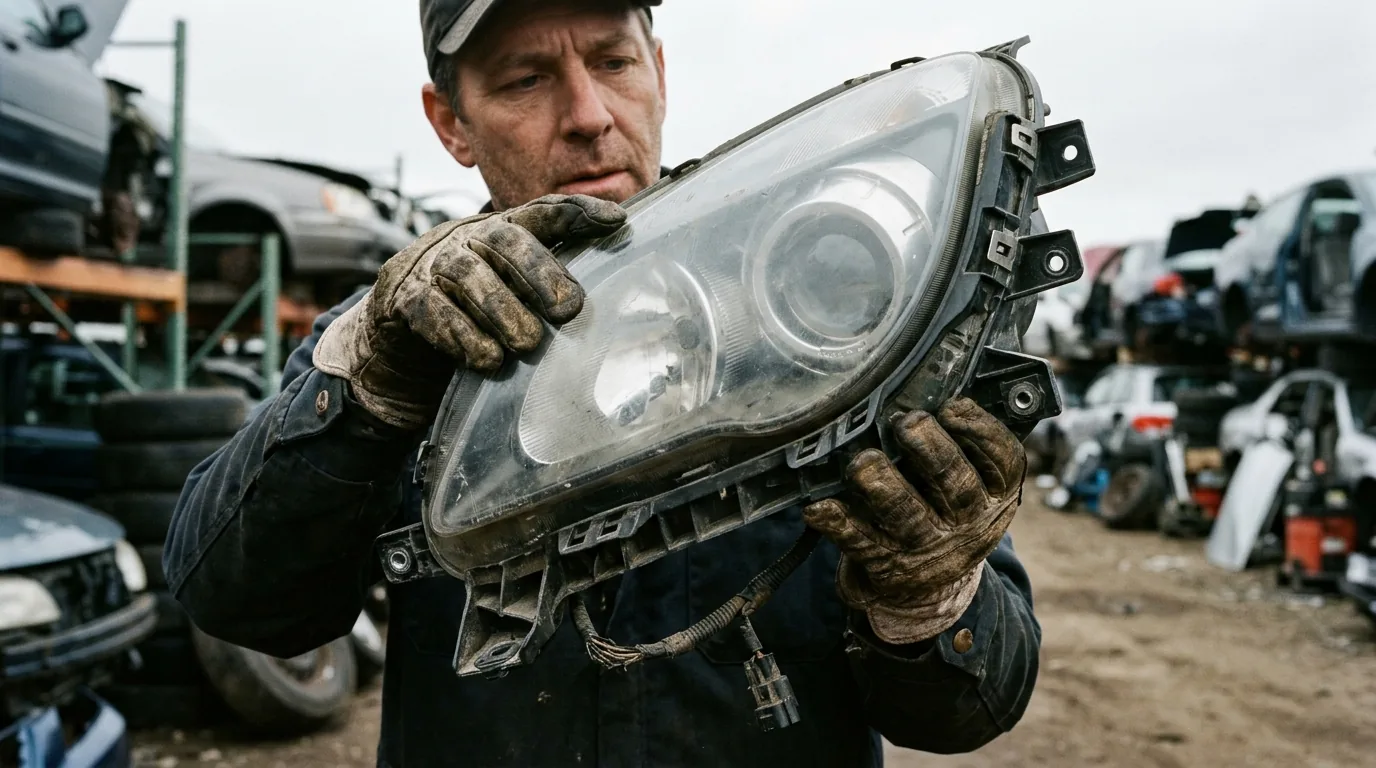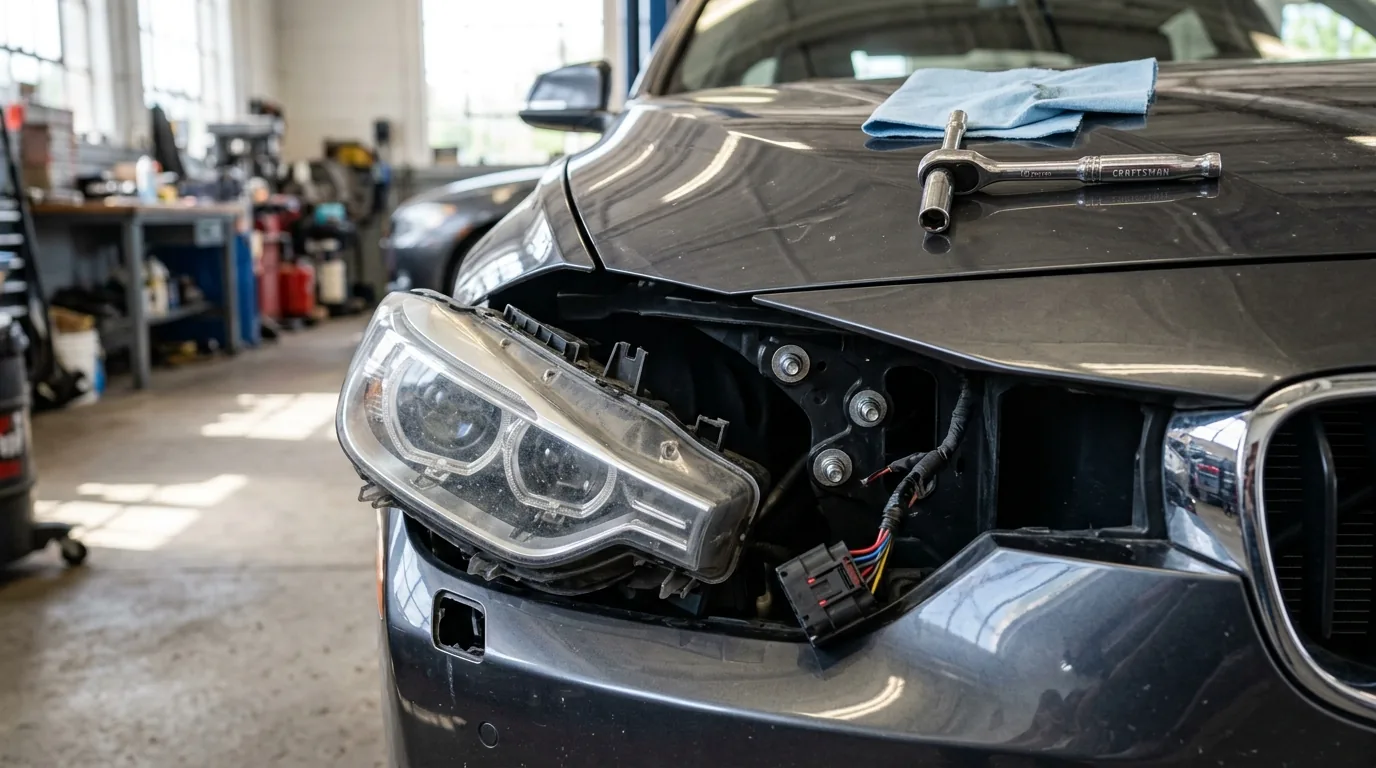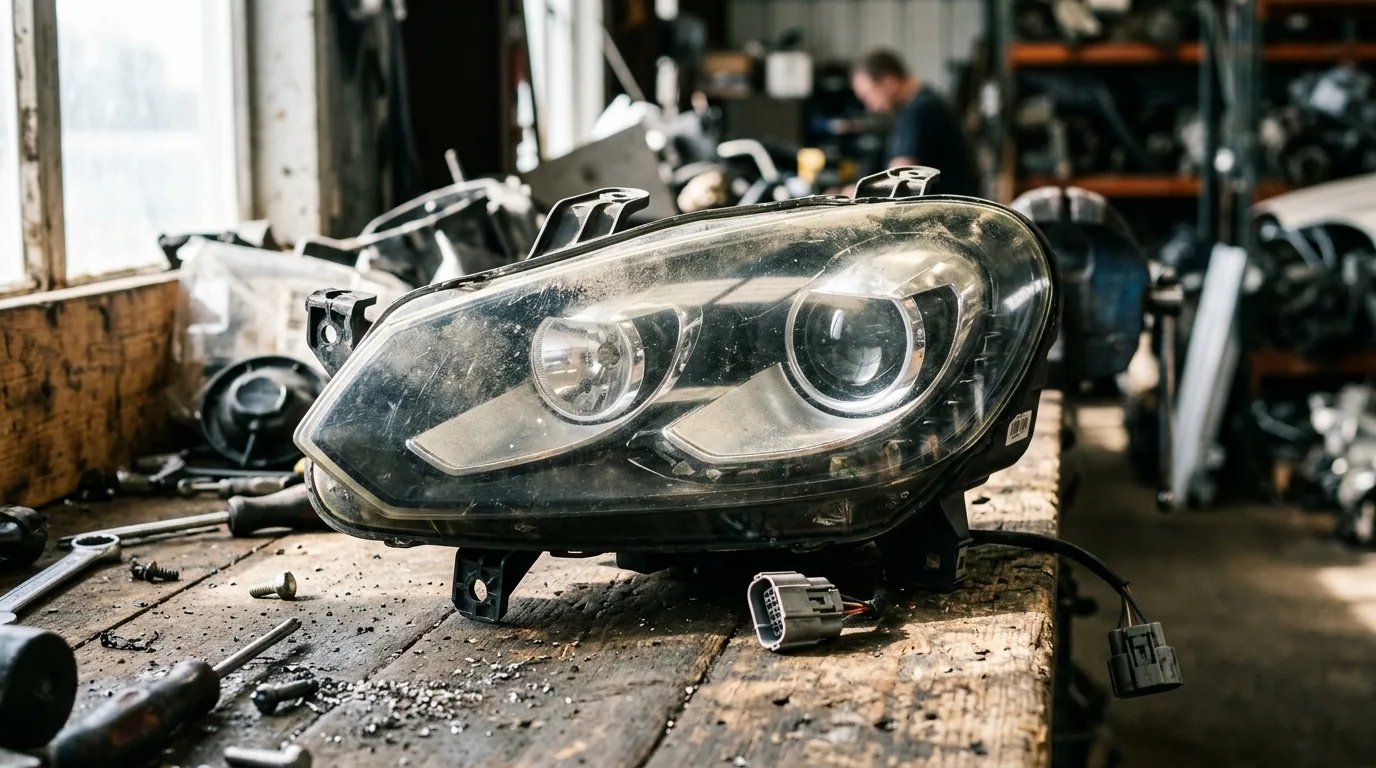
A used OEM headlight assembly costs $650 median across 76,427 salvage yard listings, while a new aftermarket assembly costs $60 to $300, but for most vehicles the used OEM unit is still the better buy. Headlights are the rare part where the cheap new option is genuinely worse, because an aftermarket assembly is an optical copy of the original, and optical copies are hard to get right.
That flips the usual salvage-yard logic. On radiators, alternators, and brake components, a new aftermarket part frequently matches or beats a used one on both price and quality. On headlights, the aftermarket discount buys you a beam pattern the factory never signed off on.
- Used OEM: $650 median across 76,427 salvage yard listings, range $187–$1,800 by model and technology
- New aftermarket: $60–$300, dramatically cheaper, but beam pattern, sealing, and fitment quality vary wildly
- New OEM: $300–$3,000+, with adaptive LED assemblies at the top end
- Beam pattern is a safety issue, not a preference, bad optics either fail to light the road or throw glare into oncoming traffic
- Used OEM is strongest on LED, projector, and adaptive headlights; aftermarket is defensible on basic halogen assemblies for economy cars
Price Comparison
| Factor | Used OEM | New Aftermarket | New OEM |
|---|---|---|---|
| Price range | $187–$1,800 | $60–$300 | $300–$3,000+ |
| Typical cost | $650 median | ~$140 | ~$700 |
| Warranty | 30–90 days | 1 year typical | 1–2 years |
| Beam pattern | Factory spec | Variable, often out of spec | Factory spec |
| DOT/SAE compliance | Original certification | Claimed, inconsistently verified | Original certification |
| Housing seal | Factory ultrasonic weld | Often adhesive bead | Factory ultrasonic weld |
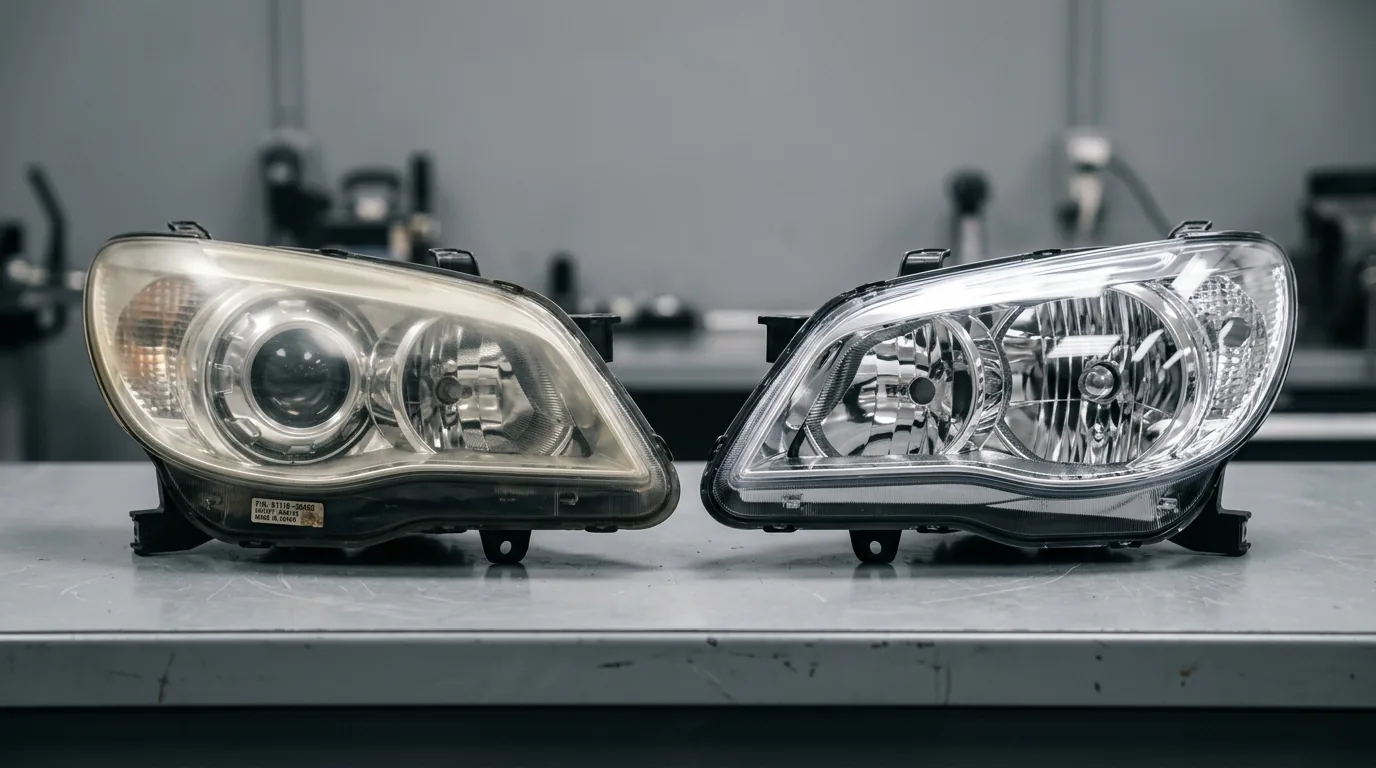
| Lens condition | Some UV hazing likely | New, clear | New, clear |
| Fitment | Exact (OEM part number) | Gaps and alignment issues common | Exact |
What the table shows is where that $510 goes. You're not buying a discount on the same part; you're buying a different part that happens to bolt into the same hole.
*Used pricing source: PartPriceGuide.com analysis of 76,427 salvage yard listings, August 2026.*
Why Aftermarket Headlights Have Quality Issues
Most auto parts are mechanical. A radiator moves heat, a brake rotor absorbs it, a starter turns a ring gear. Manufacturing tolerance affects longevity, but a slightly imperfect radiator still cools.
A headlight is an optical instrument mounted on a moving vehicle. Three things have to be right simultaneously, and budget manufacturing gets all three wrong in predictable ways.
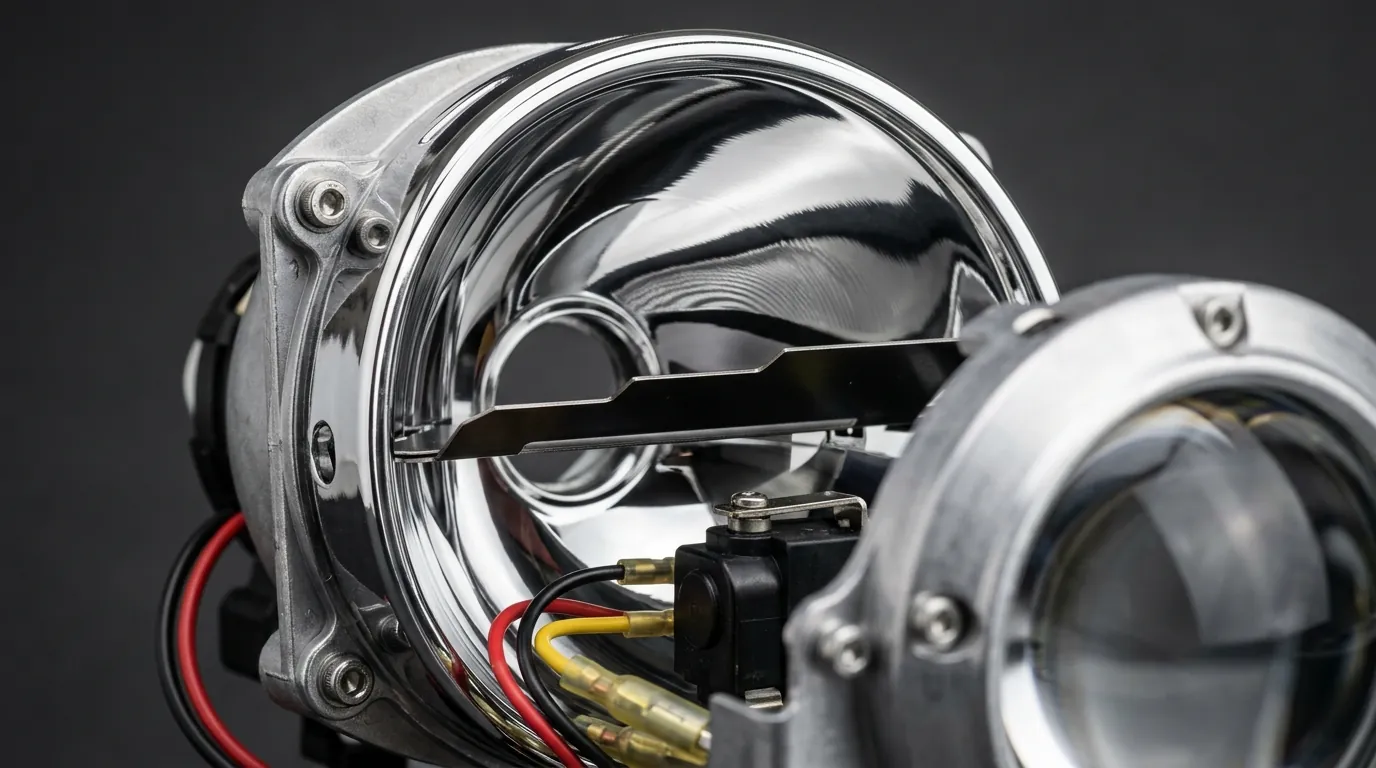
Reflector and lens geometry. The internal reflector bowl, the projector lens, and the cutoff shield are shaped to distribute light into a specific pattern: bright on the road ahead, sharply cut off below the eye line of oncoming drivers, with controlled spread onto the shoulder. Reproducing that requires the original optical design data, precise mold tooling meeting SAE International beam pattern standards, and consistent metallization on the reflector. Aftermarket manufacturers reverse-engineer the shape from a sample part. Small deviations that would be invisible on a bracket become visible as light in the wrong places.
Housing sealing. OEM assemblies join the lens to the housing with an ultrasonic weld or a heat-staked seal designed around the specific thermal cycling of that vehicle's engine bay, and vent through a breather tube fitted with a moisture-permeable membrane. Many budget aftermarket units substitute an adhesive bead and an unfiltered vent. After a few dozen heat-and-cool cycles, the bead develops micro-gaps, humid air gets in, and condensation forms on the inside of the lens where you can't reach it.
Mounting and fitment. Headlight assemblies mount on thin plastic tabs that also set the panel gap against the hood, fender, and bumper cover. Aftermarket tabs are frequently a millimeter or two off, which shows up as an uneven gap, a lens that sits proud of the fender, or an adjuster screw that runs out of travel before the beam is aimed correctly.
None of these are universal. Reputable brands like Depo, TYC, and Hella produce assemblies that are genuinely fine on common vehicles. The problem is that the low end of the market, the $60 to $90 listings that make aftermarket attractive in the first place, is where all three failure modes cluster.
The Beam Pattern Problem
This is the part that separates headlights from every other cost-saving parts decision, and it deserves its own section because it's a safety issue rather than a durability one.
A correct low beam has a sharp horizontal cutoff, as defined by FMVSS 108 headlamp standards. Light goes onto the road and the right shoulder; almost nothing goes above the cutoff line where oncoming drivers' eyes are. That cutoff is produced by physical geometry inside the housing, the shield edge in a projector, the reflector facets and lens flutes in a reflector housing.
When an aftermarket assembly gets the geometry wrong, two things happen, usually together:
Light scatters above the cutoff. Oncoming and preceding drivers get glare. Their pupils constrict, their own forward visibility drops, and the risk transfers to people who never made a purchasing decision. This is the reason poorly executed aftermarket headlights draw complaints and, in some jurisdictions, inspection failures.
The hot spot weakens or moves. Light that escapes above the cutoff is light that is no longer on the road. A scattered pattern looks bright when you stand in front of the car, because you can see light everywhere, but it puts less usable illumination on the pavement at 200 feet. Drivers often describe the result as "brighter but I can see less," which is exactly what the physics predicts.
Aiming doesn't fix this. Adjusters move the whole pattern up, down, left, or right; they don't change its shape. If the cutoff is fuzzy or the hot spot is in the wrong place, aiming trades one problem for the other; aim it down to kill the glare and you shorten your own sight distance.
A used OEM assembly sidesteps all of it. The optics are the ones the vehicle was certified with, the DOT/SAE marking on the lens is the original, and the beam that comes out is the beam the engineers designed. A hazed lens can be polished; incorrect optical geometry can't be corrected at any price.
When Used OEM Is the Best Buy
For most vehicles on the road today, used OEM is the right answer. The case is strongest in these situations:
LED and projector headlights. These have the most complex optics and the widest quality gap. An LED assembly involves specific emitter placement, heat sinking, and a driver module; aftermarket versions frequently mismatch color temperature between the left and right sides, run hot enough to shorten emitter life, or produce a cutoff that looks nothing like the original.
Adaptive and curve-adaptive systems. If the assembly contains a leveling motor, a swivel actuator, or a bus-connected control module, aftermarket coverage is thin and frequently triggers dashboard faults. Used OEM is often the only option that integrates cleanly.
Any vehicle where only one side is damaged. A single aftermarket headlight next to an original one is visibly mismatched, different lens tint, different color temperature, different beam shape. Used OEM matches because it's the same part.
Vehicles under five years old. Aftermarket coverage for recent models is limited and the tooling is newest, meaning least refined. The used market, meanwhile, is well supplied by collision write-offs, which is exactly the donor you want: low mileage, minimal UV exposure on the lens.
Lease returns and resale-sensitive vehicles. Panel gaps and mismatched lenses are the kind of detail that shows up in an inspection or knocks a few hundred dollars off a trade-in appraisal.
The tradeoff is condition. Used lenses carry UV hazing, and mounting tabs on donor assemblies are commonly cracked from the collision that put the car in the yard. Searching Car-Part.com for your exact part number is the fastest way to compare condition grades across multiple yards. Our guide on how to buy a used headlight assembly covers what to inspect before you pay.
When Aftermarket Works
Aftermarket is a reasonable choice in a narrower set of cases, and it's worth being clear about them rather than dismissing the category:
Basic halogen reflector assemblies on economy cars. A simple halogen housing has the least complex optics and the deepest aftermarket competition. Established brands produce genuinely acceptable assemblies for a Civic, Corolla, Sentra, or Focus, and the price difference against a $400+ used OEM unit is hard to ignore.
Older, high-mileage vehicles. If the car is worth $2,500 and you plan to drive it another two years, a $90 assembly from a reputable brand is a rational allocation. Buy the brand, not the cheapest listing.
Discontinued models with no salvage supply. When the used market is empty and the dealer part is discontinued, aftermarket is the only path.
Cosmetic-only damage on a vehicle you will sell soon. A cracked lens on an otherwise working assembly is a cheap fix for curb appeal.
In every one of these, the advice is the same: buy from a named manufacturer with a track record, confirm the lens carries a DOT/SAE marking, and check the beam against a garage wall before you decide the job is done. The $60 unbranded listing is where the failure stories come from.
For a full picture of installed cost either way, see our headlight assembly replacement cost breakdown.
Warranty and Longevity Comparison
| Source | Warranty | What's Covered | Real-World Risk |
|---|---|---|---|
| Self-pull yard | 24–48 hour exchange | DOA only | Cracked mounting tabs, hazed lens |
| Counter-service yard | 30–90 days | Defective part only | Lens condition varies by donor |
| Aftermarket (budget) | 1 year | Part replacement | Moisture ingress, beam pattern, fitment gaps |
| Aftermarket (Depo/TYC/Hella) | 1 year | Part replacement | Low on halogen, moderate on LED |
| New OEM | 1–2 years | Part, sometimes labor at dealer | Very low |
Longevity works out differently than the warranty table suggests. An OEM assembly is engineered for the life of the vehicle, and its common failure mode is a hazed polycarbonate lens, which is cosmetic, gradual, and correctable with a restoration kit or a professional wet-sand and re-clear. A budget aftermarket assembly's common failure modes are moisture ingress and seal breakdown, which are progressive, not correctable, and end with buying the part twice.
That reframes the price gap. A $140 aftermarket assembly replaced twice in six years costs $280 in parts plus a second round of labor, against one $650 used OEM unit that continues doing its job. The used option still costs more on many vehicles, but the gap is smaller than the sticker suggests, and you get correct optics for the whole period.
For the full pricing breakdown by vehicle model, headlight technology, and condition grade, see used headlight assembly cost, and check live listings on the headlight assembly price index.