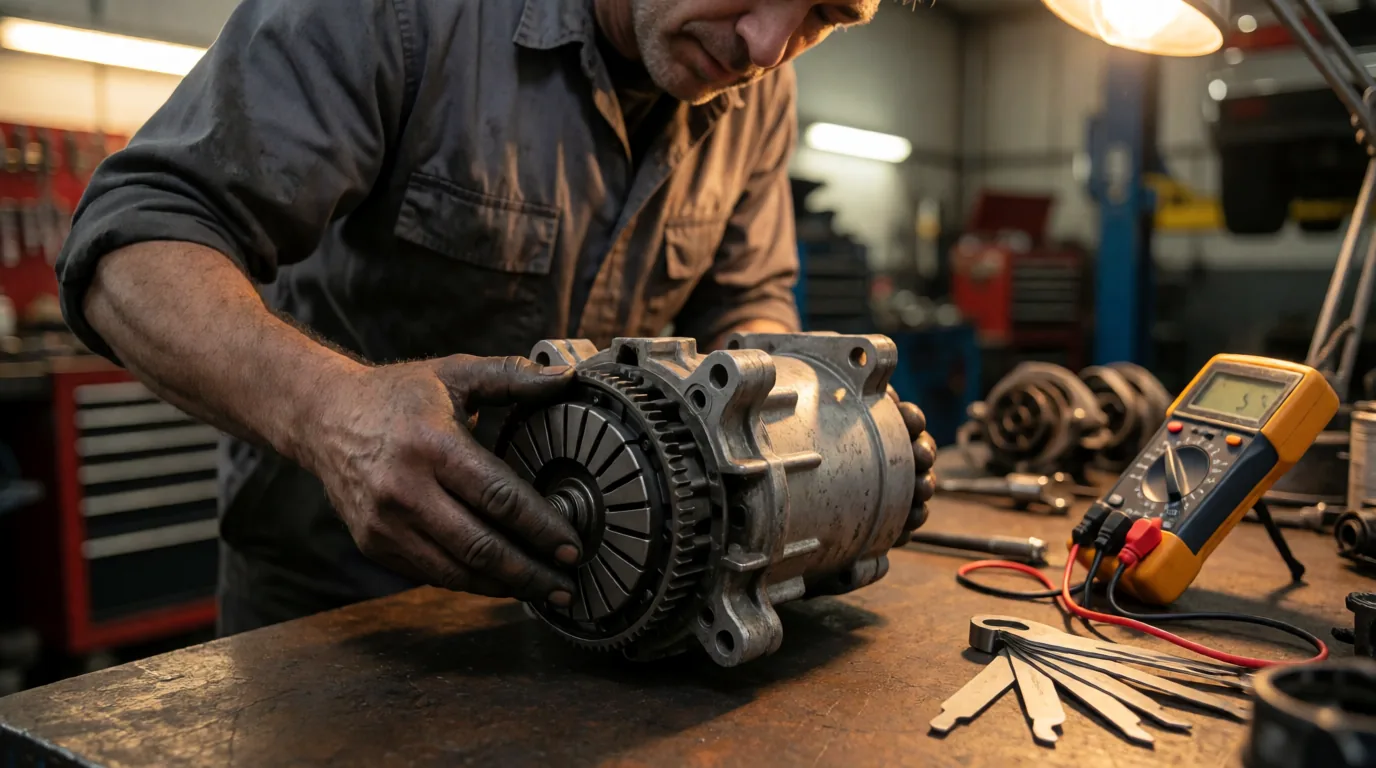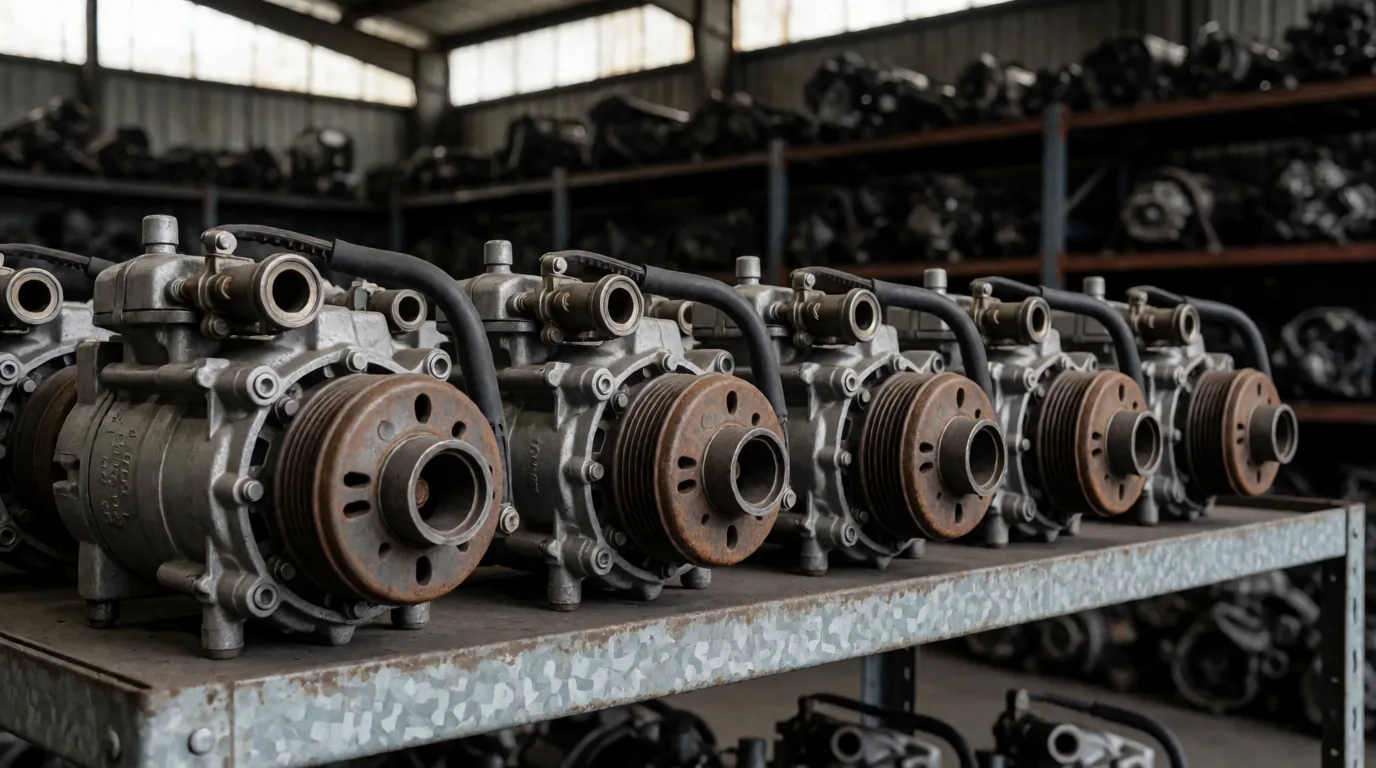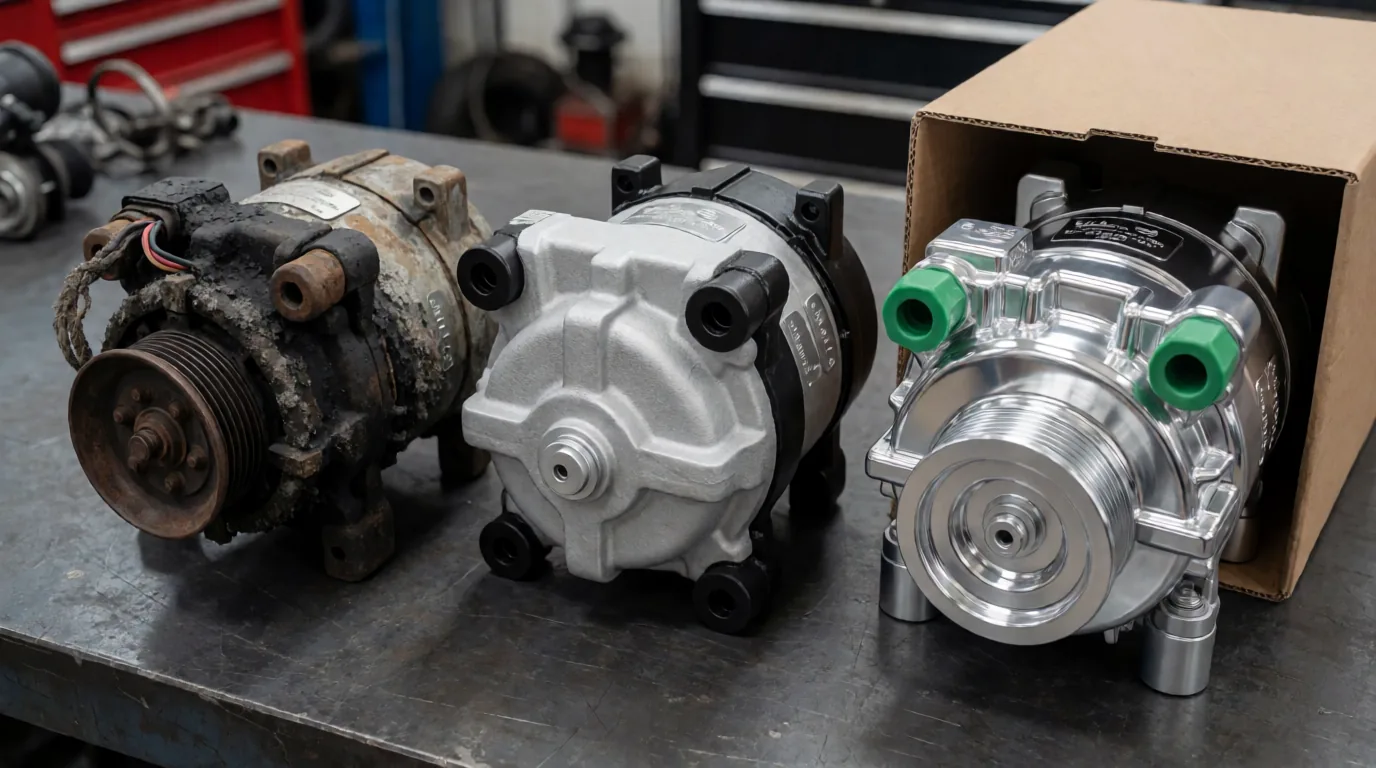
Buy used when you're doing the labor yourself and the old compressor failed from a leak. Buy remanufactured or new the moment a shop is turning the wrenches, because no salvage warranty covers the $300 to $500 it costs to install the part a second time.
The part prices make used look obvious: a $149 median against $400 to $900 new. The total-job math is much closer, and labor exposure is what flips it.
- Part cost: used $149 median, reman $180 to $350, new OEM $400 to $900 (used pricing from 22,777 salvage listings)
- Warranty is the real gap. 30 to 90 days used, 1 to 3 years reman, 1 to 3 years new
- Every option needs the same $250 to $500 in supporting parts and service, which compresses the percentage savings
- Break-even for a DIY installer: used stays cheaper until failure odds pass roughly 55 percent
- Break-even with $350 shop labor: reman wins once used failure odds pass roughly 25 percent
The Quick Answer
Used makes sense for DIY installers on vehicles worth under $12,000 where the old compressor leaked rather than seized. Remanufactured is the default recommendation for anyone paying shop labor, because the warranty outlives the window where infant failures happen — read more on whether a used AC compressor is worth the risk. New OEM is worth the premium on hybrids, R-1234yf systems under five years old, and vehicles you plan to keep past 150,000 more miles.
That's the whole decision in three sentences. The rest of this post shows the numbers behind it.
Used vs Reman vs New Compared
| Factor | Used | Remanufactured | New OEM |
|---|---|---|---|
| Part price | $100 to $267 median range | $180 to $350 | $400 to $900 |
| Typical price | $149 median | ~$250 | ~$550 |
| Warranty | 30 to 90 days | 1 to 3 years | 1 to 3 years |
| Labor covered by warranty | Almost never | Sometimes | Sometimes |
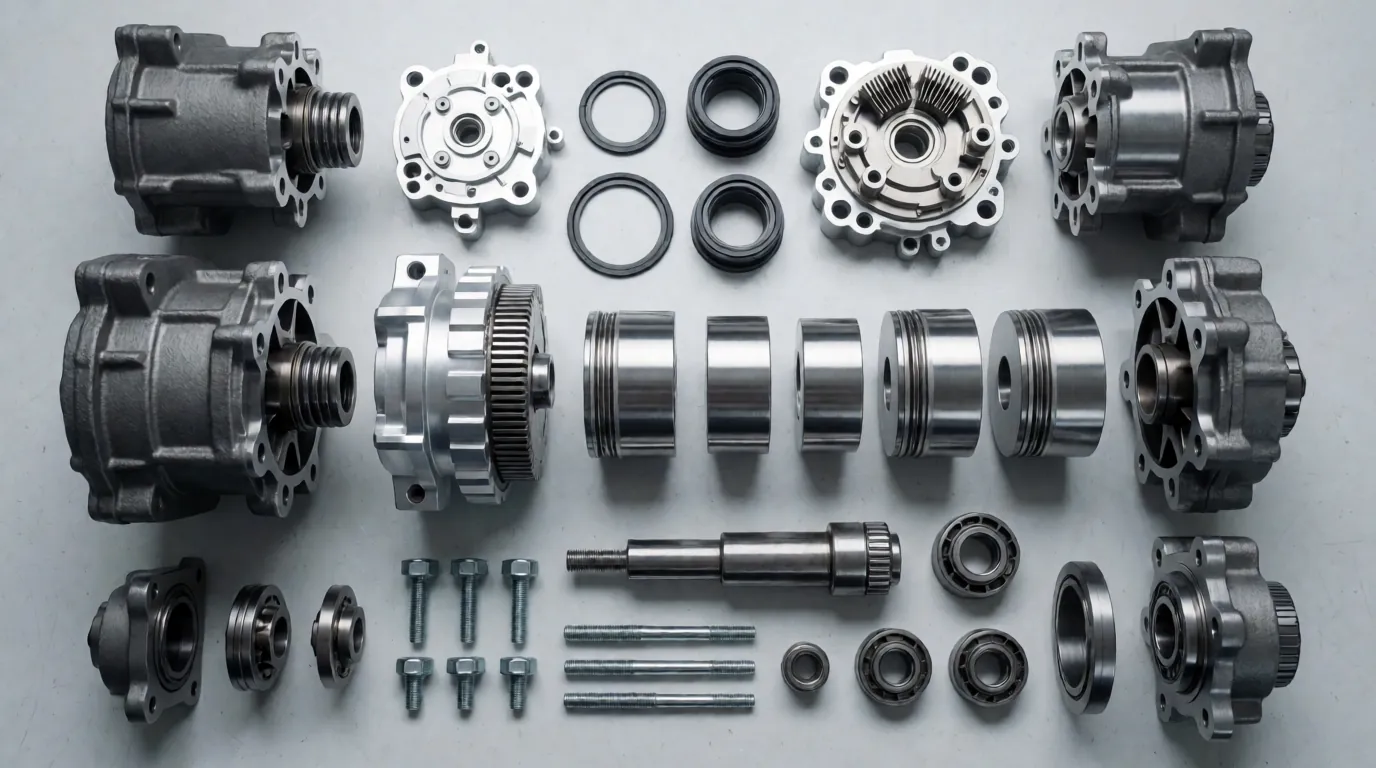
| What's replaced inside | Nothing | Seals, bearings, clutch, valve plate | Everything |
| Expected remaining life | 40k to 100k mi | 80k to 150k mi | 100k to 150k mi |
| Clutch condition | Donor mileage, unverifiable | New or rebuilt | New |
| Availability | Same day at yards | 1 to 3 day shipping | 1 to 7 days, sometimes special order |
| Oil charge included | Residual donor oil, must drain | Usually shipped dry | Usually shipped dry or pre-charged |
| Core charge | None | $30 to $80 | $30 to $80 |
The row that matters most is "what's replaced inside." A used compressor is a bet on the donor's remaining life. A reman is a rebuilt unit with the wear items renewed. That difference is exactly why the reman premium is only about $100 over used but the warranty stretches from 60 days to two years. See the grade breakdown on our AC compressor pricing page for how condition affects what you pay.
The Hidden Costs Nobody Quotes You
The supporting parts cost more than most people budget, and they're identical across all three options.
| Line Item | Cost | Required When |
|---|---|---|
| Receiver/drier or accumulator | $20 to $60 | Always |
| Orifice tube or expansion valve | $15 to $50 | Always |
| PAG or POE oil | $10 to $25 | Always |
| Evacuate and recharge (R-134a) | $120 to $200 | Always |
| Evacuate and recharge (R-1234yf) | $250 to $450 | Always, on 2015+ vehicles |
| System flush | $100 to $200 | After internal failure |
| Condenser replacement | $80 to $250 | After internal failure on parallel-flow systems |
| Shop labor | $150 to $400 | If not DIY |
That has an important implication people miss: the flush is not a used-compressor tax. It applies equally to the $900 new unit. When you compare options, put the flush on both sides of the ledger or you'll wrongly penalize the used route.
R-1234yf changes the arithmetic more than the compressor choice does. A yf recharge can run $250 to $450 because the refrigerant itself costs $80 to $150 per pound. On a 2018 vehicle, the recharge may cost more than a used compressor. When the service cost dominates, spending the extra $100 for a reman with a two-year warranty is easy to justify. Our breakdown of what goes wrong with used compressors covers the R-134a versus R-1234yf compatibility rules in detail.
Warranty Is the Real Difference
Compare the warranty window to when compressors actually fail, and the reman case gets strong fast.
Compressor failures cluster at two points: within the first few thousand miles, from contamination or install error, and near end of life, from accumulated wear. A 30 to 90 day salvage warranty covers the first cluster but expires long before the second. A one to three year reman warranty covers both the infant window and the first stretch of normal service.
Three warranty details worth checking before you buy:
Does it cover labor? Salvage yards almost never do. Reman brands sometimes do, often capped at a flat rate. New OEM through a dealer usually does when the dealer installs it. On a job with $350 in labor, this clause is worth more than the entire part-price difference.
Does it require documented service? Most reman warranties require proof you replaced the drier and flushed the system. Keep receipts. Claims get denied over this constantly.
Is it exchange-only or refund? Self-service junkyards typically offer a 30-day exchange, not a refund. If they don't have another unit for your vehicle in stock, an exchange warranty is worth very little.
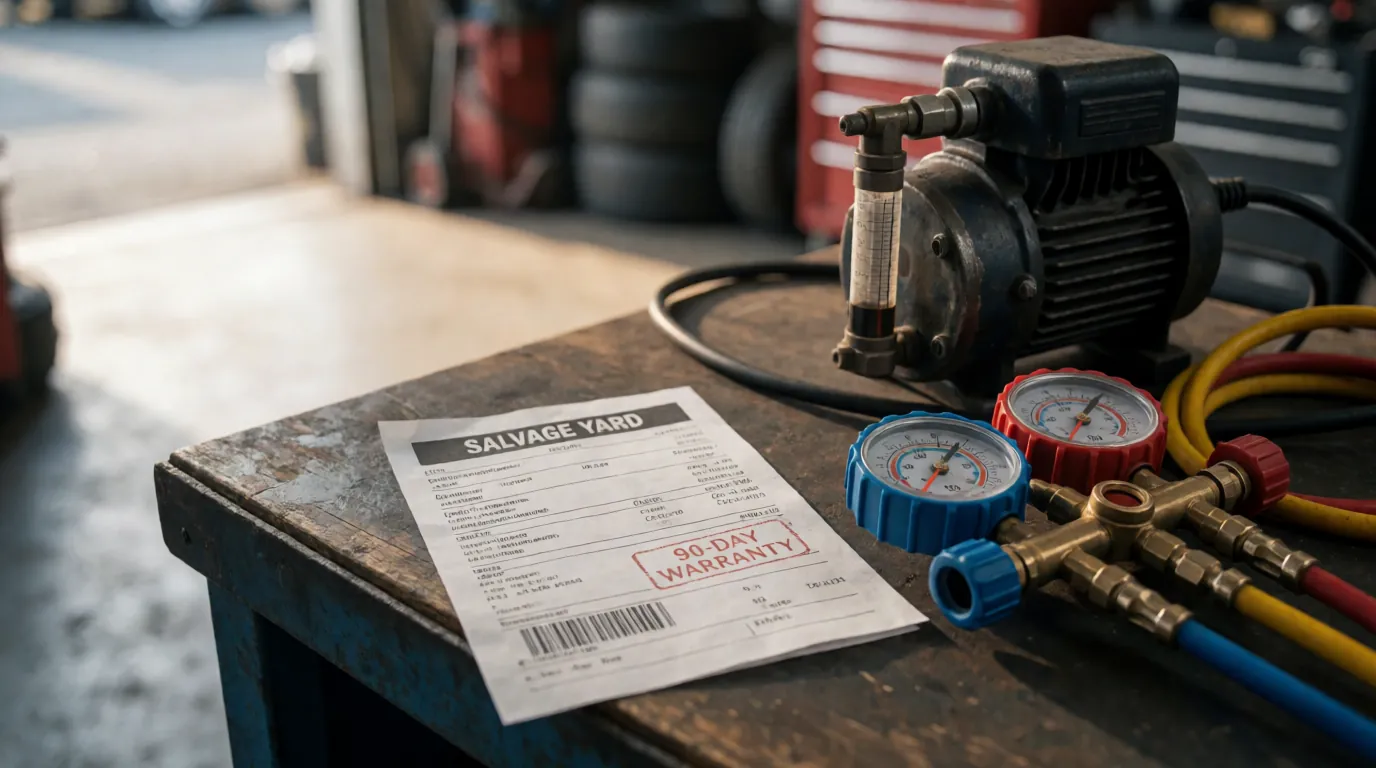
Break-Even Analysis
Here's the math that actually answers the question.
Assume a common vehicle: a used compressor at the $149 median, a reman at $250, and $350 in shop labor per install. Supporting parts and recharge run $250 and apply to both options, so they cancel out.
Scenario A, DIY (labor cost $0):
- Used path: $149. If it fails, buy again and reinstall: $149 more plus $250 in recharge and drier again.
- Reman path: $250, covered by warranty if it fails.
- Used stays cheaper until failure probability passes roughly 55 percent.
Scenario B, shop install ($350 labor):
- Used path: $149 + $350 labor. A failure means $149 + $350 + $250 again.
- Reman path: $250 + $350 labor. A failure inside warranty means a free part but you may still pay labor.
- Reman wins once used failure probability passes roughly 25 percent.
What's the actual failure probability? It depends almost entirely on two inputs you can control. A Grade A unit from a donor under 80,000 miles, installed into a flushed system with a new drier, fails inside the first year at a low single-digit rate in line with normal parts attrition. An ungraded unit with unknown mileage installed into an unflushed system after an internal grenade fails at a rate that clears 25 percent easily.
The practical rule: if you can verify donor mileage and you're doing the flush properly, used clears the bar in both scenarios. If either of those is missing and you're paying labor, buy the reman.
Which Option Fits Your Situation
Buy used when:
- You're doing your own labor and have access to a vacuum pump and gauges
- The old compressor still turns freely and the drained oil is clean amber
- Your vehicle is worth under about $12,000
- Your model has deep salvage supply. Ford F150 shows 1,396 priced listings, Hyundai Elantra 1,303, Chevy Silverado 1500 1,178, so replacements are easy to source if needed
- Your vehicle runs R-134a, where a recharge is $120 to $200 instead of $250 to $450
Buy remanufactured when:
- A shop is doing the install and you're exposed to labor twice
- Your old compressor seized and you're already spending on a flush
- You plan to keep the vehicle 3 to 8 more years
- You couldn't get donor mileage from any local yard
Buy new OEM when:
- The vehicle is a hybrid or EV with an electrically driven compressor
- It's under five years old and running R-1234yf
- The application is rare enough that salvage supply is thin. Hyundai Santa Fe shows only 97 priced listings against a $219 median, so sourcing options are limited and prices stay firm
- You're keeping the vehicle past 150,000 more miles
A note on luxury applications. The Mercedes E-Class carries a $267 used median, the highest in our index, but new OEM on that platform frequently exceeds $900. The percentage savings from going used is actually largest on expensive applications, not the cheap ones. On a Nissan Sentra at a $100 used median against maybe $350 new, you save $250. On the E-Class you save $650 or more for the same amount of labor.
See real pricing for your specific vehicle on our AC compressor price index, or read the full cost breakdown by model and grade to set your budget before you shop.