A full sunroof replacement costs $385 to $1,650 using a used OEM assembly, with the part running $100 to $750 (median $300) and labor adding $285 to $900. New OEM assemblies start at $500 and climb past $1,500 for luxury or panoramic models, making used the stronger value play for a part that rarely wears out mechanically.
Before committing to a full replacement, though, most sunroof problems do not require one. Clogged drain tubes, cracked glass panels, and worn motor gears each have targeted fixes that cost a fraction of swapping the entire assembly. The sections below break down when a full replacement is actually necessary and when a cheaper repair will solve the problem.
- Full replacement: $385–$1,650 with a used OEM assembly ($100–$750 part + $285–$900 labor)
- New OEM assemblies cost $500–$1,500+, and aftermarket sunroof assemblies are rare on the secondary market
- Glass-only replacement runs $250–$650 total, the right fix when tracks and motor still work
- Most sunroof leaks cost $50–$150 to fix by clearing clogged drain tubes, no replacement needed
- Labor is 55–75% of the total bill because the headliner, trim, and wiring must come out before the assembly
What Sunroof Replacement Costs
Sunroof assemblies are one of the few parts where used OEM is nearly the only secondary-market option. Aftermarket manufacturers rarely produce full sunroof assemblies because each design is tightly integrated with the vehicle's roof structure, drain routing, and electrical system. That leaves two realistic sourcing paths.
| Cost Component | Used OEM | New OEM |
|---|---|---|
| Part cost | $100–$750 (median $300) | $500–$1,500+ |
| Labor (3–6 hrs at $95–$150/hr) | $285–$900 | $285–$900 |
| Total | $385–$1,650 | $785–$2,400 |
Panoramic sunroofs push costs higher. These assemblies span most of the roof, use heavier glass, and include more complex track and motor systems. Expect the upper end of both the part and labor ranges on any vehicle with a panoramic roof.
For current used sunroof pricing by vehicle, see the sunroof price lookup tool.
*Pricing source: PartPriceGuide.com analysis of salvage yard listings across 63 vehicle models, August 2026.*
Repair vs Full Replacement
A full assembly swap is the most expensive path and is only necessary when the frame, tracks, or tray are damaged. Most sunroof failures affect a single component that can be repaired or replaced individually.
Glass Panel Replacement
When the glass is cracked or shattered but the frame, tracks, and motor work correctly, replacing only the glass panel is the right call.
| Component | Cost |
|---|---|
| Used OEM glass panel | $150–$400 |
| Labor (1–2.5 hrs) | $100–$250 |
| Total | $250–$650 |
Drain Tube Cleaning or Replacement
Clogged drain tubes are the most common sunroof complaint and the cheapest to fix. Each sunroof has four drain tubes, one at each corner of the tray, that route water down through the pillars and out under the vehicle. When debris blocks a tube, water pools in the tray and leaks into the cabin.
A shop clears the tubes with compressed air or a flexible wire for $50 to $150. If a tube is cracked or disconnected, replacement costs $100 to $300 including labor. Either fix takes under an hour in most cases.
Motor Replacement
A failed sunroof motor prevents the panel from opening, closing, or tilting. The motor bolts to the assembly frame and connects with a single wiring harness plug.
| Component | Cost |
|---|---|
| Used OEM motor | $50–$200 |
| Labor (1–2 hrs) | $95–$300 |
| Total | $145–$500 |
When Full Replacement Is Necessary
Replace the entire assembly when:
- The track system is bent or stripped, preventing the glass from sliding
- The tray (the metal pan under the glass) is corroded through, causing leaks that drain tube work cannot fix
- The frame is warped from collision damage
- Multiple components have failed simultaneously, making individual repairs collectively more expensive than one swap
If only one component is broken, fix that component. A full assembly replacement to solve a $75 drain tube clog is the automotive equivalent of replacing an engine to fix a spark plug.
Common Sunroof Problems
Sunroof complaints cluster around five failure modes. Understanding which one you are dealing with determines whether you need a $50 fix or a $1,650 replacement.
Leaks and Water Intrusion
The most reported sunroof problem. Water stains on the headliner, damp carpet, or a musty smell after rain all point to water getting past the sunroof system. The sunroof seal itself is rarely the culprit. The tray is designed to collect water and route it through drain tubes to the ground. When those tubes clog with leaves, pine needles, or dirt, water overflows the tray and drips into the cabin.
Fix: Drain tube cleaning ($50–$150). If the seal is visibly cracked or compressed flat, seal replacement runs $150–$350.
Stuck Open or Closed
The panel refuses to move, or moves partway and stops. Common causes are a failed motor, a blown fuse, a stripped cable, or debris in the tracks. Start with the fuse, that is a $2 fix. If the fuse is intact, the motor is the next suspect.
Fix: Fuse replacement (under $5), motor replacement ($145–$500), or cable/track repair ($200–$600). Full assembly replacement only if the tracks themselves are bent.
Cracked or Shattered Glass
Road debris, hail, or thermal stress can crack sunroof glass. Because sunroof glass is tempered (not laminated like a windshield), a crack usually means the entire panel needs replacing. Tempered glass cannot be repaired the way a windshield chip can.
Fix: Glass panel replacement ($250–$650).
Wind Noise at Highway Speed
A whistling or buffeting noise at speed usually indicates the glass panel is not seating flush in the closed position. Worn guide pins, a stretched cable, or a misadjusted track stop can all prevent a tight seal. Less commonly, the seal itself has hardened and no longer compresses against the glass.
Fix: Track adjustment or guide pin replacement ($100–$300). Seal replacement if the rubber is the issue ($150–$350).
Motor Failure
The switch clicks but nothing moves, or you hear grinding from the motor housing. Sunroof motors contain small plastic gears that wear down over time, and once a gear strips, the motor cannot drive the cable that moves the panel.
Fix: Motor replacement ($145–$500).
Aftermarket Sunroof Installation
Adding a sunroof to a vehicle that was not built with one is technically possible but carries significant trade-offs. This section covers installing a new aftermarket sunroof, not replacing a factory-installed one.
What It Costs
Aftermarket sunroof installation runs $1,000 to $2,500 for a standard pop-up or sliding unit. A spoiler-style mini sunroof (the small units popular in the 1990s) is cheaper at $500 to $1,000, but these are increasingly rare.
The Installation Process
The installer cuts a rectangular hole in the vehicle's roof panel, installs a reinforcement frame, drops the sunroof tray and mechanism into the opening, seals the perimeter, and finishes the interior with a new headliner section. The process takes 4 to 8 hours.
Structural Concerns
Factory sunroofs are engineered into the vehicle's body structure from the design phase. The roof panel is stamped with reinforcements around the opening, the pillars are sized to compensate for the removed material, and drain routing is integrated into the body channels. An aftermarket installation replicates none of this engineering.
Cutting into the roof removes material that contributes to the vehicle's rigidity. While aftermarket kits include a reinforcement frame, it does not match the structural analysis that went into the factory design. On modern vehicles with roof-mounted curtain airbag deployments paths, an aftermarket roof cut can interfere with airbag timing and trajectory.
Resale and Warranty Impact
An aftermarket sunroof voids the factory corrosion warranty on the roof panel and surrounding areas. Many buyers view aftermarket roof cuts negatively because of the leak and structural risks. The installation cost of $1,000 to $2,500 is unlikely to be recouped at resale. In many cases, it reduces the vehicle's value rather than increasing it.
For most owners, the math does not work. If a sunroof is a priority, buying a vehicle that came with one from the factory is the better financial path, and salvage yard pricing on factory sunroof assemblies shows that replacement parts are available when the factory unit eventually needs service.
DIY Feasibility
Sunroof work splits cleanly into jobs most owners can handle and jobs that should go to a shop.
DIY-Friendly Repairs
Drain tube cleaning is the easiest sunroof maintenance task. Open the sunroof, locate the four drain holes at the corners of the tray, and feed a thin flexible wire or weed-trimmer line down each one to clear any debris. Follow with a slow pour of water to confirm flow. Total cost: under $5 in materials and 20 to 30 minutes of time. This single task prevents the majority of sunroof leaks.
Fuse replacement is a 5-minute job if a blown fuse is the reason the sunroof stopped moving. The owner's manual identifies the sunroof fuse location, and a replacement fuse costs $1 to $3.
Glass panel replacement is manageable on vehicles where the glass clips into the track guides rather than being adhesive-bonded. Unclip the old panel from the exterior, clip the new one in, and test the operation. No interior work required. However, on models where the glass is bonded with urethane adhesive, the job requires proper adhesive, a caulk gun, and cure time, which moves it closer to shop territory.
Leave It to a Shop
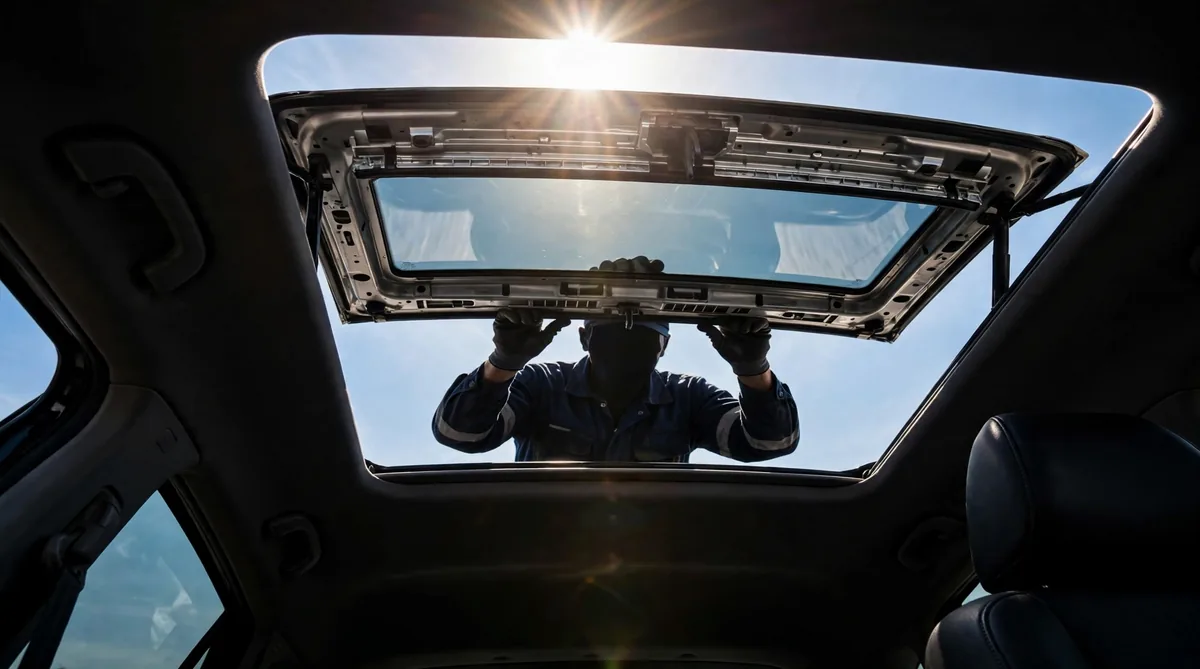
Full assembly replacement involves removing the headliner, disconnecting wiring, unbolting the assembly from the roof frame, and then reinstalling everything in reverse. The headliner is the main obstacle. Modern headliners are one-piece molded panels held by dozens of clips and trim pieces. Removing one without cracking it, sagging the fabric, or breaking a clip requires patience and experience. A damaged headliner costs $200 to $500 to replace, which can erase any labor savings from the DIY attempt.
Motor replacement sits in between. The motor is accessible from the interior, but reaching it usually requires partial headliner removal, and the motor's mounting position varies by vehicle. On some models the motor drops out after removing two bolts and a connector. On others it is buried behind the headliner and requires the same interior teardown as a full assembly swap.
Track adjustment and cable replacement require specialized knowledge of the specific sunroof mechanism. Getting the cable tension and track alignment wrong can result in a panel that binds, jumps its track, or fails to seal, all of which are more expensive to fix than the original problem.
For a broader look at which salvage yard parts are worth installing yourself, see the used auto parts pricing guide.