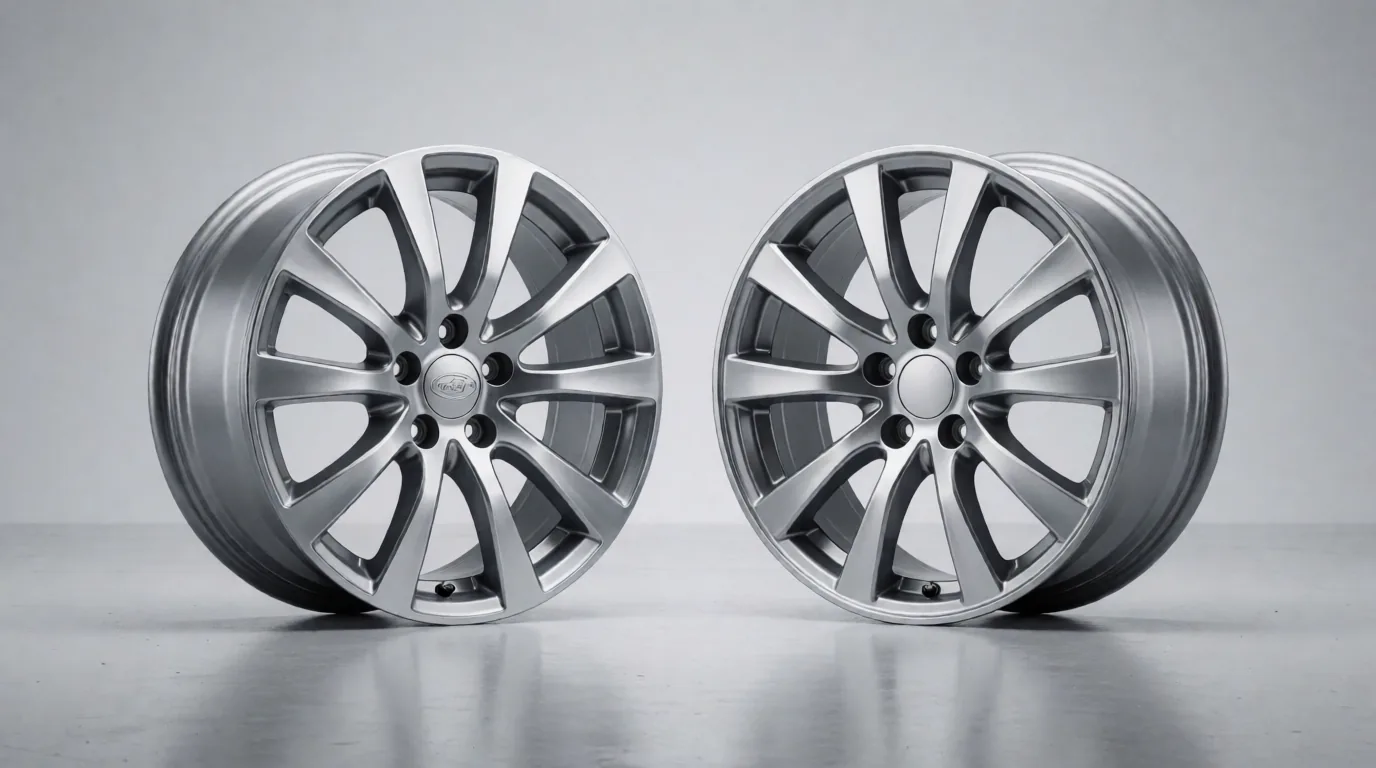
OEM wheels are the safer default for a straight replacement, because a factory wheel built for your model already matches bolt pattern, hub bore, offset, brake clearance, and load rating without you checking a single number. Aftermarket wheels cost less and offer far more styles, but they hand every one of those verification jobs back to you.
That's the whole trade in one sentence. What makes it worth a longer look is that "aftermarket" covers everything from forged wheels engineered past factory spec to unbranded replicas with no published test data at all, and those two things don't belong in the same category.
- OEM guarantees five specs at once: bolt pattern, hub bore, offset, brake caliper clearance, and load rating
- No US federal performance standard exists for aftermarket passenger car wheels, which is why the voluntary SAE J2530 and Japanese JWL/VIA marks matter
- Load rating is the spec people skip: each wheel needs to meet your gross axle weight rating divided by two
- Replica does not mean OEM: a replica copies the look, not the engineering or the validation testing
- TPMS sensors don't come with aftermarket wheels, but salvage OEM takeoffs frequently still have them installed
OEM vs Aftermarket at a Glance
| Factor | OEM / Factory | Quality Aftermarket | Replica |
|---|---|---|---|
| Bolt pattern and hub bore | Exact match guaranteed | Verify against your specs | Verify against your specs |
| Offset | Factory spec | Often adjustable by design | Usually copies OEM |
| Brake caliper clearance | Guaranteed | Check spoke geometry | Check spoke geometry |
| Load rating | Meets vehicle spec | Published by maker | Often unpublished |
| Test standard | Automaker validation | SAE J2530, JWL/VIA, TÜV | Varies, may be none |
| TPMS sensor | Included on salvage takeoffs | Sold separately | Sold separately |
| Style choice | Limited to factory designs | Very wide | Copies factory designs |
| Finish durability | Consistent, high QC | Generally good | Highly variable |
What OEM Actually Means
The term gets stretched to cover four different things, and the differences change what you're actually buying.
Genuine OEM is the wheel the automaker specified, carrying its part number and, usually, its logo on the center cap. In the used market these are called takeoffs, wheels pulled from a vehicle that either went to salvage or had its wheels swapped early in its life.
OE supplier wheels are built by the same company that produces for the automaker, sold without the automaker's branding. Same production line, different box.
Quality aftermarket wheels are designed independently by companies that publish their specifications and test data. This category includes forged and flow-formed wheels that are lighter and stronger than the factory part, and they're usually the ones people buy on purpose rather than as a repair.
Replicas, sometimes labeled "style" or "reproduction" wheels, copy the visual design of an OEM wheel without access to the original engineering. A replica of a factory wheel will typically get bolt pattern and diameter right, because those are measurable from the outside. What it can't copy from the outside is the internal section thickness, the spoke transition radii, or the validation program that proved the original survives a fatigue test.
The practical read: "OEM" and "replica" often look identical in a photo listing, so check whether the seller is describing a factory part number or a design name.
Fitment Guarantees You Give Up
Going aftermarket means personally confirming four things that a factory wheel settles automatically.
Bolt pattern and hub bore. Patterns that differ by two or three millimeters won't seat correctly even though the wheel will start onto the studs. Aftermarket wheels also frequently ship with an oversized hub bore so one casting can serve several vehicles, which means you need hub-centric rings to restore proper centering. OEM wheels are bored for your hub exactly.
Offset. A factory wheel puts the tire where the suspension geometry expects it. Change offset significantly and you change the scrub radius, which affects steering feel and loads the wheel bearing differently than designed. Aftermarket wheels intended for a wider stance are making that trade deliberately, and that's fine if you chose it. It's not fine if you didn't notice.
Brake caliper clearance. Spoke geometry on the inner face has to clear the caliper. This one bites people replacing wheels on vehicles with larger brake packages, where the same model year came with two different caliper sizes.
Lug seat type. Conical, ball, and flat seats aren't interchangeable, and aftermarket wheels don't necessarily use the same type your car's nuts were made for.
If you're sourcing a used wheel from salvage, work through the physical inspection in our junkyard wheel inspection guide once fitment checks out.
Are Aftermarket Wheels Safe?
A well-made aftermarket wheel is safe. The problem is that "well-made" isn't guaranteed by anything you can see, because the United States has no federal performance test that an aftermarket passenger car wheel must pass before it can be sold. Federal rules address rim marking and the tire and rim combinations a vehicle manufacturer specifies, not the fatigue strength of a replacement wheel someone imports and puts on a shelf.
That gap is why voluntary standards carry the weight here:
SAE J2530 is the North American reference for aftermarket passenger car and light truck wheels. It specifies cornering fatigue, radial fatigue, and impact testing. A manufacturer stating J2530 compliance is telling you the design was tested against a defined protocol.
JWL and VIA are the Japanese marks. JWL certification is required for wheels sold in Japan, and VIA indicates independent verification of those test results. Wheels carrying both marks have been through third-party testing rather than self-certification alone.
TÜV approval, common on wheels developed for the European market, means a German technical inspection body validated the wheel for specific vehicle applications.
Construction method matters too. Cast wheels are the most common and the least expensive. Flow-formed wheels are cast and then spun to compress the barrel, producing a stronger, lighter part. Forged wheels are the strongest and the most expensive. A quality cast wheel is entirely adequate for normal road use; the method tells you about the strength margin, not about whether the wheel is acceptable.
An OEM wheel skips this whole question. It went through the automaker's own validation for that specific vehicle, which is generally more demanding than the voluntary standards because it also covers corrosion, finish durability, and NVH.
Load Rating, the Spec Truck Owners Miss
Every wheel has a maximum load rating, and it's the specification most likely to be ignored on a truck or SUV. Find your vehicle's gross axle weight rating on the door jamb sticker, divide it by two, and each wheel must be rated at or above that number.
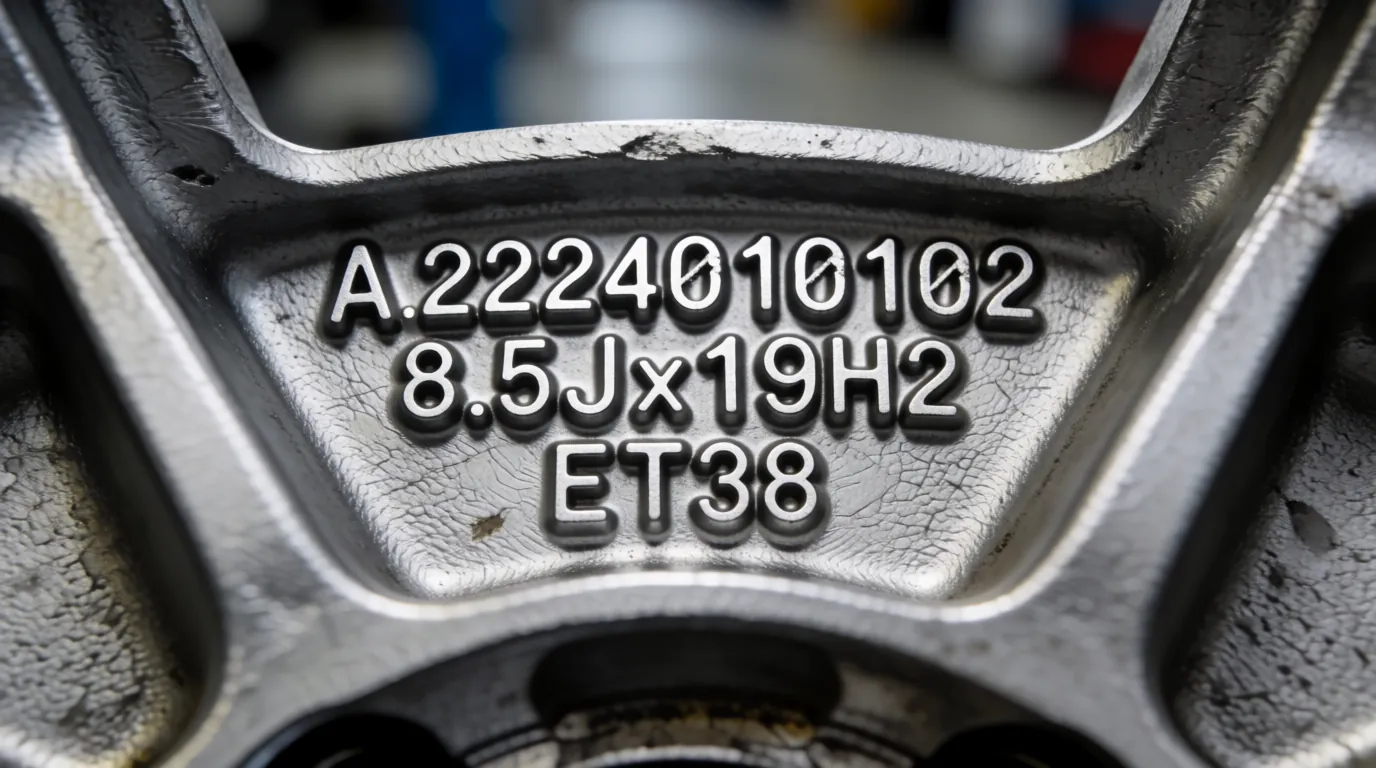
The rating is cast or stamped on the back of the spokes or inside the barrel, usually in kilograms alongside a MAX LOAD marking. If a used wheel has no legible load rating and no traceable part number, you have no way to confirm it belongs on a heavy vehicle.
This matters most in two situations. The first is putting passenger car wheels on a light truck, where the bolt pattern can match perfectly while the load rating falls well short. The second is towing, where the tongue weight lands on the rear axle and pushes the per-wheel load toward the limit. A wheel that's fine unloaded can be over its rating with a trailer attached.
TPMS Compatibility
Direct tire pressure monitoring systems put a battery-powered sensor inside each wheel, mounted at the valve stem. Wheels don't include sensors when you buy them new, so an aftermarket set means either transferring your existing sensors or buying a new set, then running the vehicle's relearn procedure so it recognizes each sensor position.
Three compatibility details are worth checking before you commit:
Valve hole diameter and angle. Clamp-in metal sensors and snap-in rubber sensors need different hole geometry. A wheel drilled for one won't seal correctly with the other.
Sensor body clearance. The sensor sits inside the barrel near the drop center. Some wheel designs don't leave room for a particular sensor body, which shows up as a sensor that gets crushed during tire mounting.
Radio frequency. Sensors operate on different frequencies by market, commonly 315 MHz in North America and 433 MHz in Europe. A sensor on the wrong frequency won't be seen by your receiver.
This is a quiet advantage for salvage OEM takeoffs. A factory wheel pulled with its tire often still has the original sensor in it, already the right type and frequency for your car. The sensor battery has whatever life the donor vehicle left on it, typically several years from new, so it isn't free forever, but it saves the immediate purchase.
What Each Option Costs
The general shape of the market is straightforward even before you look at specific numbers. Used OEM takeoffs are the cheapest way to get a genuine factory wheel, because the wheel's value drops sharply the moment it's separated from a car. New replicas undercut new OEM significantly. Quality aftermarket and forged wheels sit above new OEM, since you're buying them for performance or appearance rather than as a repair.
For current listings, see the used wheel price index, and for the full breakdown of what salvage wheels sell for, read our analysis of used rims cost.
Which Should You Buy?
Buy a used OEM takeoff when you're replacing one damaged wheel. Matching the other three matters cosmetically, and a factory wheel eliminates every fitment question in one step. This is the most common repair scenario and OEM wins it clearly.
Buy new aftermarket when you're replacing all four, want a different look or size, or need a dedicated winter set. Buying a full set removes the matching problem, and a separate winter set on cheaper wheels protects your good ones from salt.
Buy a replica only when you can confirm the maker publishes a load rating and a test standard. The price is attractive precisely because some manufacturers skip the validation step, so the burden is on you to tell the two kinds apart.
Buy forged or flow-formed when unsprung weight actually matters to you, which for most drivers on public roads it doesn't.
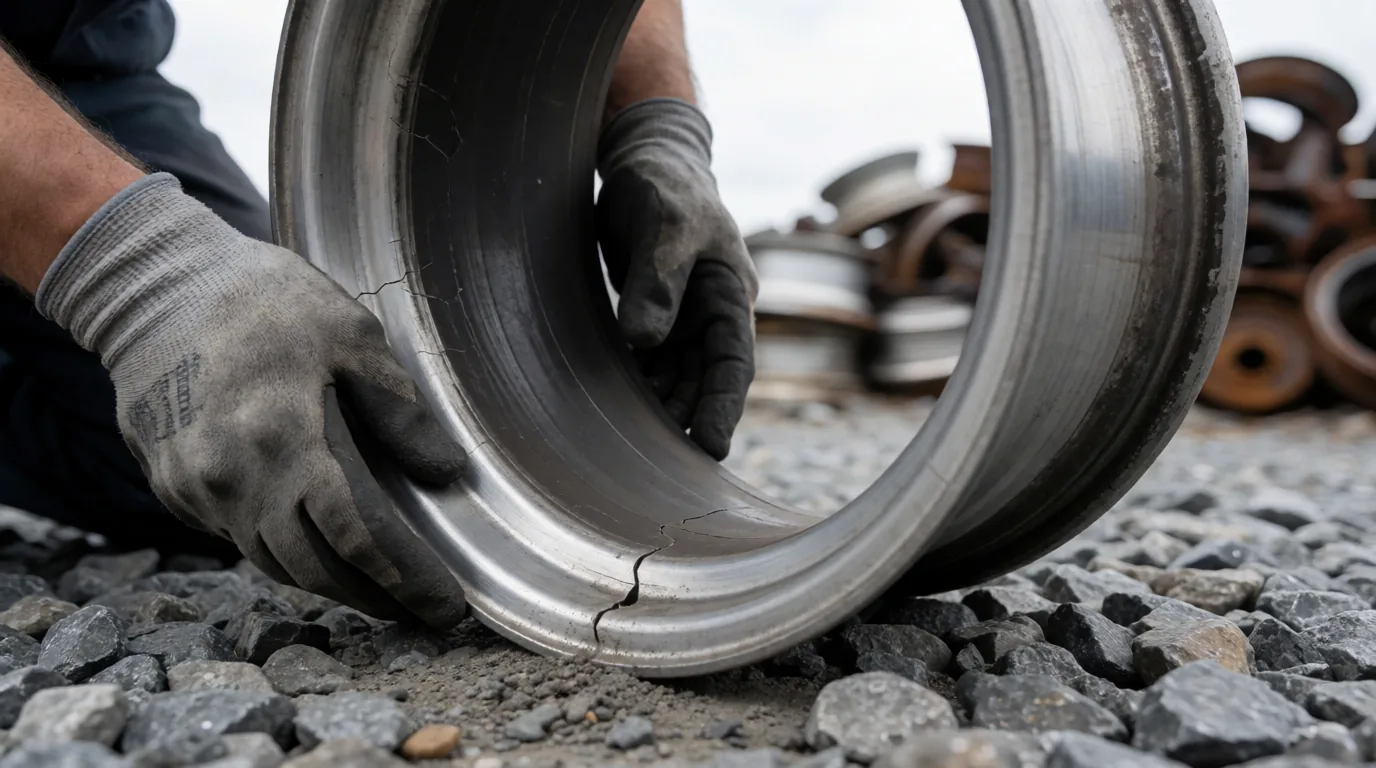
Whichever route you pick, if the wheel is used, inspect it before it goes on the car. Our junkyard wheel inspection guide covers the crack, bend, and corrosion checks that a seller won't do for you.