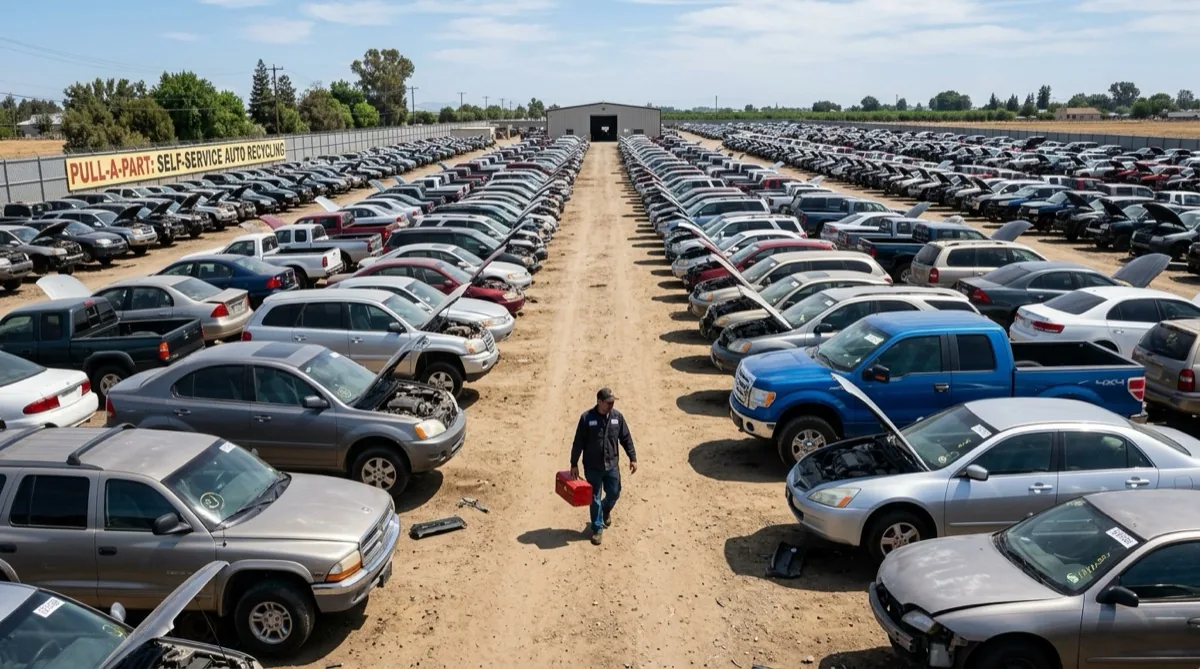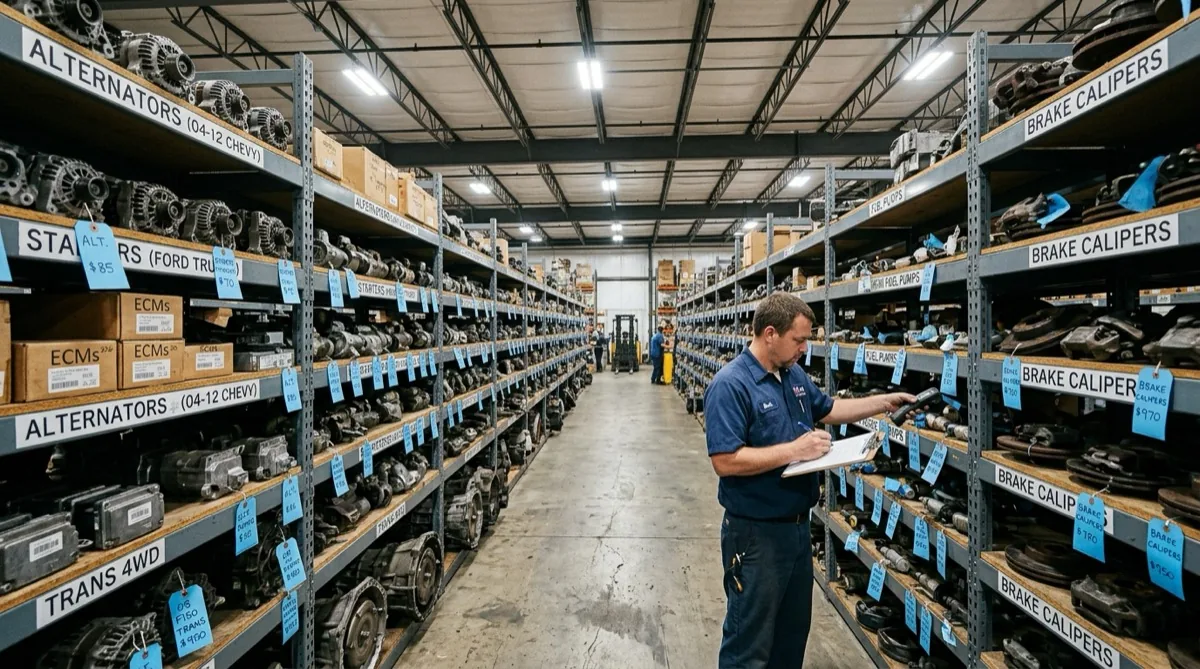
Replacing a single brake caliper costs $177 to $382 total with a used part and $215 to $650 with a new aftermarket or OEM unit. The caliper itself is relatively affordable at $82 median for a used part across 46,020 salvage yard listings. Labor runs $95 to $300 for one to two hours of shop time, and every caliper job includes a brake fluid bleed to purge air from the hydraulic system.
See also: how much do junkyards charge for parts.
If you're replacing both calipers on one axle, expect $259 to $464 with used parts or $430 to $1,000 with new. The labor per side stays the same, but you're paying for two parts. Most SERP estimates quote $300 to $600 for a single caliper and $500 to $1,500 per axle, numbers that assume new OEM parts and dealer labor rates. Using a salvage caliper cuts the part cost by 50 to 75 percent.
- Single caliper, used part: $177–$382 total ($82 median part + $95–$300 labor)
- Single caliper, new part: $215–$650 total ($120–$350 aftermarket, $200–$500 OEM)
- Per-axle pair, used parts: $259–$464 total (double the part cost, same labor rate per side)
- Labor includes a mandatory brake fluid bleed after every caliper swap
- Not every job requires a pair. A single seized or leaking caliper can be replaced on its own if the other side functions normally
- Dataset: 46,020 priced brake caliper listings, August 2026
What Brake Caliper Replacement Costs
A caliper replacement has three cost components: the caliper itself, the labor to swap it, and the brake fluid bleed that's required on every job. The bleed is typically bundled into the labor quote rather than listed as a separate line item.
| Cost Component | Used | New Aftermarket | New OEM |
|---|---|---|---|
| Part cost (single) | $60–$120 (median $82) | $120–$350 | $200–$500 |
| Labor (1–2 hrs at $95–$150/hr) | $95–$300 | $95–$300 | $95–$300 |
| Total (single) | $177–$382 | $215–$650 | $295–$800 |
| Total (pair, per axle) | $259–$464 | $335–$1,000 | $495–$1,300 |
The per-axle totals double the part cost but not the labor, because both calipers are accessible once the wheels are off and the technician is already working at that corner of the car. Some shops discount the second side slightly, but the savings are modest since each caliper still needs its own bleed procedure.
For broader context, see our used auto parts price guide.
Single vs Pair: Do You Need to Replace Both?
The short answer: replace only what has failed. Brake calipers are not wear items with a predictable lifespan like pads or rotors. They fail when a piston seizes, a slide pin corrodes, or a seal leaks, and that can happen to one side while the other side is perfectly functional.
Replace one caliper when:
- Only one side is seized, leaking, or dragging
- The other caliper slides freely and shows no signs of corrosion or uneven pad wear
- The vehicle has relatively low mileage and the calipers are not original high-mileage units
Replace the pair when:
- Both calipers show signs of sticking or uneven wear
- The vehicle has over 150,000 miles on original calipers and one has already failed (the other is likely close behind)
- You want matched braking force on that axle and plan to keep the vehicle long-term
Replacing both when only one has failed is conservative but not wasteful if the calipers share high mileage. The incremental cost of a second used caliper ($82 median) is small relative to the labor already being performed, and a second caliper failure three months later means paying the labor charge twice.
Seized Caliper Symptoms
A seized brake caliper is the most common reason for replacement. The caliper piston or slide pins corrode and stop moving freely, which keeps the brake pad pressed against the rotor even when you're not braking. The symptoms are distinct enough to diagnose without special tools.
Vehicle pulls to one side under braking. A seized caliper on one side grips harder (or doesn't release), creating unequal braking force. The car pulls toward the side with more braking friction.
Uneven pad wear. If one pad on a single wheel is worn significantly more than the other, or one wheel's pads are thinner than the opposite side, a sticking caliper is the most likely cause. A technician can confirm this during a standard brake inspection.
Burning smell or excessive heat from one wheel. A caliper that doesn't release keeps the pad dragging on the rotor, generating friction heat. After a moderate drive, one wheel will be noticeably hotter than the others. In severe cases, you'll smell burning brake material.
Brake fluid leak near the wheel. A failed piston seal leaks hydraulic fluid at the caliper body. Brake fluid is clear to amber-colored and has a distinct chemical smell. Any visible leak at a caliper means immediate replacement, because reduced hydraulic pressure compromises braking on that circuit.
Reduced fuel economy and sluggish acceleration. A dragging caliper creates constant resistance. If the vehicle feels like it's fighting itself or fuel economy drops noticeably without another explanation, a seized caliper is worth checking.
Cost by Vehicle Type
Brake caliper costs vary more by vehicle class than by specific model, because caliper design and size scale with vehicle weight. Heavier vehicles need larger calipers with bigger pistons, which cost more to manufacture and source.
| Vehicle Type | Used Part (est.) | Labor | Estimated Total (single) |
|---|---|---|---|
| Compact car (Civic, Corolla) | $55–$80 | $95–$200 | $150–$280 |
| Mid-size sedan (Camry, Accord) | $65–$95 | $95–$220 | $160–$315 |
| Compact SUV (RAV4, CR-V) | $70–$100 | $100–$230 | $170–$330 |
| Full-size truck (F-150, Silverado) | $80–$120 | $100–$250 | $180–$370 |
| Full-size SUV (Tahoe, Expedition) | $85–$130 | $110–$260 | $195–$390 |
| European luxury (BMW, Mercedes) | $100–$180 | $130–$300 | $230–$480 |
| Performance vehicles (multi-piston) | $150–$300 | $150–$300 | $300–$600 |
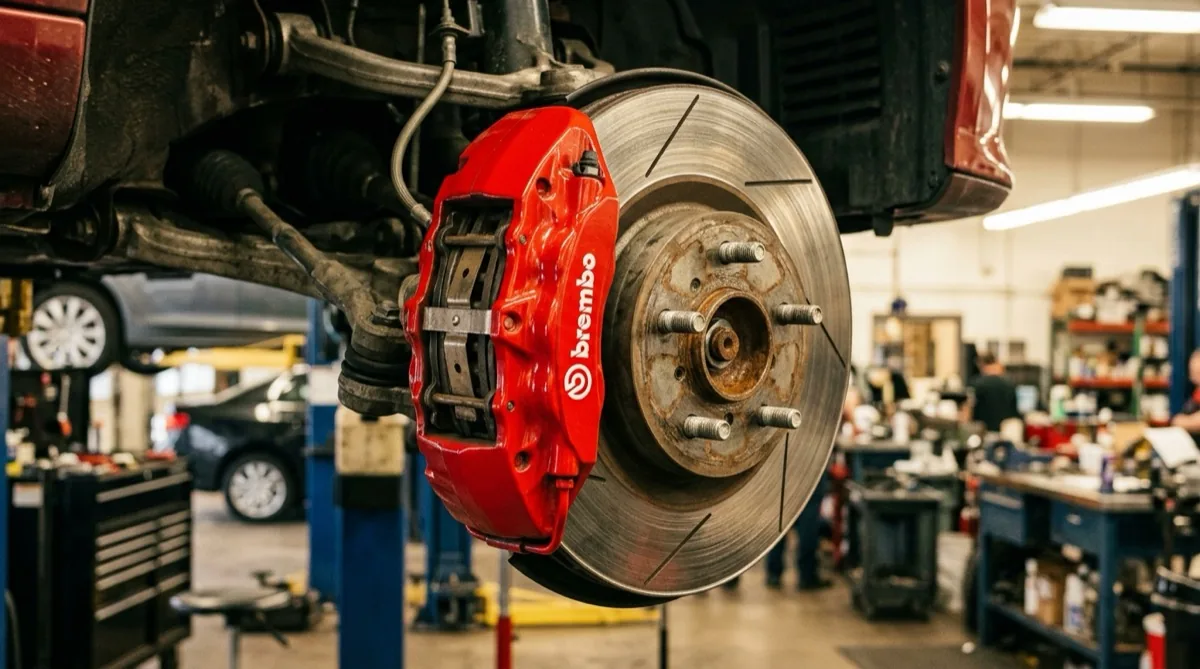
European luxury and performance vehicles carry the highest caliper costs for two reasons. The parts are model-specific with limited aftermarket availability, and the calipers themselves are larger, often multi-piston designs. A four-piston Brembo caliper on a performance car costs several times what a single-piston sliding caliper costs on a Civic.
For a detailed breakdown, see our control arm replacement cost guide.
Can You Replace a Brake Caliper Yourself?
Brake caliper replacement is a realistic DIY job for anyone comfortable with basic brake work. The mechanical portion is straightforward: unbolt the caliper, disconnect the brake hose, transfer the pads to the new caliper, bolt it back on, and reconnect the hose. The critical skill is bleeding the brake system afterward.
Tools you'll need: jack and jack stands, lug wrench, socket set (typically 14mm and 17mm for caliper brackets), flare nut wrench for the brake line fitting, a brake bleeder kit or a helper to pump the pedal, fresh DOT 3 or DOT 4 brake fluid, and a drip pan.
The bleed is the step that matters. Any time you open a brake hydraulic line, air enters the system. Air is compressible and fluid is not, so even a small air bubble gives you a soft or spongy pedal. The bleed procedure pushes fresh fluid through the system until no air bubbles appear at the bleeder valve. A one-person vacuum bleeder ($30 to $50 from any auto parts store) makes this easier than the two-person pump-and-hold method.
Budget two to three hours for a first attempt on one caliper, including the bleed. The second caliper on the same axle adds about an hour. Experienced DIYers can do a single caliper in under an hour.
Skip the DIY if you're not confident in the bleed procedure or don't have the right tools for the brake line fitting. A poorly bled brake system is a safety issue, and rounding the flare nut on the brake line creates a much more expensive problem. Brakes are the one system where a botched repair has immediate safety consequences.
Sourcing a used caliper from a junkyard at the $82 median price and doing the labor yourself brings the total cost to under $100 for parts and fluid, saving the entire $95 to $300 labor charge.