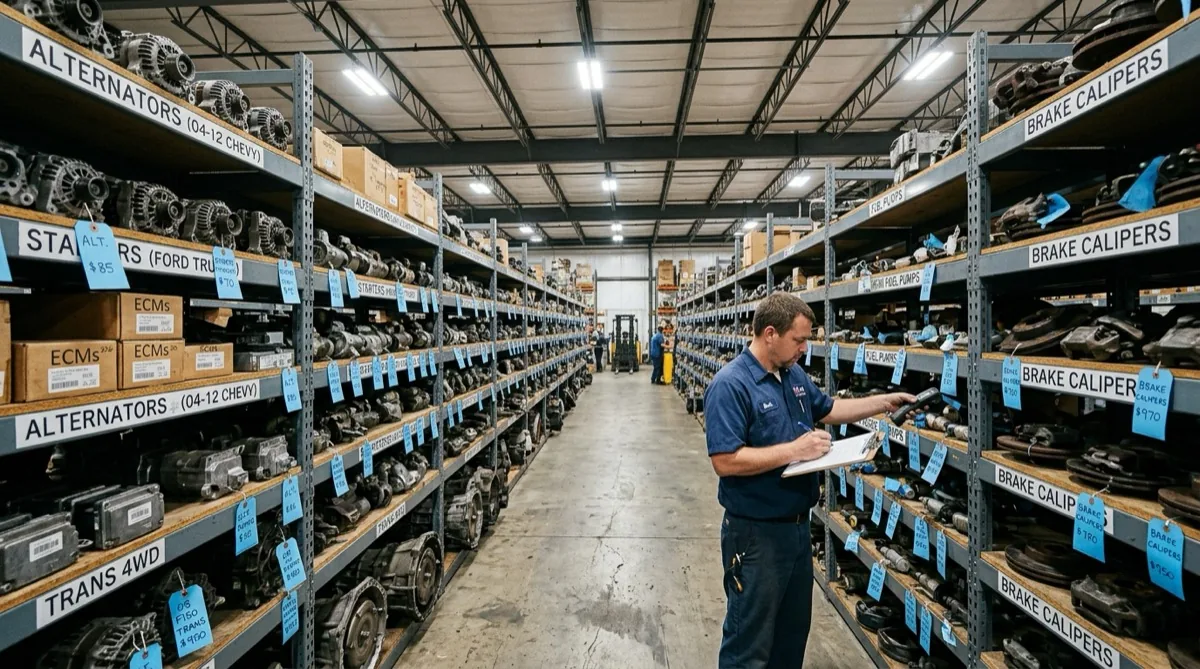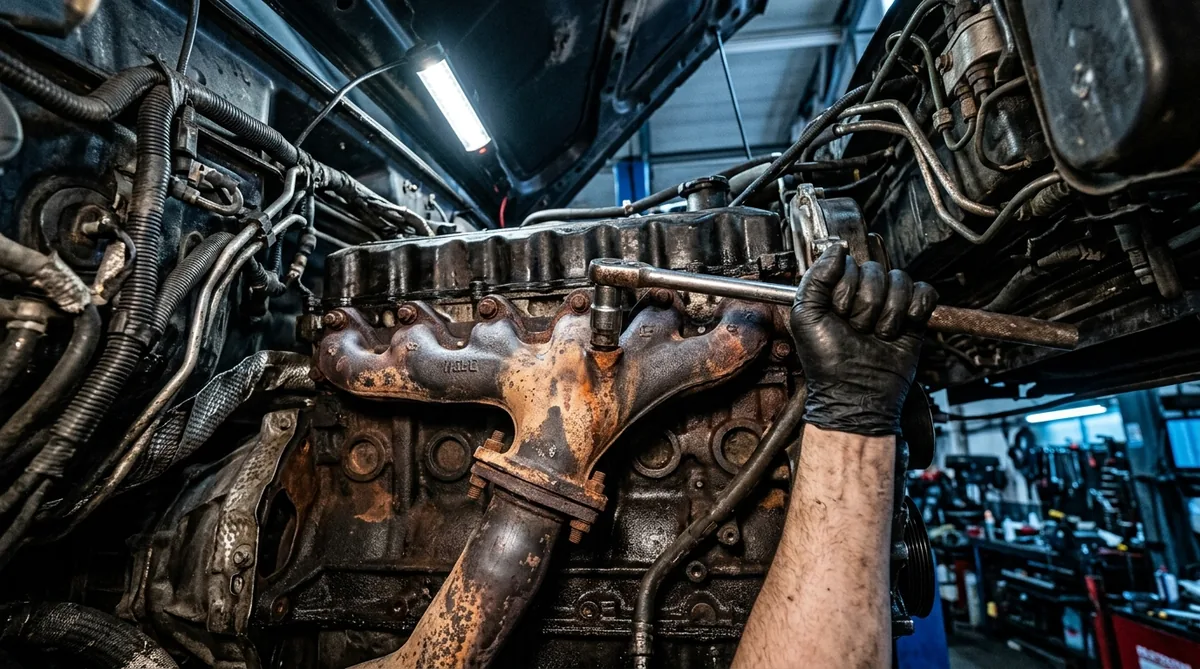
Replacing an exhaust manifold costs $266 to $1,700 total when you source a used manifold from a salvage yard, or $270 to $1,150 with a new aftermarket part. The part itself is rarely the expensive half of this repair. Labor runs $190 to $750 for 2 to 5 hours of shop time, and the real cost driver is what the mechanic finds once the old manifold comes off: rusted, seized, or snapped exhaust studs that add hours to the job.
For a broader look at salvage yard part pricing, see the used auto parts price guide.
- Total cost with a used manifold: $266–$1,700 (median part price $225, labor $190–$750, gaskets $30–$100)
- New aftermarket manifold: $80–$400 for the part. New OEM: $200–$700
- V6 and V8 engines have two manifolds, which can double the parts cost
- Broken exhaust studs are the real cost driver, adding 1–3 hours of labor for extraction or thread repair
- Used cast iron manifolds are excellent salvage buys since cast iron rarely fails structurally
What It Costs
Exhaust manifold replacement breaks into three line items: the manifold, the gaskets and hardware, and the labor. Labor dominates the bill on most vehicles because access is tight and fasteners corrode. The part is the one variable you can control.
| Cost Component | Used (Salvage) | Aftermarket (New) | OEM (New) |
|---|---|---|---|
| Manifold | $46–$850 (median $225) | $80–$400 | $200–$700 |
| Gaskets and hardware | $30–$100 | $30–$100 | $30–$100 |
| Labor (2–5 hrs at $95–$150/hr) | $190–$750 | $190–$750 | $190–$750 |
| Total | $266–$1,700 | $300–$1,250 | $420–$1,550 |
*Pricing based on PartPriceGuide.com analysis of salvage yard listings across 63 vehicle models, August 2026. New part prices reflect 2026 retail data from major aftermarket suppliers and OEM dealer parts departments.*
Cracked vs Leaking Manifold
A cracked manifold and a leaking manifold gasket produce similar symptoms but call for different repairs. Knowing which one you have saves money.
Hairline cracks are the most common exhaust manifold failure. Cast iron manifolds expand and contract with every heat cycle, and over years of thermal stress, small cracks develop between the exhaust ports. The classic symptom is a ticking or tapping noise on cold start that fades as the engine warms up. The noise fades because the metal expands when hot, temporarily closing the crack. If your mechanic confirms a hairline crack, the manifold needs replacement. Welding is possible on cast iron using nickel rod, and a repair typically costs $150 to $300. However, welded cracks often reopen after continued thermal cycling, so most shops recommend replacement over welding.
Gasket leaks happen at the flange where the manifold bolts to the cylinder head. The gasket can blow out from warping, overtorqued bolts, or simple age. Symptoms include a persistent exhaust smell in the engine bay and sometimes a hissing sound at all temperatures, not just cold start. A gasket-only replacement costs $130 to $350 (gasket plus 1 to 2 hours of labor) if the manifold and studs are in good shape. The catch: once the manifold comes off for a gasket swap, mechanics often discover the studs are seized or the manifold flange is warped, turning a gasket job into a full replacement.
Warped manifolds are less common but occur on cast iron pieces that have overheated or been reinstalled with uneven torque. A warped manifold will not seal against a new gasket. Machine shops can sometimes resurface the flange for $75 to $150, but replacement is often faster and more reliable.
Broken Exhaust Studs: The Hidden Cost
Broken or seized exhaust manifold studs are the reason this repair's labor estimate has such a wide range. The manifold itself comes off in 30 to 45 minutes on most inline-four engines. The studs are what turn a two-hour job into a five-hour ordeal.
Exhaust manifold studs thread directly into the cylinder head and live in one of the hottest, most corrosion-prone environments on the engine. After 8 to 10 years of heat cycles and road salt exposure, these studs essentially weld themselves to the aluminum or cast iron head through rust and galvanic corrosion. When a mechanic tries to remove them, they snap.
Extracting a broken stud follows an escalating process:
- Penetrating oil and heat (30 minutes). The mechanic soaks the studs in penetrating oil, applies heat with a torch, and attempts removal with an extractor bit. This works on maybe half of stuck studs.
- Drilling and extraction (1–2 hours). If the stud snaps flush with the head, the mechanic drills a pilot hole and uses a screw extractor (Easy-Out) to back the stud out.
- Heli-Coil thread insert (2–3 hours). If the extractor damages the threads in the head, the mechanic drills out the hole, taps new threads, and installs a threaded insert. This is a permanent repair, and the insert is often stronger than the original threads.
- Cylinder head removal (rare, worst case). If a stud breaks deep in the head or the head cracks during extraction, the head must come off for machine shop work. This scenario can push total repair cost past $2,000.
Every additional stud that breaks adds $50 to $150 in labor. On a V8 with 16 exhaust manifold studs across both banks, the risk compounds quickly. When getting estimates, ask the shop whether their quote accounts for broken studs. Some shops quote a base price for the manifold swap and add stud extraction as a separate line item.
Cast Iron vs Tubular Headers
Factory exhaust manifolds are almost always cast iron. Aftermarket replacements come in both cast iron and tubular steel, and the choice affects cost, durability, and performance differently.
Cast iron manifolds are thick, heavy, and built to last. A factory cast iron manifold often outlasts the vehicle, with 200,000+ mile lifespans being common. They absorb and retain heat, which helps catalytic converters reach operating temperature faster and keeps emissions in check. Cast iron manifolds are also quiet. The downside is weight (15 to 30 pounds per manifold) and the fact that they crack eventually under thermal stress. Replacement cast iron manifolds, whether used or new, are a direct bolt-on fit. A salvage yard cast iron manifold is one of the best values in used parts because the material is so durable. The PartPriceGuide parts database shows pricing across dozens of applications.
Tubular steel headers use individual runners welded to a collector and are designed for exhaust flow efficiency rather than durability. They weigh less, flow more exhaust gas, and can add 5 to 15 horsepower on naturally aspirated engines. Aftermarket tubular headers come in two materials:
- Mild steel ($80–$200): Affordable and adequate for moderate climates. Mild steel corrodes faster, especially in salt-belt states, and typically lasts 5 to 8 years before rust becomes a problem.
- Stainless steel ($200–$500): Resists corrosion far better and can last 15+ years. The higher upfront cost pays off in longevity, particularly for vehicles driven in winter road salt conditions.
Tubular headers also tend to be louder than cast iron manifolds because the thinner walls transmit more exhaust noise. On some applications, aftermarket headers may trigger a check engine light if they alter exhaust gas flow past the oxygen sensors. For daily drivers, a replacement cast iron manifold is the practical choice. Tubular headers make sense for performance builds or when a cast iron replacement is not available for an older or uncommon vehicle.
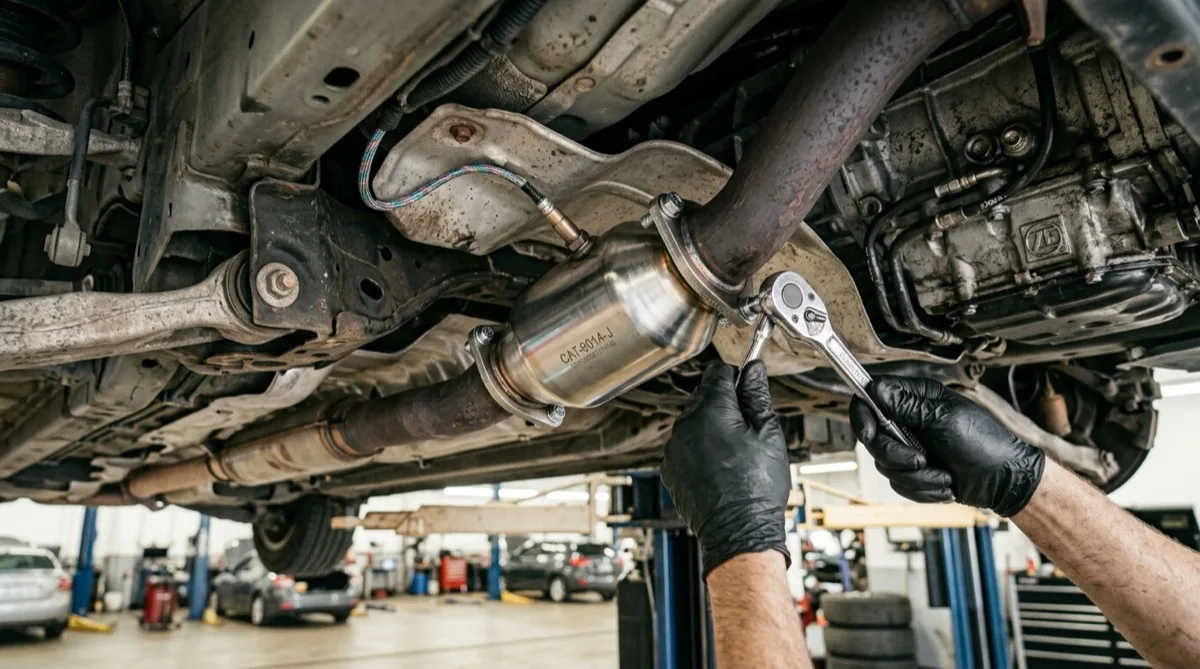
For more on how exhaust system problems affect downstream components, see our guide on catalytic converter replacement cost.
Can You Drive With a Cracked Exhaust Manifold?
Yes, short-term. A cracked exhaust manifold will not leave you stranded, and the engine will run normally. But driving with one carries real risks that escalate over time.
Carbon monoxide exposure is the most serious concern. A cracked manifold leaks exhaust gas into the engine bay. At highway speeds with good airflow, the gas disperses. In stop-and-go traffic, at idle, or with the heater on recirculate, carbon monoxide can enter the cabin through the HVAC system or firewall seals. CO is odorless, and prolonged exposure causes headaches, drowsiness, and worse. If you must drive with a known crack, keep windows cracked and the HVAC set to fresh air, not recirculate.
Downstream component damage is the financial argument for prompt repair. A cracked manifold introduces unmetered air into the exhaust stream. This causes the downstream oxygen sensor to read lean, triggering the ECU to add fuel. Over weeks, the O2 sensor can fail from thermal shock caused by the air/exhaust temperature differential at the crack site. A new O2 sensor costs $100 to $300 installed. If the lean readings persist, the catalytic converter works harder and runs hotter, shortening its lifespan. Replacing a catalytic converter costs $450 to $1,850 with an aftermarket part, turning a $266 manifold repair into a $1,000-plus problem.
The noise gets worse. The cold-start ticking from a hairline crack eventually becomes a constant exhaust leak noise as the crack grows. Beyond the annoyance, a loud exhaust leak can result in a failed vehicle inspection in states that include noise or emissions testing.
The practical timeline: A small hairline crack can go months without causing secondary damage. A visibly separated crack or a gasket blowout should be repaired within a week or two. If the check engine light comes on with P0420 (catalyst efficiency below threshold) or O2 sensor codes, the crack has already started affecting other components.