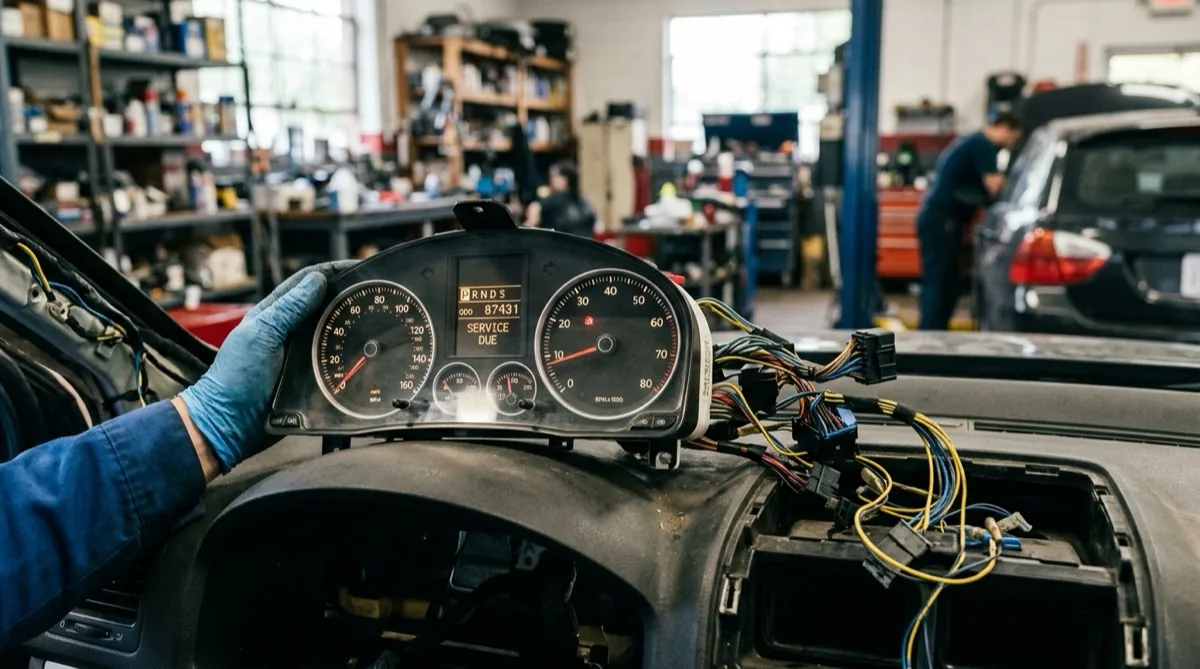
Repairing an instrument cluster costs $150 to $400 when the failure is limited to stepper motors, backlighting, or a cracked LCD. Full replacement with a used cluster runs $300 to $900 total including the part, labor, and mileage reprogramming. A new OEM cluster from the dealer pushes the total to $500 to $1,500, and fully digital clusters on newer vehicles can exceed $2,000.
The repair-versus-replace decision hinges on what actually failed. Stepper motor rebuilds and backlight repairs are straightforward fixes that specialty shops handle by mail for $150 to $300. But when the circuit board is damaged or the display has gone completely dark, a replacement cluster is the faster path. The catch with any used replacement is mileage: federal law requires the odometer to display the vehicle's actual mileage, which means reprogramming or a disclosure sticker on the door frame.
[INTERNAL-LINK: junkyard parts pricing overview → /blog/price-analysis/how-much-do-junkyards-charge-for-parts]
- Cluster repair: $150-$400. Stepper motor rebuilds, LCD replacement, and backlight fixes are handled by mail-in specialty shops
- Used cluster replacement: $300-$900 total. Includes the used part ($75-$350), labor ($100-$250), and mileage reprogramming ($50-$150)
- New OEM replacement: $500-$1,500 total. Digital clusters on newer vehicles can reach $2,000+
- Mileage reprogramming is legally required when installing a used cluster, per federal odometer law (49 U.S.C. 32703)
- Stepper motor failure is the most common issue, especially on 2003-2006 GM trucks and SUVs
- Repair preserves your original mileage and avoids the reprogramming step entirely
- Coverage: 63 vehicle models in our instrument cluster pricing index
Repair vs Replacement Costs
Instrument cluster costs split into two paths: repairing the original unit or replacing it entirely. Repair is almost always cheaper when the failure is a known, fixable component like stepper motors or backlighting.
| Cost Component | Repair (Mail-In) | Used Replacement | New OEM (Dealer) |
|---|---|---|---|
| Part/service cost | $150-$400 | $75-$350 | $300-$1,000 |
| Labor (removal/install) | $0 (DIY) or $100-$200 | $100-$250 | $100-$250 |
| Mileage reprogramming | Not needed | $50-$150 | Not needed (new) |
| Total | $150-$600 | $300-$900 | $500-$1,500 |
Replacement makes sense when the circuit board is physically damaged, when the cluster has water intrusion, or when multiple components have failed and the repair cost approaches the price of a used unit. The used cluster itself runs $75 to $350 depending on vehicle and condition, but mileage reprogramming adds $50 to $150 on top. That reprogramming step is what makes the replacement path less straightforward than it appears.
Browse current used instrument cluster prices for your vehicle on our instrument cluster pricing page.
*Labor estimates consistent with RepairPal national ranges.*
Common Instrument Cluster Failures
Instrument clusters fail in predictable patterns based on component type and vehicle generation. Knowing the specific failure helps you decide between a $200 repair and an $800 replacement.
Stepper motor failure
Stepper motors are the small electric motors behind each gauge needle (speedometer, tachometer, fuel, temperature, oil pressure). When they fail, the gauge reads incorrectly, sticks at zero, or bounces erratically. GM trucks and SUVs from 2003 to 2006 (Silverado, Sierra, Tahoe, Yukon, Suburban, Avalanche) are the most notorious for this issue, but it affects vehicles from all manufacturers.
Replacing all stepper motors in a cluster costs $150 to $250 at a mail-in shop. Most shops replace the full set rather than just the failed motor, since the remaining motors are the same age and likely to fail soon. The motors themselves cost $2 to $5 each, so the charge is almost entirely labor for disassembly, soldering, and reassembly.
LCD and display failures
LCD screens in instrument clusters develop dead segments, faded pixels, or complete blackouts. This is common on mid-2000s GM and Chrysler vehicles, as well as some Ford models. The LCD itself degrades from heat cycling, since the cluster sits directly behind the windshield and absorbs heat.
LCD replacement runs $100 to $300 depending on whether the cluster uses a simple segment display or a full dot-matrix screen. Newer vehicles with full-color TFT displays are more expensive to repair because the screens are proprietary and harder to source.
LED backlight failure
When the cluster appears dark or unreadable at night but the gauges still function, the LED or incandescent backlights have failed. Older clusters use small incandescent bulbs that burn out individually, creating dark spots. Newer clusters use LED strips or surface-mount LEDs that can fail from age or heat.
Backlight replacement costs $75 to $200. Many shops upgrade incandescent bulbs to LEDs during the repair, which improves brightness and longevity.
Cold solder joints and circuit board cracks
Thermal cycling (heating and cooling) can crack solder joints on the circuit board, causing intermittent failures. Gauges may work when the car is cold and fail when it warms up, or vice versa. This issue requires reflowing or resoldering the affected joints, which costs $100 to $250 at a repair shop.
Mileage Reprogramming Requirements
Installing a used instrument cluster triggers a legal requirement that most vehicle owners do not know about until they are already committed to the replacement. Federal odometer law (49 U.S.C. 32703) prohibits displaying an incorrect odometer reading, and a used cluster from a different vehicle will show that donor vehicle's mileage, not yours.
What the law requires
When a used cluster is installed, one of two things must happen. The odometer must be reprogrammed to display the vehicle's actual mileage, or a written disclosure must be placed on the driver's door frame stating the odometer reading is not the vehicle's true mileage. The second option is legal, but it effectively brands the title as having a mileage discrepancy, which reduces resale value.
Reprogramming is the better option. Dealers and qualified shops with factory-level scan tools can write the correct mileage to the cluster's EEPROM chip. This costs $50 to $150 and takes 15 to 30 minutes.
Which vehicles need programming beyond mileage
On vehicles built before roughly 2005, most clusters are analog units that simply plug in. The only step is mileage correction. On newer vehicles with CAN bus networking, the cluster communicates with other modules (ECM, body control module, anti-theft system) and may need to be programmed to the vehicle's network.
GM vehicles from 2006 onward often require the cluster to be "married" to the body control module. Ford vehicles with the PATS (Passive Anti-Theft System) may require security relearn procedures after a cluster swap. Chrysler/Dodge vehicles from 2008 onward may need dealer-level Witech or StarSCAN tools for cluster configuration.
This programming step is separate from and in addition to the mileage correction. It adds complexity and sometimes cost, especially if the work requires a dealer visit. Combined, mileage reprogramming and module pairing can cost $100 to $250 at a dealer.
For comparison, ECM replacement involves a similar programming requirement. See our ECM replacement cost guide for how those programming fees break down.
Why repair avoids this entirely
Repairing the original cluster sidesteps the mileage and programming issue completely. The repaired unit returns with the same EEPROM data, the same VIN pairing, and the same odometer reading. This is the primary reason repair is the preferred path when the failure is fixable.
[INTERNAL-LINK: ECM replacement programming costs → /blog/repair-costs/ecm-replacement-cost]
Used vs New vs Repair: Which Path Saves the Most?
Each sourcing path has a cost advantage in a different situation. The right choice depends on the failure type, vehicle age, and whether the cluster requires network programming.
Repair the original cluster
Best for: stepper motors, backlights, LCD segments, intermittent electrical issues.
Send the original cluster to a mail-in repair shop for $150 to $400. Turnaround is one to three business days. The vehicle is undrivable during this time unless you have a spare cluster or can schedule the repair around your transportation needs.
Advantages: lowest cost, no mileage reprogramming, no module pairing, original VIN data preserved. Disadvantages: vehicle is down while the cluster is out (typically two to four days including shipping), and not all failures are repairable. A cracked circuit board or water-damaged unit may not be salvageable.
Used cluster from a salvage yard
Best for: unrepairable original clusters, cracked boards, fire or water damage.
A used instrument cluster costs $75 to $350 from a salvage yard. Add $100 to $250 for labor and $50 to $150 for mileage reprogramming. Total: $300 to $900. On newer vehicles that require module pairing, add another $50 to $100 for dealer programming.
Advantages: faster than mail-in repair (no shipping wait), lower cost than new. Disadvantages: mileage reprogramming is mandatory, the used unit may have its own age-related wear, and module pairing can complicate the install on newer vehicles.
Check availability and pricing for your specific vehicle on our instrument cluster pricing page.
New OEM cluster from the dealer
Best for: current-model vehicles, fully digital displays, warranty-covered repairs.
A new cluster from the dealer runs $300 to $1,000 for the part alone. Fully digital clusters on luxury vehicles and newer trucks (2019+ Ram TFT display, 2020+ GM digital cluster) can cost $800 to $1,500 for the part. Add $100 to $250 for installation. Total: $500 to $1,500+.
Advantages: no mileage issues (dealer programs the correct mileage during install), full warranty, no concerns about used-part condition. Disadvantages: significantly more expensive, and availability can be limited for older models that are no longer in production.
Cost by Vehicle Type
Cluster repair and replacement costs vary more by cluster technology than by vehicle brand. Analog clusters with stepper motors are cheaper to repair and replace than digital clusters with TFT screens.
| Vehicle Type | Repair Cost | Used Cluster | New OEM | Typical Failure |
|---|---|---|---|---|
| GM trucks 2003-2006 (Silverado, Tahoe) | $150-$250 | $75-$150 | $300-$500 | Stepper motors |
| GM trucks 2007-2013 | $175-$300 | $100-$200 | $400-$700 | Stepper motors, LCD |
| Ford trucks (F-150, Ranger) | $150-$300 | $100-$250 | $400-$800 | LCD, backlights |
| Chrysler/Dodge (Charger, Durango) | $150-$300 | $100-$250 | $350-$700 | LCD segments, stepper motors |
| Japanese sedans (Civic, Camry, Accord) | $100-$250 | $75-$200 | $300-$600 | Backlights, LCD |
| Japanese SUVs (4Runner, Highlander, Pilot) | $150-$300 | $100-$250 | $400-$700 | LCD, backlights |
| Korean (Elantra, Sonata, Forte) | $100-$250 | $75-$200 | $300-$600 | LCD, backlights |
| European (BMW, Mercedes) | $200-$400 | $200-$350 | $600-$1,200 | Pixel fade, LCD |
| Full digital cluster (2019+ trucks, luxury) | $300-$500+ | $300-$600 | $800-$1,500+ | TFT screen, motherboard |
European vehicles cost more because their clusters integrate more functions (navigation prompts, driver assistance displays, configurable digital gauges) into the cluster unit, making both parts and repair more complex. BMW and Mercedes pixel repair for older models (E39, W203, W211) is a cottage industry, with specialized shops charging $200 to $400 to replace failed pixel ribbons.