Replacing a steering column costs $385 to $1,276 total when using a salvage yard part and $685 to $2,200 with a new OEM column. The column itself runs $166 median for a used unit across 59 models in our salvage yard index, while labor adds $285 to $900 for three to six hours of shop time, making this one of the more labor-intensive steering system repairs.
For a broader look at salvage yard part pricing, see the used auto parts price guide.
The high labor cost reflects the column's location deep behind the dashboard and the number of systems routed through it. The airbag clockspring, multifunction switch, ignition lock, tilt and telescoping mechanisms, and multiple wiring harnesses all live on or inside the steering column. A straightforward shaft swap on a base-model truck can take three hours. A column replacement on a luxury vehicle with memory tilt, telescoping, heated steering wheel, and lane-keeping assist sensors can push past six hours.
- Used steering column: $385–$1,276 total ($166 median part + $285–$900 labor + up to $100 SRS reset)
- New OEM column: $685–$2,200 total ($400–$1,200 part + $285–$900 labor + up to $100 SRS reset)
- Aftermarket columns are uncommon for most vehicles, making used or OEM the primary options
- Airbag clockspring and SRS reset add complexity and cost that other steering repairs do not have
- Dataset: PartPriceGuide.com analysis of salvage yard listings across 59 models and 63 vehicle models, August 2026
What It Costs
Steering column replacement costs break into two main components: the column assembly and the labor to remove and install it. On some vehicles, a third cost appears for SRS system reset or electronic recalibration after the swap.
| Cost Component | Used (Salvage) | New OEM |
|---|---|---|
| Part cost | $100–$276 (median $166) | $400–$1,200 |
| Labor (3–6 hrs at $95–$150/hr) | $285–$900 | $285–$900 |
| SRS reset / calibration (if needed) | $0–$100 | $0–$100 |
| Total | $385–$1,276 | $685–$2,200 |
The part cost spread reflects the wide variation in column complexity. A basic non-tilt, non-telescoping column for a mid-2000s pickup runs closer to $100 from a salvage yard. A column for a late-model SUV with power tilt, telescoping, memory positions, and an integrated electronics module can reach $276 or higher used.
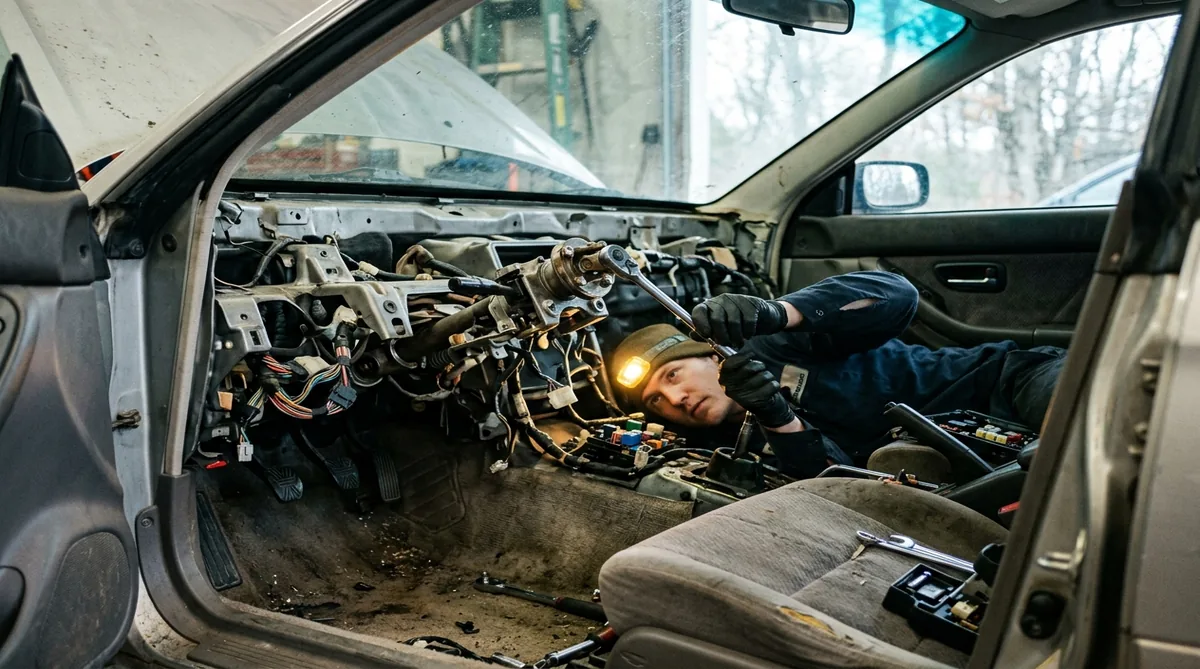
Labor is where steering column replacement gets expensive relative to other steering repairs. The column sits behind the dashboard, and accessing it means removing the steering wheel, the airbag module, column covers, knee bolster panels, and often part of the lower dashboard. On vehicles with pedal adjustability or a column-mounted shifter, those systems need to be disconnected and reconnected as well.
Aftermarket steering columns are uncommon. Unlike brake calipers or control arms where aftermarket manufacturers produce high volumes, steering columns are vehicle-specific assemblies with integrated electrical systems that make aftermarket production impractical for most applications. Your realistic options are a used column from a salvage yard or a new OEM unit from the dealer.
When Steering Columns Need Replacement
Most steering columns last the life of the vehicle. When they do fail, the cause is typically collision damage, a worn internal mechanism, or an electrical component failure that makes individual repair impractical.
Collision damage is the most common reason for full column replacement. The steering column is engineered to collapse during a frontal impact, absorbing energy to protect the driver. Once a collapsible column has compressed, it cannot be repaired or reset. The entire assembly must be replaced. Even a moderate frontal collision can deform the column enough to trigger replacement, and insurance adjusters typically write for a full column assembly in these cases.
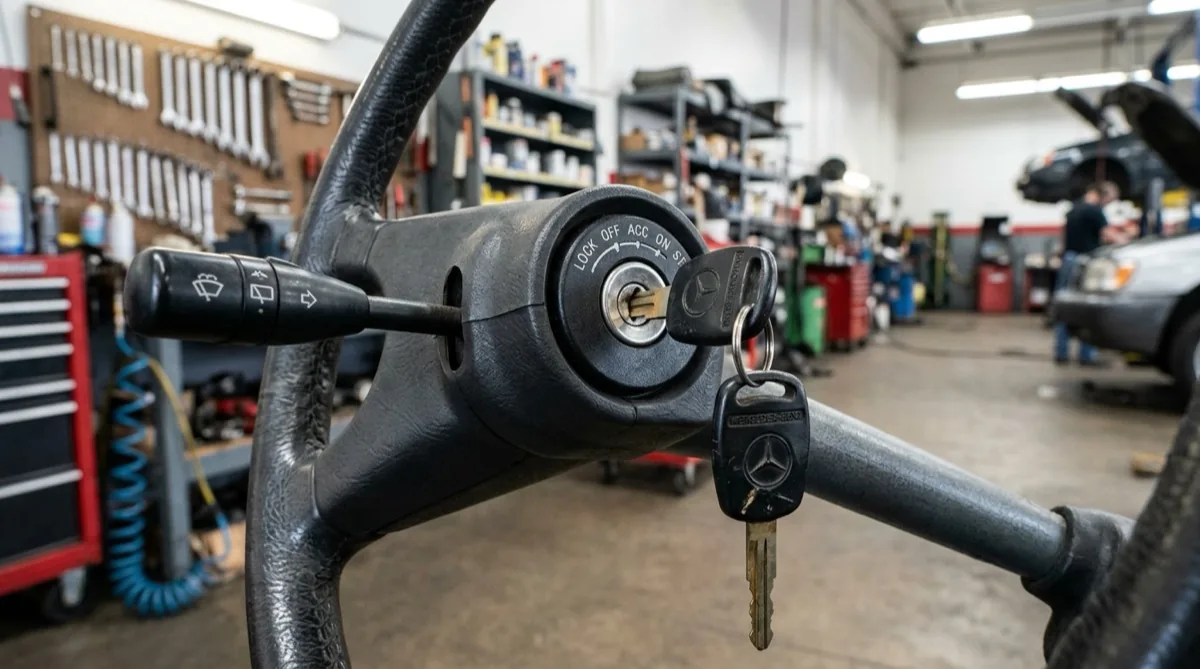
Ignition lock failure can force column replacement on vehicles where the lock cylinder is integrated into the column housing rather than being a separate removable component. On some GM and Ford models from the 1990s and 2000s, the ignition lock is pressed or pinned into the column in a way that makes standalone replacement difficult or impossible without damaging the column housing. When the lock fails on these designs, replacing the entire column is sometimes more practical and cost-effective than attempting to extract and replace just the lock.
For related costs, see our ignition switch replacement cost guide.
Tilt or telescoping mechanism failure creates excessive play or a steering wheel that will not lock in position. On vehicles with manual tilt, the pivot and locking mechanism can wear out, allowing the steering wheel to flop between positions while driving. Power tilt and telescoping systems add electric motors and gear drives inside the column that can strip or seize. When the tilt or telescoping mechanism fails, individual components are rarely available separately, and the repair usually requires a complete column assembly.
Excessive play in the steering column indicates worn universal joints or bearings within the column shaft assembly. A small amount of rotational free play before the front wheels respond is normal, but play that exceeds a quarter inch of steering wheel movement is a safety concern. This slack means the steering wheel can rotate without corresponding wheel movement, reducing steering precision and response time in emergency maneuvers.
Steering Column vs Steering Rack
The steering column and the steering rack are different components in different locations, but they are frequently confused because they are both part of the steering system. Understanding which one has failed determines the correct repair, and the cost difference between the two can be substantial.
The steering column lives inside the cabin. It is the shaft and housing assembly that runs from the steering wheel down through the dashboard to the firewall. The column translates your hand rotation into rotational motion delivered to the steering system below. It also houses the ignition lock, turn signal and wiper switches, the airbag clockspring, and the tilt or telescoping mechanism. Column problems show up as play or looseness at the steering wheel, clicking when turning the wheel, a steering wheel that won't lock in tilt position, or electrical issues with the horn, airbag light, or cruise control.
The steering rack (rack and pinion) lives under the vehicle, mounted to the subframe or crossmember. It converts the rotational motion from the column into the linear, side-to-side movement that turns the front wheels through the tie rods. Rack problems show up as power steering fluid leaks, a groaning or whining noise when turning, uneven tire wear, or the vehicle pulling to one side. Rack replacement typically costs $800 to $2,000 for parts and labor because it requires raising the vehicle, disconnecting tie rod ends, and performing a wheel alignment afterward.
For steering rack pricing, see our guide on whether it's worth replacing rack and pinion.
The intermediate shaft connects the two. This is the shaft that passes through the firewall between the column (inside the cabin) and the rack (under the vehicle). It uses universal joints or a flexible coupling to accommodate the angle change. The intermediate shaft is a separate, replaceable component that costs less than either the column or the rack. A clunk or binding sensation when turning the steering wheel, particularly at low speed, often points to a worn intermediate shaft U-joint rather than a column or rack problem.
Here is how symptoms map to the correct component:
| Symptom | Steering Column | Steering Rack | Intermediate Shaft |
|---|---|---|---|
| Play or looseness at the steering wheel | Yes | Unlikely | Possible |
| Steering wheel won't hold tilt position | Yes | No | No |
| Horn, airbag, or cruise control issues | Yes | No | No |
| Power steering fluid leak | No | Yes | No |
| Whining noise when turning | No | Yes | No |
| Clunk when turning at low speed | Possible | Possible | Yes |
| Vehicle pulls to one side | No | Yes | No |
Airbag and Electrical Considerations
The steering column is not just a mechanical shaft. It is an electrical junction point for several safety-critical systems, and these systems make column replacement more complex than most other chassis or steering repairs.
The clockspring (also called a spiral cable or contact reel) is a coiled ribbon cable inside the column that maintains electrical continuity between the rotating steering wheel and the stationary vehicle wiring. It connects the driver airbag, horn, steering wheel audio and cruise control buttons, and on some vehicles, the heated steering wheel circuit. The clockspring must be centered during column installation. If it is off-center, turning the steering wheel to full lock can break the ribbon, disabling the airbag and other steering wheel controls. A replacement clockspring costs $50 to $200, but used columns from salvage yards typically come with the clockspring included.
The multifunction switch handles turn signals, headlights, wipers, and sometimes cruise control. It mounts on the column below the steering wheel. When sourcing a used column, getting one with the multifunction switch already installed saves a separate purchase and ensures compatibility.
The tilt motor and position sensors on power tilt and telescoping columns add electronic components that need to be matched to the vehicle. Some vehicles store tilt and telescope positions in the body control module and require a relearn procedure after column replacement. This relearn may need a factory scan tool or equivalent diagnostic equipment.
Before any work begins, the battery must be disconnected. The industry standard practice is to disconnect the negative battery terminal and wait a minimum of two minutes (some manufacturers specify up to 10 minutes) before touching any airbag components. This waiting period allows the SRS backup capacitor to discharge. Skipping this step risks accidental airbag deployment, which can cause serious injury.
After installation, an SRS system reset is almost always required. Disconnecting and reconnecting the airbag clockspring and any column-mounted SRS wiring will typically trigger a diagnostic trouble code and illuminate the airbag warning light on the dashboard. Clearing this code requires a scan tool capable of accessing the SRS module. Some vehicles also require a calibration procedure for the steering angle sensor, which is often integrated into the column or its base. This sensor feeds data to the stability control and lane-keeping systems, and an uncalibrated sensor can affect those systems' operation.
DIY Feasibility
Steering column replacement is an advanced repair that falls outside the skill range of most home mechanics. The combination of airbag safety hazards, the volume of components to disconnect and reconnect, and the potential for electronic calibration requirements makes professional installation the recommended path.
Airbag safety is the primary concern. The driver airbag module sits directly on the steering column, and the clockspring connects it to the SRS system. An airbag inflator deploys with enough force to cause fatal injuries if it fires unexpectedly during handling. Professional technicians follow manufacturer-specific disarming procedures, use insulated tools, and understand how to handle inflator modules safely. Without this training, the risk of injury during the repair is real and significant.
The intermediate shaft alignment requires precision. When reconnecting the column to the steering rack through the intermediate shaft, the splined connection must be indexed correctly. If the intermediate shaft is installed one or more splines off, the steering wheel will be off-center when the front wheels point straight ahead. While this can be corrected, getting it right during installation saves a return trip under the dashboard.
Electronic calibration may require dealer-level tools. On vehicles with electric power steering, lane departure warning, or stability control systems, the steering angle sensor in the column base needs to be zeroed after installation. Some aftermarket scan tools can perform this calibration, but many cannot. A dealer or shop with factory-level diagnostic equipment may be needed to complete this step, which partially offsets the labor savings of a DIY approach.
If you have the skills and tools, budget six to eight hours for a first-time column replacement. The work involves removing the steering wheel (requiring an airbag module removal and steering wheel puller), disconnecting all column wiring, unbolting the column from the dash support bracket, disconnecting the intermediate shaft at the firewall, and reversing the entire process with the new column. The job is more tedious than technically difficult, but the number of steps and the safety considerations make it one where mistakes are costly.
For most vehicle owners, the practical choice is sourcing a used steering column at the $166 median price and paying a shop for the three to six hours of labor. The total of $385 to $1,276 is substantially less than the $685 to $2,200 a new OEM column commands, and professional installation ensures the airbag system and electronic calibrations are handled correctly.