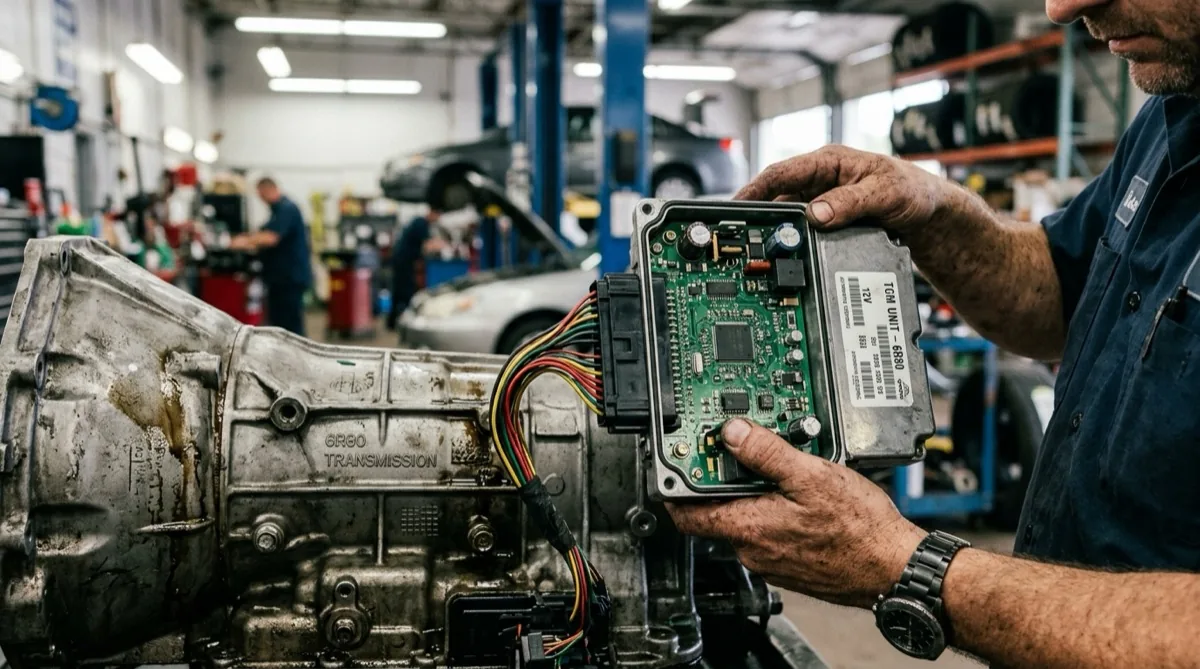
Replacing a transmission control module costs $400 to $1,200 total depending on the vehicle, sourcing path, and whether dealer programming is required. A used TCM from a salvage yard runs roughly $150 median, but programming and labor push the installed price well above the part cost alone.
The TCM is the computer that controls your automatic transmission's shift points, torque converter lockup, and line pressure. When it fails, the transmission cannot shift properly, often defaulting to a single-gear limp mode that limits the vehicle to second or third gear. Unlike a mechanical transmission failure that requires a $3,000-$7,000 rebuild or replacement, a bad TCM is an electronic problem with a comparatively affordable fix, provided the diagnosis is correct.
For current used TCM pricing by vehicle, see our transmission control module pricing page.
- Used TCM + programming: $325-$787 total. The module runs $150 median, programming adds $100-$200, and labor adds $75-$225
- Remanufactured pre-programmed: $400-$900 total. Ships configured to your VIN with no dealer visit for flashing
- New OEM from a dealer: $800-$1,800 total. European and luxury vehicles can exceed $2,000
- Programming is mandatory on most 2005+ vehicles and requires manufacturer-specific diagnostic software
- The TCM is separate from the ECM. The TCM controls the transmission; the ECM controls the engine. Some vehicles combine both into a PCM
- Dataset: 1,092 priced TCM listings across 63 vehicle models, August 2026
What TCM Replacement Costs
TCM replacement involves three cost components: the module, the labor to physically install it, and the programming charge. The programming step is what separates this from a simple bolt-on swap and is where most cost estimates fall short.
| Cost Component | Used + Programming | Reman Pre-Programmed | New OEM (Dealer) |
|---|---|---|---|
| Module cost | $50-$300 (median $150) | $300-$650 | $500-$1,200 |
| Labor (0.5-1.5 hrs) | $75-$225 | $75-$225 | $75-$225 |
| Programming/flashing | $100-$200 | Included | Included |
| Total | $325-$787 | $400-$900 | $800-$1,800 |
The used module price range of $25 to $912 across our index reflects how much vehicle model matters. A TCM for a Honda Accord or Toyota Camry pulls $50 to $120 from salvage, while a BMW or Mercedes unit can run $300 to $900 due to lower salvage availability and integrated electronics.
*Part pricing source: PartPriceGuide.com analysis of 1,092 priced salvage yard listings across 63 vehicle models, August 2026. Labor range consistent with RepairPal national estimates.*
[INTERNAL-LINK: junkyard parts pricing → /blog/price-analysis/how-much-do-junkyards-charge-for-parts]
TCM vs ECM vs PCM: Three Computers, Three Jobs
Modern vehicles use multiple electronic control modules, and confusing them leads to misdiagnosis, wrong parts orders, and wasted money. Here is how the three main powertrain computers differ.
TCM (transmission control module) controls the automatic transmission exclusively. It reads input from the vehicle speed sensor, turbine speed sensor, throttle position sensor, and transmission fluid temperature sensor to determine when and how to shift gears. It also manages torque converter lockup timing and transmission line pressure. When the TCM fails, shifting problems appear, but the engine continues to run normally.
ECM (engine control module) controls the engine. It manages fuel injection, ignition timing, idle speed, variable valve timing, and emissions equipment. When the ECM fails, the engine may not start at all. ECM replacement runs $352 to $679 with a used module plus programming. For a complete breakdown, see our ECM replacement cost guide.
PCM (powertrain control module) combines both functions into a single unit. On vehicles with a PCM, there is no separate TCM. The one computer handles both engine management and transmission control. Most GM, Ford, and Chrysler vehicles from the mid-2000s onward use a PCM rather than separate ECM and TCM units. If your vehicle has a PCM and the transmission shifting is the only problem, you still need to replace the entire PCM, which tends to cost more than a standalone TCM because it handles both systems.
How to tell which module your vehicle has
Check your vehicle's service manual or search for your specific year, make, and model. As a general rule:
- Separate TCM + ECM: Common on Honda, Toyota, Hyundai, Nissan, and many European vehicles
- Combined PCM: Common on GM, Ford, and Chrysler domestic vehicles
- TCM inside the transmission: Some GM and Ford models integrate the TCM into the transmission housing (called a TEHCM on GM), making it a more involved replacement
The module type determines how you shop for parts. If your vehicle has a combined PCM, searching for a "TCM" will not find the correct part. Look up the specific module by part number rather than by acronym.
[INTERNAL-LINK: ECM replacement cost → /blog/repair-costs/ecm-replacement-cost]
Programming Requirements for Used TCMs
A used TCM pulled from a different vehicle will not work correctly without programming, and this step is where the "cheap junkyard part" approach gets more expensive than expected. Programming loads the correct shift calibration tables, adaptive learning parameters, and vehicle-specific configuration into the module.
What programming involves
The technician connects a factory-level scan tool to the vehicle's OBD-II port and performs two operations. First, the module firmware is updated or flashed with the correct calibration file for your vehicle's engine, transmission, axle ratio, and tire size. Second, the TCM is configured to communicate with the other modules on the CAN bus network, including the ECM, ABS module, and body control module.
What it costs
TCM programming runs $100 to $200 at most dealerships, somewhat less than ECM programming because the calibration files are smaller and the security handshake is simpler. Independent shops with manufacturer-specific software (GM SPS, Ford FDRS, Toyota Techstream) can perform the same service, often at the lower end of the range. General-purpose aftermarket scan tools cannot program most TCMs.
The pre-programmed alternative
Remanufactured TCMs sold as "VIN-programmed" ship with the correct calibration already loaded. You provide your VIN at purchase, and the rebuilder flashes the module before shipping. After installation, the technician performs a quick module initialization and adaptive learning reset with a scan tool, but no dealer programming appointment is needed. This path costs more for the module ($300-$650 versus $50-$300 for a used unit) but eliminates the $100-$200 programming charge and the logistics of a separate dealer visit.
Vehicles that skip programming
A small number of older vehicles (generally pre-2005) use TCMs that are plug-and-play as long as the part number matches. These modules store their calibration in non-volatile memory and do not require VIN-specific flashing. If your vehicle falls into this category, a used TCM is genuinely a bolt-in replacement with no additional cost beyond labor. Your service manual or a quick call to a dealer parts counter can confirm whether your TCM requires programming.
Bad TCM Symptoms
TCM failure produces transmission-specific symptoms that are distinct from mechanical transmission problems. Recognizing these patterns helps avoid an unnecessary $3,000-$7,000 transmission rebuild when the actual problem is a $400-$1,200 electronic module.
The transmission shifts erratically or harshly. The most common TCM failure symptom is unpredictable shifting. The transmission may slam into gear, shift at the wrong RPM, skip gears, or hunt between two gears repeatedly. These symptoms worsen when the module overheats or after the vehicle has been driven for an extended period.
The transmission is stuck in one gear (limp mode). When the TCM detects an internal fault, it defaults to a single-gear failsafe mode to prevent further damage. Limp mode typically locks the transmission in second or third gear, allowing you to drive at reduced speed but preventing normal shifting. The check engine light illuminates, and the vehicle feels sluggish because it cannot upshift.
Delayed or no engagement from park. Shifting from park to drive or reverse produces a long delay (3-5 seconds or more) before the transmission engages, or the vehicle does not move at all. This happens when the TCM fails to command the correct solenoid to apply the forward or reverse clutch pack.
The check engine light is on with transmission codes. Diagnostic trouble codes associated with TCM failure include:
- P0700 - Transmission control system malfunction (general)
- P0613 - TCM processor error
- P0614 - ECM/TCM incompatible (communication failure between modules)
- U0101 - Lost communication with TCM
- P0706 through P0770 - Various solenoid and sensor circuit codes that indicate the TCM is sending incorrect commands
The torque converter does not lock up. The TCM controls torque converter clutch engagement. When the TCM fails to command lockup, you notice increased RPM at highway speed, reduced fuel economy, and sometimes a shudder at cruising speed. This symptom is easy to confuse with a worn torque converter clutch, so scan data showing the TCM is not commanding lockup helps isolate the cause.
Before replacing the TCM: have a technician verify the module is the actual failed component. A corroded connector at the TCM harness, a damaged ground wire, or low transmission fluid can produce every symptom listed above. Checking the TCM connector for corrosion, verifying power and ground circuits with a multimeter, and confirming the transmission fluid level and condition takes 30 minutes and can save hundreds of dollars in unnecessary parts.
[INTERNAL-LINK: transmission shifting problems → /blog/part-guides/transmission-slipping-causes-repair-cost]
Repair vs Replace: When Each Option Makes Sense
Not every TCM problem requires a full replacement. In some cases, a repair or reflash resolves the issue at a fraction of the cost.
TCM reflash (software update)
Some shifting problems are caused by outdated software rather than hardware failure. Manufacturers issue technical service bulletins (TSBs) with updated calibration files that correct shift timing, line pressure, and torque converter lockup behavior. A reflash at the dealer costs $100 to $150 and takes under an hour. This is worth trying before replacing the module, especially if the symptoms appeared gradually rather than suddenly.
TCM circuit board repair
A subset of TCM failures are caused by cracked solder joints, blown capacitors, or corroded circuit traces rather than a completely dead processor. Companies that specialize in automotive electronics repair can reflow solder joints and replace failed components on the circuit board for $150 to $350, returning the original module with its existing calibration intact. This eliminates the need for reprogramming entirely, since the repaired module retains its original data.
This approach works best for known failure patterns. For example, certain GM 6T70 and 6T75 transmission modules (TEHCM units) develop cracked solder joints at specific connector pins, and board-level repair has a high success rate for that specific failure mode.
Full replacement
Replace the TCM outright when the module has suffered physical damage (water intrusion, heat damage, cracked housing), when the processor itself has failed (verified by a technician who has ruled out wiring and connector issues), or when the vehicle has diagnostic codes pointing to an internal processor error (P0613). A full replacement is also the faster path when the vehicle is not drivable and downtime matters more than saving $100-$200 on a repair attempt.
Cost comparison
| Option | Cost | Downtime | Programming Needed? |
|---|---|---|---|
| Software reflash | $100-$150 | Under 1 hour | No (update only) |
| Circuit board repair | $150-$350 | 3-7 days (ship-out) | No (original data retained) |
| Used TCM + programming | $325-$787 | 1-2 days | Yes |
| Reman pre-programmed | $400-$900 | 1-3 days (shipping) | No |
| New OEM (dealer) | $800-$1,800 | Same day | No (arrives programmed) |