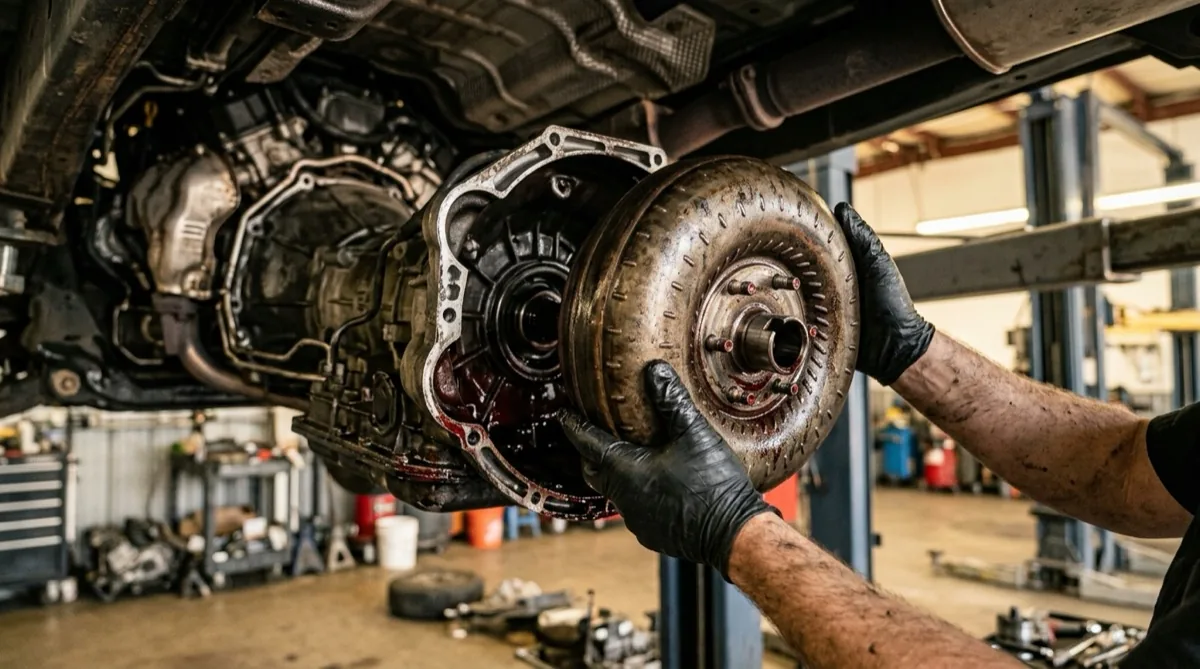
Replacing a torque converter costs $845 to $2,075 total when you install a used unit, or $720 to $2,300 with a remanufactured converter. The part itself is a modest expense at $275 median for a used converter. What drives the bill up is a single mechanical fact: the transmission has to come out to reach it.
That means every torque converter job carries the same $570 to $1,800 in labor as a full transmission replacement, because the remove-and-reinstall procedure is identical. You are paying transmission job prices for a $275 part, and that labor-to-part ratio is the most important thing to understand before approving a repair estimate.
For a detailed breakdown, see our used transmission cost analysis guide.
- Total cost with a used torque converter: $845–$2,075. The part is $275 median; labor is $570–$1,800
- Labor matches a transmission replacement because the transmission must be removed to access the converter
- Remanufactured converters run $150–$500, new OEM runs $300–$800, but labor stays the same regardless of part source
- Always replace the TC during transmission work. Adding a $275 part while the transmission is already out avoids paying $570–$1,800 in labor a second time
- Most common symptom: a shudder between 30 and 50 mph that feels like driving over rumble strips
- Data source: 1,245 priced torque converter listings, August 2026
What Torque Converter Replacement Costs
Torque converter replacement breaks into two line items: the converter itself and the labor to remove and reinstall the transmission. Labor does not change based on which converter you buy, so the choice between used, remanufactured, and new only moves the smaller number.
| Cost Component | Used | Remanufactured | New OEM |
|---|---|---|---|
| Part cost | $150–$400 (median $275) | $150–$500 | $300–$800 |
| Labor (6–12 hrs at $95–$150/hr) | $570–$1,800 | $570–$1,800 | $570–$1,800 |
| Total | $845–$2,075 | $720–$2,300 | $870–$2,600 |
Dealer estimates typically land between $1,500 and $2,200+ because dealers bill higher hourly rates and use new OEM converters. An independent shop using a remanufactured converter on a truck can come in under $1,000.
*Part pricing source: PartPriceGuide.com analysis of 1,245 salvage yard torque converter listings, August 2026. Labor range based on standard transmission R&R book times and national shop rate surveys.*
Why It Costs As Much As a Transmission Job
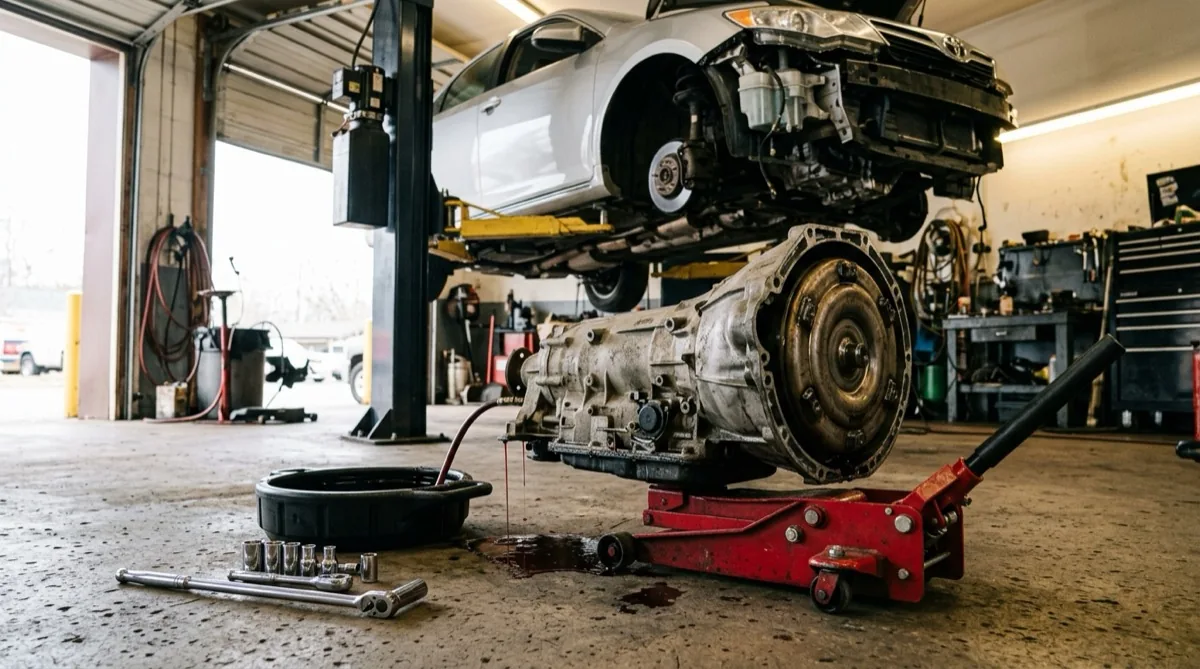
The torque converter sits between the engine's flexplate and the transmission's input shaft, sealed inside the bellhousing. There is no access panel, no shortcut, and no way to remove it without pulling the entire transmission out of the vehicle first.
Here is what that procedure involves:
- Drain the transmission fluid and disconnect all cooler lines, electrical connectors, and shift linkage
- Support the engine from above and the transmission from below with a transmission jack
- Remove the driveshaft (RWD) or axle shafts (FWD)
- Unbolt the transmission from the engine block and lower it out
- Slide the torque converter off the transmission input shaft
- Install the new converter, reassemble everything in reverse order
- Refill transmission fluid, check for leaks, and road-test
Steps 1 through 4 and 6 through 7 are the same whether you are replacing the torque converter, the transmission, or both. The converter swap itself, step 5, takes about ten minutes. Everything else is transmission removal and reinstallation.
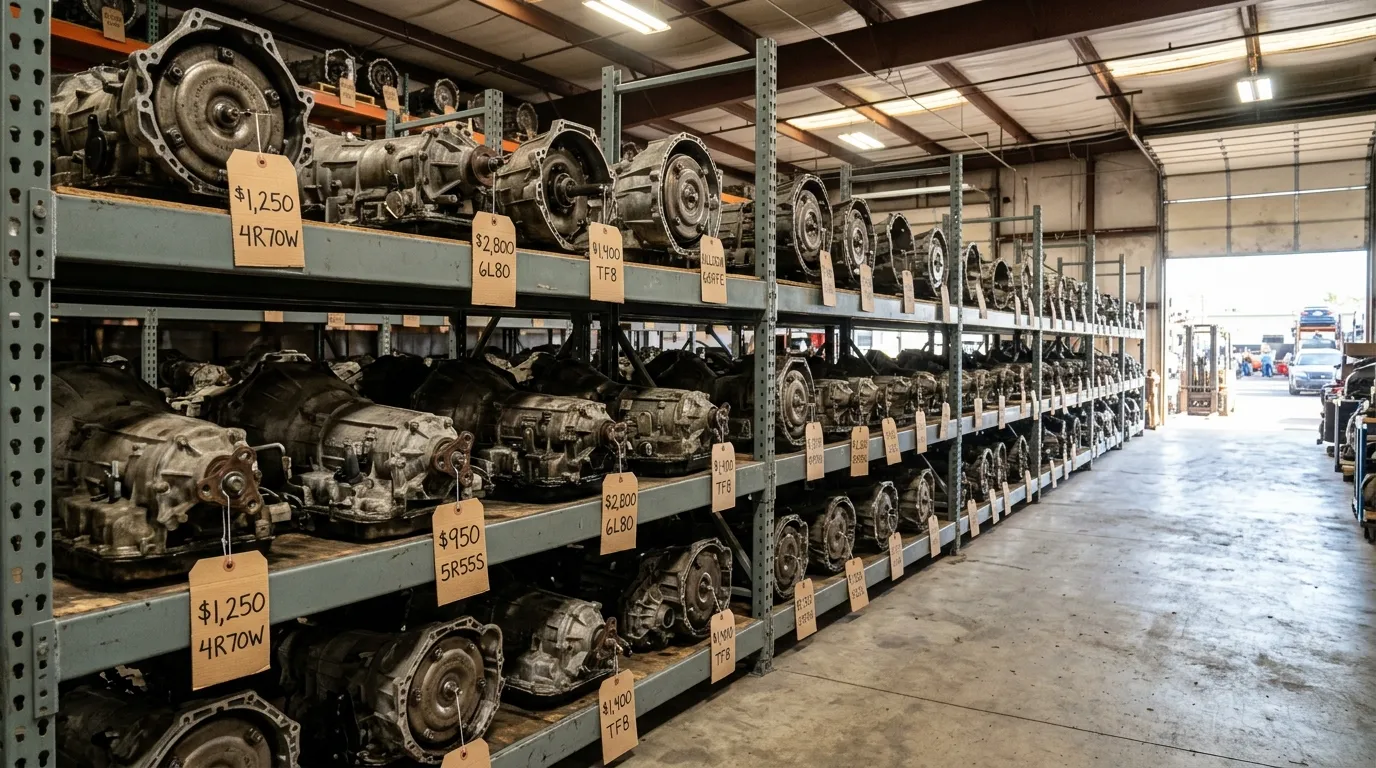
This is why torque converter labor ($570 to $1,800) matches transmission replacement labor nearly dollar for dollar. The used transmission in our index runs a median of $1,400 across 95,948 listings, which means a transmission swap is more expensive on the parts line but identical on the labor line.
Bad Torque Converter Symptoms
A failing torque converter usually announces itself gradually. Catching it early matters because a damaged converter can contaminate the transmission fluid with metal debris, turning a converter-only repair into a full transmission rebuild.
Shudder Between 30 and 50 MPH
The signature symptom. The lockup clutch inside the converter begins to slip and grab inconsistently, producing a vibration that feels like driving over rumble strips or a rough road surface. It typically appears during light acceleration in the 30 to 50 mph range when the lockup clutch is trying to engage. Some manufacturers issued TSBs (Technical Service Bulletins) for specific models prone to this condition, and a fluid flush with updated fluid sometimes resolves early-stage shudder without a full replacement.
Transmission Slipping
A worn converter cannot transfer engine torque to the transmission efficiently. You may notice the engine revving higher than normal without a corresponding increase in speed, or brief moments where the vehicle loses forward drive before catching again.
Delayed or Harsh Engagement
When you shift from park or neutral into drive or reverse, a failing converter may cause a noticeable delay before the vehicle moves, or a harsh clunk when it finally engages.
Overheating Transmission Fluid
A slipping converter generates excess heat. If your temperature gauge shows the transmission running hot, or if the fluid on the dipstick appears dark brown and smells burnt, converter slip is a common cause.
Stalling at Low Speed or Idle
In severe cases, the converter's internal components can seize or lock at the wrong time, causing the engine to stall when you come to a stop, similar to stalling a manual transmission without pressing the clutch.
Diagnostic Trouble Code P0740
The OBD-II code P0740 (Torque Converter Clutch Circuit Malfunction) points directly at the converter's lockup clutch circuit. Related codes include P0741 (clutch stuck off), P0742 (clutch stuck on), and P0743 (electrical fault). These codes narrow the diagnosis but do not always mean the converter itself is bad; wiring, the solenoid, or the TCM can trigger the same codes.
Replace the TC During Transmission Work?
Almost always, yes.
If you are already paying to have the transmission removed for any reason, whether for a rebuild, a replacement, a rear main seal, or a flexplate, adding a new or remanufactured torque converter at that point costs only the price of the part. You pay zero additional labor because the converter slides on and off the transmission input shaft while the transmission is out, a step that takes minutes.
Here is the math on skipping it versus doing it:
| Scenario | Part cost | Labor cost | Total added cost |
|---|---|---|---|
| Replace TC during transmission job | $150–$500 | $0 (already included) | $150–$500 |
| Replace TC later as a separate job | $150–$500 | $570–$1,800 | $720–$2,300 |
The one exception is a nearly new converter on a vehicle with low miles where the transmission is being removed for an unrelated reason (a rear main seal leak, for example). Even then, many technicians will recommend replacing it simply because the incremental cost is small relative to the risk.
For a detailed breakdown, see our transmission replacement cost breakdown guide.
Cost by Vehicle Type
Vehicle type determines both the labor time and the part price. Rear-wheel-drive trucks and body-on-frame SUVs are the cheapest because the transmission drops from underneath without fighting front suspension, axle shafts, or subframe bolts. Front-wheel-drive and all-wheel-drive vehicles add complexity and hours.
| Vehicle Type | Typical Labor | Used TC Price Range | Estimated Total |
|---|---|---|---|
| RWD truck (F-150, Silverado, Ram) | $570–$950 | $200–$350 | $770–$1,300 |
| RWD body-on-frame SUV (Tahoe, 4Runner) | $600–$1,000 | $200–$375 | $800–$1,375 |
| FWD sedan/crossover (Camry, Accord) | $760–$1,400 | $225–$350 | $985–$1,750 |
| FWD/AWD V6 crossover (Highlander, Traverse) | $950–$1,600 | $250–$400 | $1,200–$2,000 |
| European luxury (BMW, Mercedes, Audi) | $1,100–$1,800 | $300–$500 | $1,400–$2,300 |
For salvage yard pricing on converters and transmissions by make and model, check our torque converter and transmission price lookup pages.
For a detailed breakdown, see our junkyard parts pricing guide guide.