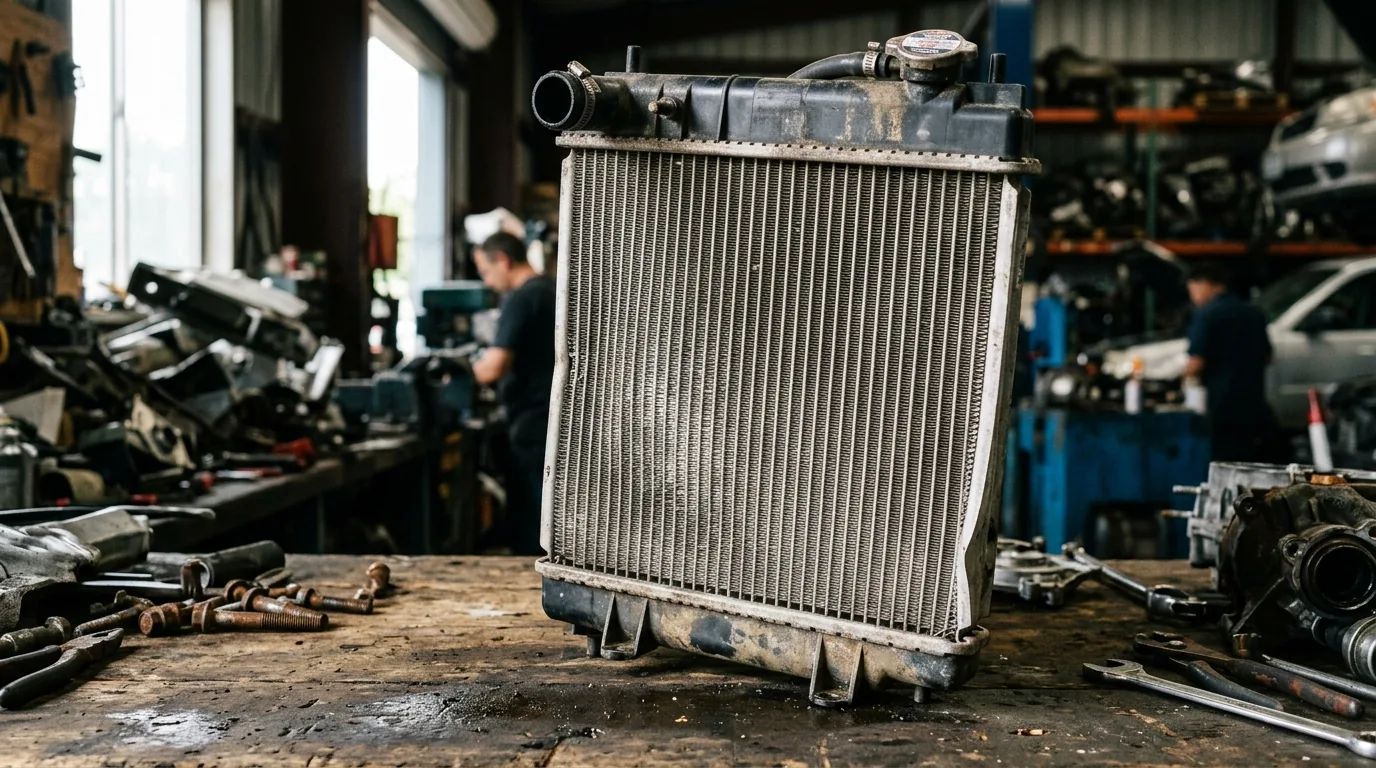
A used radiator costs $172 at the median, with model medians running from $106 to $323. That range comes from 41,113 priced salvage yard listings across 51 vehicle models, real asking prices from yards nationwide, not repair shop estimates or dealer quotes.
The spread is tighter than most salvage parts. A Subaru Impreza radiator sits at $106 while a Nissan Pathfinder radiator sits at $323, roughly a 3x gap, compared to the 12.5x gap we measured on transfer cases. Radiators are simple, high-volume parts, and that keeps prices compressed.
- Median used radiator price: $172 across 41,113 priced salvage yard listings, average $185
- Model medians range from $106 to $323: only a 3x spread, one of the tightest of any part we track
- Cheapest models: Subaru Impreza and Outback ($106), Nissan Sentra ($120), Chevy Malibu ($125)
- Most expensive: Nissan Pathfinder ($323), BMW X5 ($318), Nissan Rogue ($285)
- Condition grade barely moves the price: Grade A to Grade B is only $9, because a radiator either holds pressure or it doesn't
- New aftermarket radiators cost $80 to $250, so used mainly makes sense when you specifically need OEM
Overall Used Radiator Pricing
Across all 41,113 priced listings in the PartPriceGuide index, here's what used radiators actually sell for:
| Metric | Price |
|---|---|
| Median | $172 |
| Average | $185 |
| Lowest model median | $106 (Subaru Impreza / Outback) |
| Highest model median | $323 (Nissan Pathfinder) |
| Models with data | 51 |
| Priced listings | 41,113 |
You'll still see extreme individual listings, a Toyota Highlander listing at $11,573 and a Toyota Camry at $6,500 exist in the data. Those are almost always mispriced entries, bundled assemblies, or full front-end packages listed under the radiator category. Ignore them. The median is the number to plan around.
For most mainstream sedans and crossovers, budget $140 to $200. For full-size trucks and body-on-frame SUVs, budget $210 to $280. For German luxury, budget $250 to $330.
*Source: PartPriceGuide.com analysis of 41,113 salvage yard listings, August 2026.*
Prices by Vehicle Model
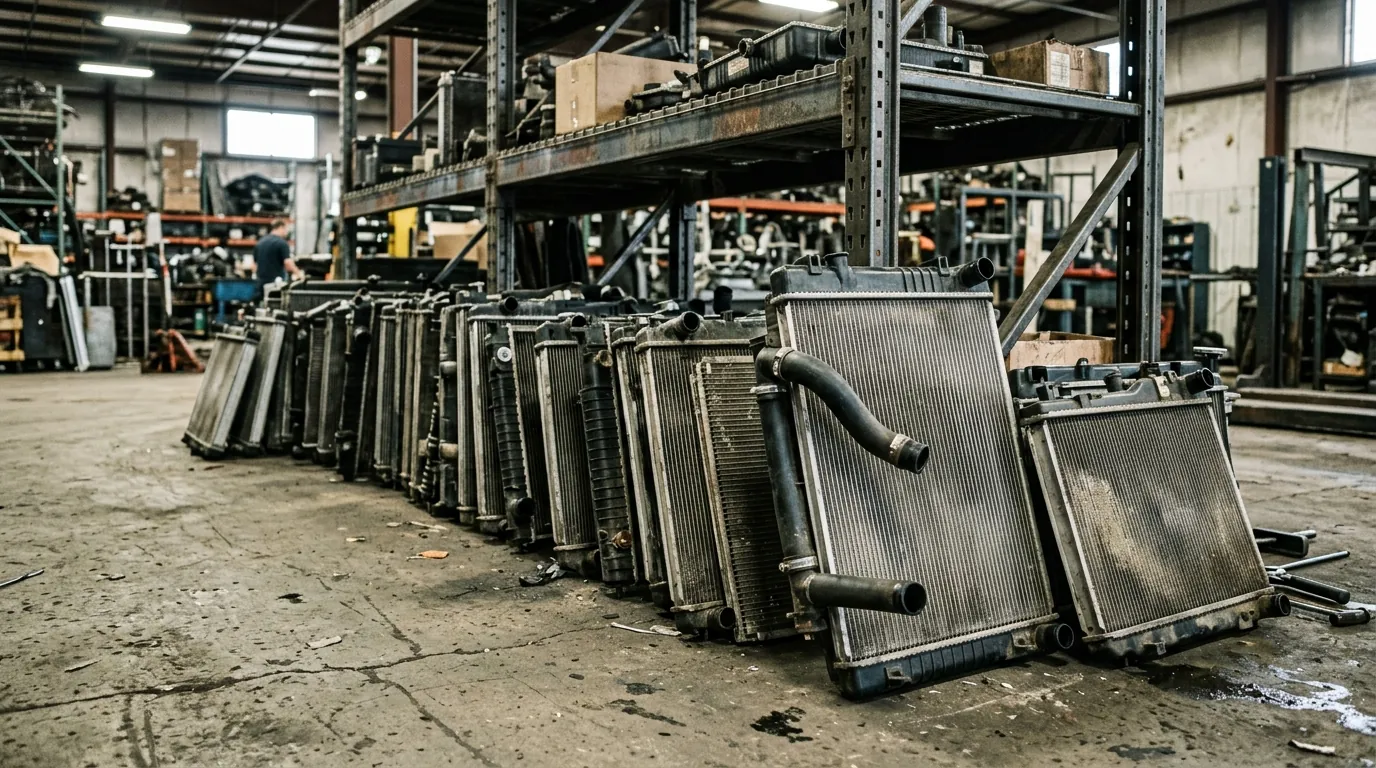
This is where flat-rate estimates fall apart. The table below shows actual pricing for the 20 most-listed radiator models in our index:
| Vehicle Model | Median | Avg | Min | Max | Listings |
|---|---|---|---|---|---|
| Jeep Wrangler | $160 | $168 | $35 | $1,450 | 2,368 |
| Ford Explorer | $164 | $186 | $50 | $491 | 2,333 |
| Jeep Grand Cherokee | $176 | $192 | $50 | $1,200 | 2,094 |
| Mercedes E-Class | $250 | $340 | $25 | $2,223 | 2,030 |
| Chevy Silverado 1500 | $225 | $232 | $20 | $550 | 1,810 |
| Mercedes C-Class | $272 | $398 | $50 | $2,500 | 1,497 |
| Toyota RAV4 | $178 | $238 | $50 | $1,954 | 1,297 |
| Ford F-150 | $177 | $201 | $50 | $1,325 | 1,286 |
| Hyundai Elantra | $188 | $215 | $41 | $1,637 | 1,279 |
| Chevy Tahoe | $224 | $236 | $45 | $944 | 1,267 |
| GMC Yukon | $278 | $299 | $25 | $1,090 | 1,252 |
| GMC Sierra 1500 | $210 | $218 | $20 | $550 | 1,241 |
| Dodge Durango | $150 | $165 | $35 | $755 | 1,113 |
| Ford Escape | $168 | $168 | $50 | $473 | 1,110 |
| Toyota Highlander | $243 | $568 | $45 | $11,573 | 1,064 |
| Toyota Camry | $170 | $288 | $50 | $6,500 | 1,058 |
| BMW X3 | $235 | $332 | $45 | $2,324 | 992 |
| Honda Accord | $140 | $159 | $35 | $650 | 986 |
| BMW X5 | $318 | $602 | $25 | $2,900 | 978 |
| Nissan Pathfinder | $323 | $675 | $50 | $2,474 | 844 |
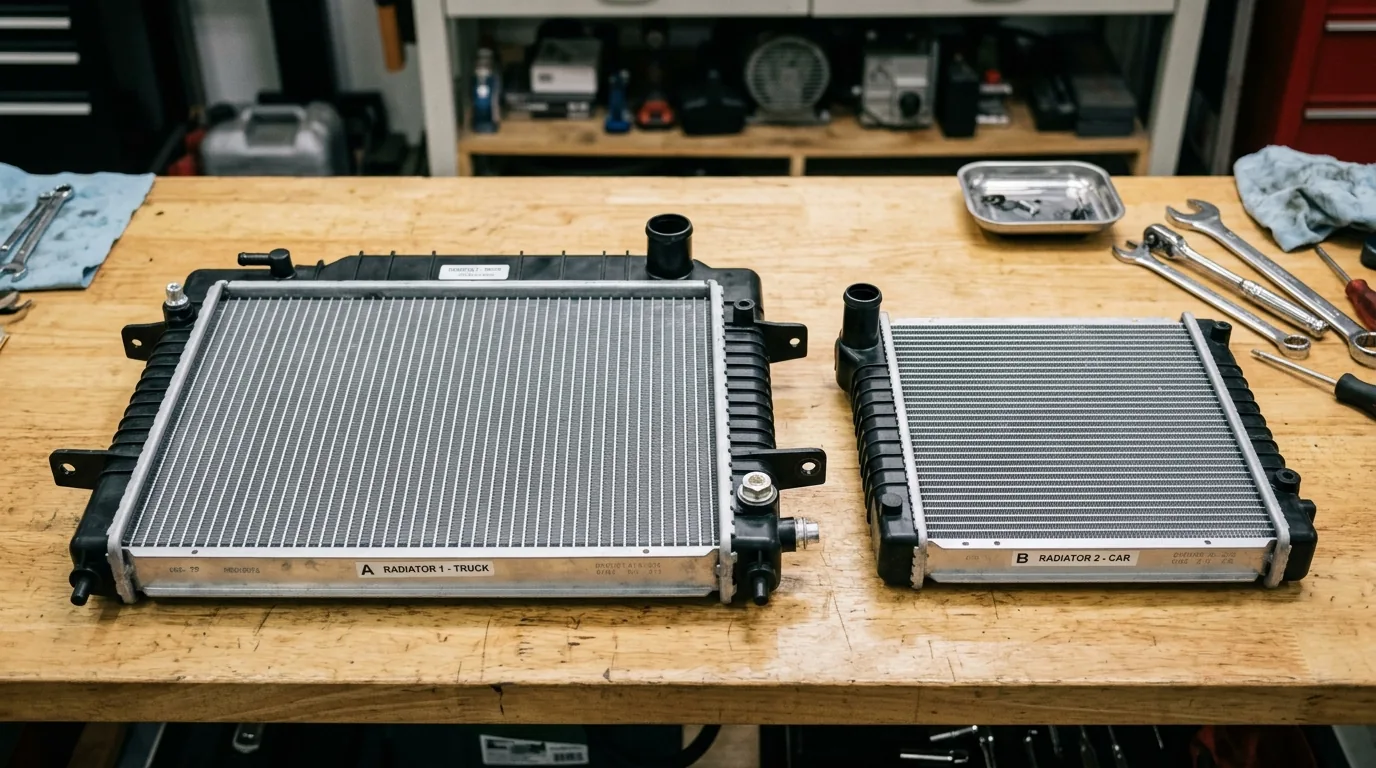
Size tracks price more than brand does. The Honda Accord ($140) and Jeep Wrangler ($160) sit at the bottom of this list, and both use physically compact cores. The GMC Yukon ($278) and Chevy Tahoe ($224) use large truck cores with integrated transmission coolers. The correlation between core volume and price is stronger here than on any other part we track.
Volume compresses the range, not the median. The Jeep Wrangler has the most listings (2,368) and a tight $160 median with a $168 average, an $8 gap. High supply doesn't drive the price to zero; it just eliminates the outliers. Compare that to the Nissan Pathfinder, where 844 listings produce a $323 median but a $675 average, because thin supply lets individual sellers ask whatever they want.
German luxury carries a real premium. The Mercedes C-Class ($272), BMW X5 ($318), and BMW X3 ($235) all price above comparably sized mainstream vehicles. These radiators frequently arrive as part of a cooling module with the condenser, auxiliary fan, and intercooler pre-assembled, and yards price the assembly rather than the bare core.
Watch the min column. Several models bottom out at $20 to $35, Silverado, Sierra, Wrangler, Honda Accord. Those are almost always self-service yard prices where you pull the part yourself, or cores being sold at scrap-adjacent value. If you're willing to do the labor, the floor is far below the median.
Check the exact price for your vehicle on a model page like Honda Civic radiator prices, available for all 51 models in our index.
How Condition Grade Affects Price
Salvage yards assign letter grades to indicate part condition. Here's how grading moves radiator pricing:
| Grade | Median | What It Means |
|---|---|---|
| A (Best) | $180 | Low-mileage donor, no visible core damage, tested |
| B (Mid) | $171 | Higher-mileage donor, minor fin damage, functional |
| X (Ungraded) | $150 | Not inspected or graded by the yard |
| C (Lower) | $100 | Visible damage, bent fins, cosmetic or structural issues |
Here's why. A transfer case is a mechanical assembly with chains, bearings, shift forks, and seals, all wearing at different rates. Two units that look identical from the outside can be worlds apart internally, which is why the Grade A premium on transfer cases is $97 (38%). A radiator isn't like that. It's a sealed heat exchanger. It either holds pressure and flows coolant, or it has a leak, a blocked core, or a cracked end tank. There's very little middle ground.
That binary quality means grade tells you less than it does elsewhere. A Grade B radiator with slightly bent fins from a fender bender still cools exactly as well as a Grade A unit, assuming the core is sound. Yards know this, so the pricing barely differentiates.
Grade C is the real dividing line. At a $100 median, Grade C radiators sit 44% below Grade A. That discount reflects actual damage, crushed fins across a meaningful fraction of the core, impact deformation, or corrosion at the tank crimp. A Grade C radiator can still work, but the reduced fin area cuts cooling capacity, and that shows up as high temps under load or while towing. Skip Grade C unless you're doing a temporary repair on a vehicle you're about to sell.
Grade X (ungraded) at $150 is a coin flip. These haven't been inspected, so the yard prices them below graded stock to move them. If the yard allows a pressure test before purchase, Grade X is the best value in the table. If it's a no-returns online listing, the $30 you save over Grade A isn't worth the risk of a second teardown.
The practical takeaway: for radiators, buy on donor vehicle age and a pressure test, not on letter grade. A three-year-old Grade B radiator beats a twelve-year-old Grade A one every time, because the failure mode is heat-cycle embrittlement of the plastic end tanks, and that's a function of calendar age and thermal cycles, not the yard's visual inspection.
*Source: PartPriceGuide.com grade-level analysis across 41,113 listings, August 2026.*
Cheapest and Most Expensive Radiators
Five cheapest models
| Model | Median | Why It's Cheap |
|---|---|---|
| Subaru Impreza | $106 | Compact boxer-engine core, huge production volume, simple single-row design |
| Subaru Outback | $106 | Shares the Impreza platform and cooling architecture almost exactly |
| Nissan Sentra | $120 | Small economy-car core, no integrated coolers, abundant salvage supply |
| Chevy Malibu | $125 | High-volume fleet sedan, thin single-purpose core |
| Jeep Cherokee | $132 | Unibody crossover core, far smaller than the Grand Cherokee unit |
Five most expensive models
| Model | Median | Why It's Expensive |
|---|---|---|
| Nissan Pathfinder | $323 | Large SUV core with integrated transmission cooler, known CVT cooler cross-contamination history drives replacement demand |
| BMW X5 | $318 | Cooling module sold as an assembly, model-specific mounting, thick multi-row core |
| Nissan Rogue | $285 | CVT cooler integration and strong replacement demand relative to salvage supply |
| GMC Yukon | $278 | Full-size body-on-frame core, tow-package transmission cooler built in |
| Hyundai Tucson | $273 | Newer platform with limited salvage supply, integrated cooling module |
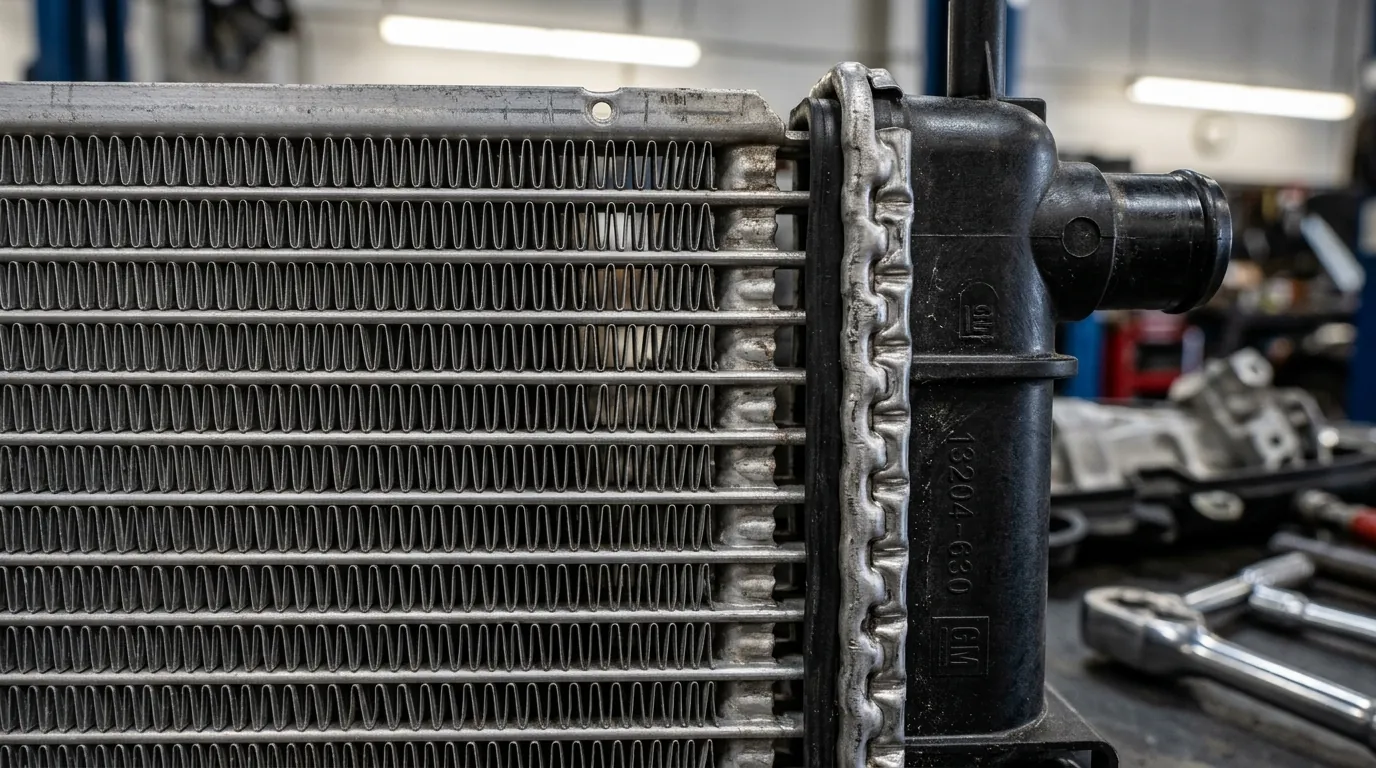
Physical size. A full-size SUV radiator can be twice the core volume of a compact sedan unit. More aluminum, more tube rows, more fin area, all of which cost more to manufacture and are worth more even as scrap. This sets a hard price floor: a yard will never sell a Yukon radiator for $60, because the aluminum alone is worth more than that to a recycler.
Integrated components. Many truck and SUV radiators have a transmission oil cooler built into one end tank, and some have engine oil coolers as well. That makes the part a multi-function assembly rather than a single heat exchanger, and it makes it non-substitutable; you can't drop a non-tow-package radiator into a tow-package truck.
OEM complexity and module packaging. German and Korean platforms increasingly ship the radiator, condenser, fan shroud, and intercooler as a bonded module. Yards pull and sell the whole module because separating it risks damaging the condenser. You pay for parts you may not need, which is why the BMW X5 average ($602) runs so far above its median ($318), some listings are bare radiators, others are complete front cooling packs.
Scrap value sets the floor. This is the underappreciated one. Radiators are among the most aluminum-dense parts in a vehicle. Even a badly damaged unit has real scrap value, which is why you almost never see a radiator listed under $20 regardless of condition. That floor is why the Grade C median ($100) is still a meaningful number rather than a giveaway price.
For a deeper look at whether a radiator from a different model or year will physically fit yours, see our guide on whether radiators are universal.
Where to Buy a Used Radiator
Used radiators come from three channels, and the price difference between them is larger than the difference between condition grades.
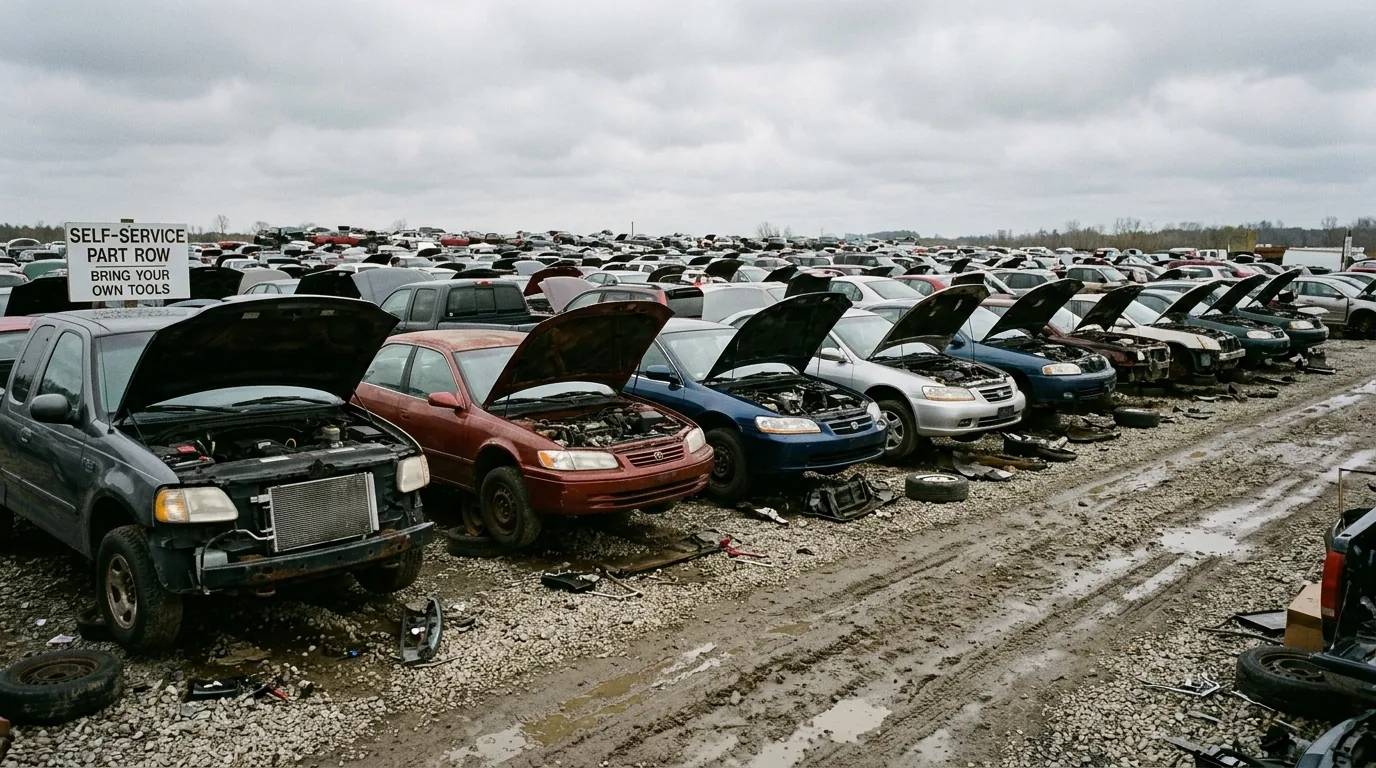
Self-service junkyards (Pull-A-Part, LKQ Pick Your Part, U-Pull-It) are the cheapest option by a wide margin. Many chains price radiators on a flat rate regardless of vehicle, often $30 to $60, which is where those $20 to $35 minimums in the model table come from. A Yukon radiator that costs $278 at a full-service yard might cost you $45 at a self-service lot.
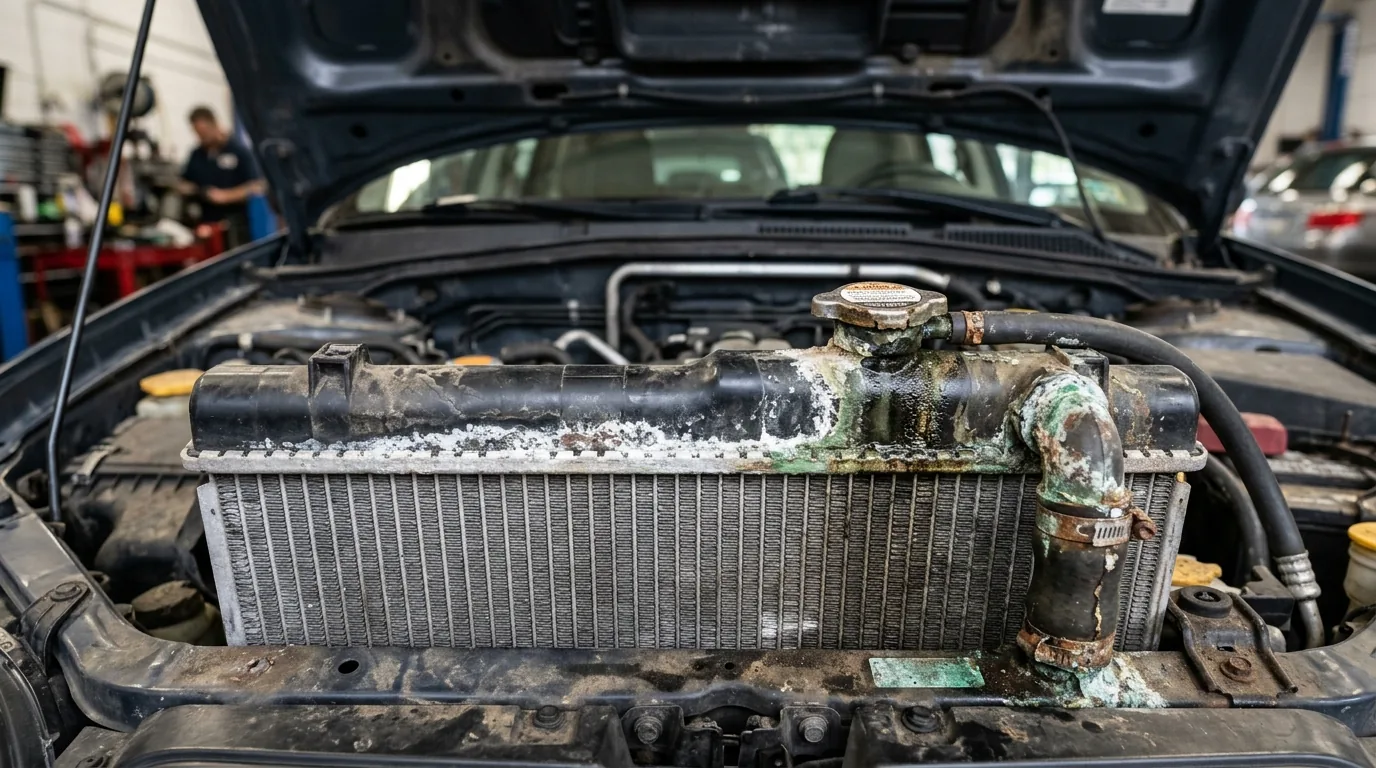
The catch is labor and risk. Pulling a radiator means draining coolant (dispose of it properly per EPA guidelines), removing the fan shroud and upper hose, disconnecting transmission cooler lines on trucks, and lifting the core out without bending the fins against the condenser. Budget 45 to 90 minutes. The bigger risk is that you can't pressure-test in the yard, so you're buying blind on the one thing that actually matters. Bring a flashlight and inspect the end tank seams and the lower corners for white or green crust, that's dried coolant, and it means the unit leaks.
For chain-by-chain pricing and what to expect at the counter, read our junkyard radiator price guide.
Full-service salvage yards pull, clean, and often pressure-test the part before it reaches the shelf. This is where the bulk of our 41,113 listings originate, and the $172 median reflects this channel. Most offer 30 to 90 day warranties, which is meaningful on a part where the failure mode is a slow leak you won't discover for two weeks. If the yard tests, the modest premium over self-service is money well spent.
Online recyclers (Car-Part.com, eBay Motors) offer the deepest selection, especially for low-volume models where your local yards have nothing. Shipping runs $30 to $80 because radiators are bulky and fragile, and shipping damage is a genuine problem, bent fins and cracked end tanks from poor packing are common complaints. Insist on listings that show photos of the actual unit and confirm the seller boxes with corner protection. Useful when you need a specific configuration (tow package, heavy-duty cooling, specific engine option) that isn't in local stock.
Whichever channel you use, confirm the part number or interchange number before buying. Radiators vary within the same model year by engine option, transmission type, and tow package. Your VIN will resolve which variant your vehicle uses.
Used vs Aftermarket vs OEM New
This is the section that matters most, and the answer is different from most other salvage parts.
| Factor | Used (Salvage) | New Aftermarket | New OEM |
|---|---|---|---|
| Price range | $106–$323 | $80–$250 | $300–$900 |
| Median price | $172 | ~$140 | ~$500 |
| Warranty | 30–90 days | 1 year to lifetime | 1–2 years |
| Expected life | 5–8 years | 7–12 years | 10–15 years |
| Fit certainty | Exact, if part number matches | Good, occasional bracket variance | Exact |
| Lead time | Same-day at yards | 1–3 day shipping | 1–5 days, sometimes special order |
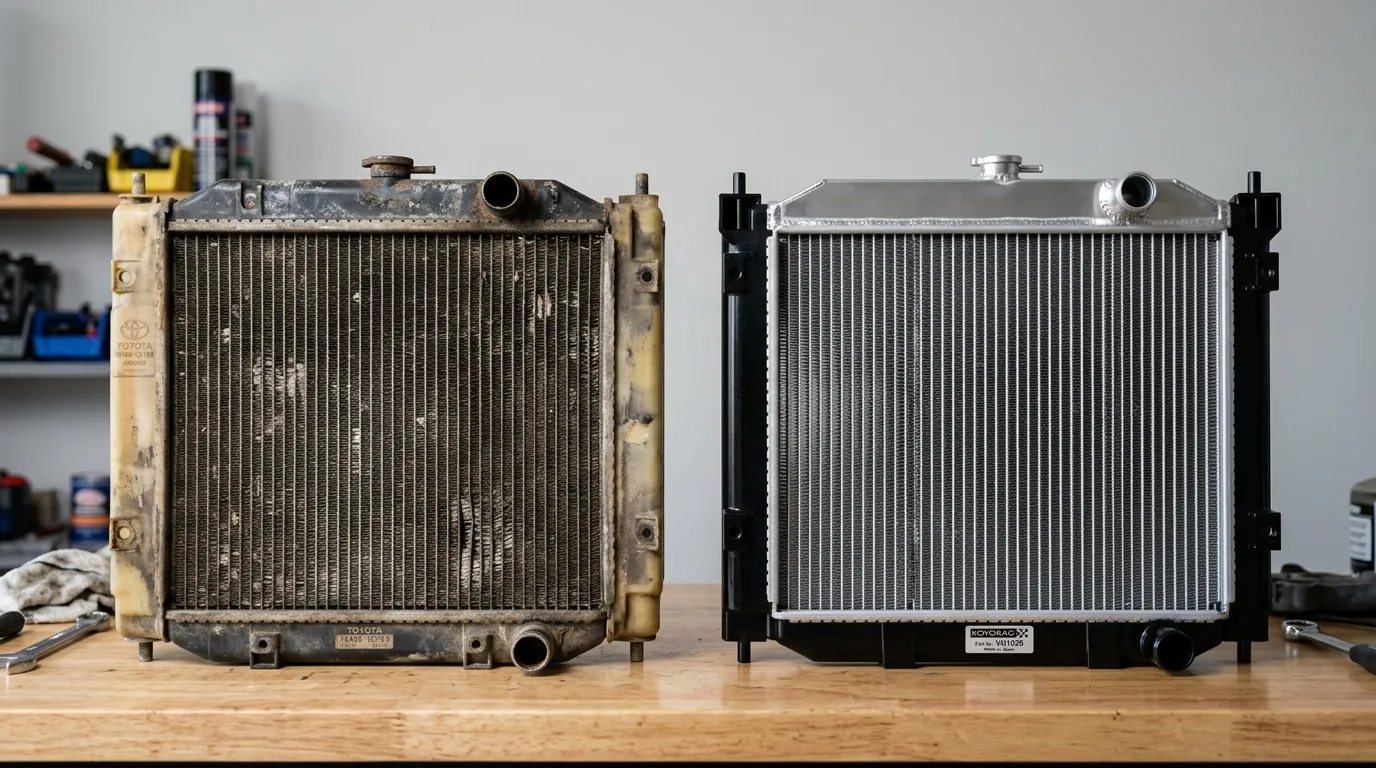
That's unusual. On a transfer case, used saves you 70 to 85% over new. On a radiator, used often saves you nothing, and sometimes costs more. Radiators are a mature, commoditized, high-volume manufactured good, and offshore production has pushed new prices down to where the salvage market can't undercut them on most vehicles.
When used genuinely makes sense:
- You want OEM and OEM-new is expensive. For a BMW X5, Mercedes C-Class, or a late-model truck with a tow package, new OEM can be $500 to $900. A $318 used OEM unit is a real saving, and you get exact factory fit including bracket geometry and cooler line placement.
- Aftermarket support for your vehicle is thin. Very new platforms and low-volume models often have no aftermarket option at all for the first few years. Salvage is your only alternative to the dealer.
- You're at a self-service yard. At $30 to $60 flat rate, used wins on price against anything, provided you accept the no-test risk.
- You need it today. Yards have it on the shelf. Aftermarket needs shipping unless a local parts store stocks your application.
- You're keeping the car under two more years. A five-year horizon on a used unit is plenty when you're selling next spring.
When new aftermarket is the better call:
- Mainstream vehicle, mainstream engine. Accord, Camry, Malibu, Elantra, Escape, the aftermarket is saturated and cheap. Pay $110 for new with a warranty rather than $150 for used with 30 days.
- You want the warranty. Radiator replacement labor runs $250 to $500 at a shop. If the part fails, you pay that labor twice. A multi-year part warranty is worth more than the $30 you saved buying used.
- The vehicle is a keeper. If you plan on another 100,000 miles, buy new. The cost delta is small and the life difference is large.
For a full side-by-side with labor costs included, read our used vs new radiator comparison.
One thing to confirm before you buy anything: make sure the radiator is actually the failed component. Overheating, coolant loss, and heater problems can trace to a thermostat, water pump, head gasket, fan clutch, or cooling fan module, all of which cost less to fix than a radiator and none of which a new radiator will resolve. Our guide to bad radiator symptoms walks through how to isolate the radiator specifically before you spend the money.
Browse all 51 models with real pricing data on our radiator price index, or jump straight to your vehicle's model page for its full price distribution.