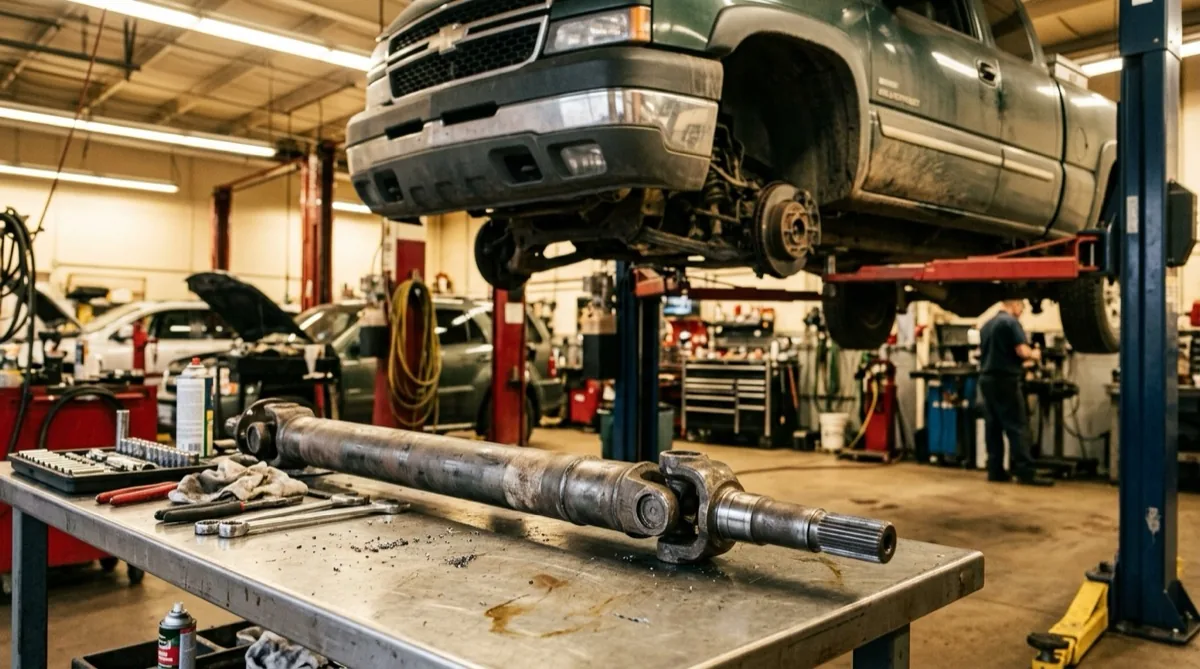
Replacing a drive shaft costs $400 to $1,500 total depending on the vehicle and whether you source a used or new shaft. A used drive shaft runs $305 median across 17,136 priced salvage listings in our index, with individual prices ranging from $117 to $1,144 depending on vehicle model and shaft configuration. Labor adds $150 to $480 for 1 to 3 hours of shop time, plus new U-joint hardware and potentially a carrier bearing.
Before committing to a full drive shaft replacement, get the shaft diagnosed. Many driveshaft vibrations and clunks trace back to worn U-joints, which cost $100 to $300 to replace, a fraction of a full shaft swap. A complete replacement is only necessary when the tube is bent, the slip yoke is worn, or the carrier bearing has failed.
[INTERNAL-LINK: related pillar content -> /blog/price-analysis/how-much-do-junkyards-charge-for-parts]
- Total replacement cost: $400-$1,500. Covers used and new parts plus 1-3 hours of labor
- Used drive shaft: $305 median across 17,136 salvage listings, ranging $117-$1,144
- U-joint replacement ($100-$300) is often enough when the shaft tube is straight and the slip yoke is tight
- Labor runs 1-3 hours at $95-$160/hr, depending on front vs rear shaft and vehicle access
- Drive shaft and axle shaft are different parts - confusing them leads to wrong diagnoses and parts orders
- Dataset: 17,136 priced drive shaft listings across 63 vehicle models, August 2026
What Drive Shaft Replacement Costs
Drive shaft replacement cost breaks into three components: the shaft itself, the labor to install it, and the small hardware items that should be replaced during the job.
| Cost Component | Used | New Aftermarket | New OEM |
|---|---|---|---|
| Part cost | $117-$1,144 (median $305) | $250-$600 | $400-$1,200 |
| Labor (1-3 hrs at $95-$160/hr) | $150-$480 | $150-$480 | $150-$480 |
| U-bolts, flange hardware, carrier bearing | $30-$120 | $30-$120 | $30-$120 |
| Total | $400-$1,500 | $430-$1,200 | $580-$1,800 |
Used shafts from salvage yards typically come with their existing U-joints. These may need replacement at installation, which adds $30 to $80 in parts and minimal extra labor since the shaft is already on the bench. New aftermarket and OEM shafts ship with fresh U-joints pre-installed.
*Part pricing source: PartPriceGuide.com analysis of 17,136 salvage yard listings across 63 vehicle models, August 2026. Labor range consistent with RepairPal national estimates.*
[INTERNAL-LINK: supporting subtopic -> /blog/price-analysis/junkyard-drive-shaft-prices]
Drive Shaft vs Axle Shaft: Know the Difference
Drive shafts and axle shafts are different components that serve different functions in the drivetrain. Confusing them leads to wrong parts orders and misdiagnosed repairs. Shops sometimes use the terms loosely, which adds to the confusion.
| Feature | Drive Shaft (Prop Shaft) | Axle Shaft (Half Shaft / CV Axle) |
|---|---|---|
| Orientation | Runs lengthwise, front to rear | Runs sideways, differential to wheel |
| Connects | Transmission/transfer case to differential | Differential to wheel hub |
| Joint type | U-joints (Cardan joints) | CV joints (constant velocity) |
| Typical count per vehicle | 1 on RWD, 2 on 4WD | 2 per driven axle |
| Common failure symptoms | Vibration at speed, clunk on shift | Clicking on turns, torn boots |
| Replacement cost range | $400-$1,500 | $150-$450 |
An axle shaft (also called a half shaft on independent suspension vehicles) transmits power from the differential to the wheel. On vehicles with independent rear suspension or front-wheel-drive vehicles, axle shafts use CV (constant velocity) joints protected by rubber boots. On solid-axle trucks, the axle shafts ride inside the axle housing and connect to the wheel hubs with flanges or C-clips.
The diagnostic shortcut. If the noise is a rhythmic clicking that gets louder during turns, it is almost certainly a CV axle (axle shaft) issue, not a drive shaft problem. Drive shaft symptoms, vibration at highway speed and clunking on acceleration, happen regardless of steering angle. If your mechanic says "drive shaft" but describes clicking on turns, clarify whether they mean an axle shaft or CV axle.
[INTERNAL-LINK: supporting subtopic -> /blog/repair-costs/cv-axle-replacement-cost]
Front vs Rear Drive Shaft Costs
Four-wheel-drive vehicles have two drive shafts: a rear shaft running from the transfer case to the rear differential, and a front shaft running from the transfer case to the front differential. The two shafts differ in cost and labor because of their size and accessibility.
| Drive Shaft Position | Typical Part Cost (Used) | Labor | Estimated Total |
|---|---|---|---|
| Rear drive shaft | $200-$500 | $150-$320 | $350-$820 |
| Front drive shaft | $175-$450 | $200-$480 | $375-$930 |
| Both shafts (4WD) | $375-$950 | $350-$640 | $725-$1,590 |
Front drive shafts are shorter and lighter but harder to reach. The front shaft runs between the transfer case and the front differential, threading past the exhaust, the oil pan, and sometimes the steering components. Tight clearances add labor time. On some vehicles (particularly GM trucks with independent front suspension), the front drive shaft includes a vacuum-actuated disconnect mechanism that adds complexity.
Replacing both shafts at the same time saves on labor because the vehicle only needs to go on the lift once and the technician is already working in the area. The combined labor runs $350 to $640 rather than double the single-shaft labor.
For 4WD vehicles that also need transfer case work, see our transfer case replacement cost breakdown. The transfer case and drive shaft jobs share overlapping labor, so bundling them saves shop time.
[INTERNAL-LINK: supporting subtopic -> /blog/repair-costs/transfer-case-replacement-cost]
2WD vs 4WD Driveshaft Costs
The number of driveshafts on your vehicle, and the total replacement cost, depends on its drivetrain configuration. Front-wheel-drive vehicles have no driveshaft at all.
| Drivetrain | Number of Driveshafts | Used Part Cost (per shaft) | Typical Total |
|---|---|---|---|
| 2WD truck/SUV (RWD) | 1 rear | $200-$500 | $350-$820 |
| Part-time 4WD truck/SUV | 1 front + 1 rear | $175-$450 front, $200-$500 rear | $375-$930 per shaft |
| Full-time AWD crossover | 1 rear (+ CV axles front) | $150-$400 | $300-$750 |
| FWD sedan/crossover | 0 | N/A | N/A |
Part-time 4WD trucks (F-150, Silverado, Ram, Wrangler) add a front driveshaft that runs from the transfer case to the front differential. The front shaft only carries load when 4WD is engaged, so it typically wears slower than the rear. Worst-case pricing for both shafts: $725 to $1,590 total.
AWD crossovers and SUVs use a rear driveshaft to send power rearward from a power transfer unit (PTU) mounted on the transaxle. These shafts are often lighter and shorter than truck driveshafts, and the AWD system may include an electronically controlled coupling rather than a traditional transfer case.
| Vehicle | Drivetrain | Used Shaft Median | Listings |
|---|---|---|---|
| Ford F-150 | RWD/4WD | $297 | 2,480 |
| Chevy Silverado 1500 | RWD/4WD | $221 | 3,594 |
| Ram 1500 | RWD/4WD | $197 | 1,288 |
| Jeep Wrangler | 4WD | $225 | 1,706 |
| Toyota 4Runner | 4WD | $150 | 219 |
| BMW X5 | AWD | $375 | 595 |
| Toyota RAV4 | AWD | $165 | 82 |
| Honda Accord | AWD | $151 | 242 |
*Part pricing source: PartPriceGuide.com salvage yard index, August 2026.*
U-Joint Replacement vs Full Drive Shaft
U-joints are the universal joints at each end of the drive shaft that allow it to flex as the suspension moves. They are the wear items on the assembly. The shaft tube itself is a steel pipe that rarely fails unless physically damaged.
| Repair | Part Cost | Labor | Total |
|---|---|---|---|
| U-joint replacement (one joint) | $15-$45 | $85-$200 | $100-$245 |
| U-joint replacement (both joints) | $30-$90 | $120-$250 | $150-$340 |
| Full drive shaft replacement (used) | $117-$1,144 | $150-$480 | $400-$1,500 |
Replace the full shaft when: the tube is visibly bent or dented, the slip yoke has play, the carrier bearing is seized or noisy, or the yoke ears are worn from repeated U-joint replacements and the new joint caps no longer seat tightly.
A shop presses out the old U-joints and presses in new ones using a hydraulic press or a bench vise. The shaft comes off the vehicle, the joints get swapped on the bench, and the shaft goes back on. Total turnaround for both joints runs $150 to $340, compared to $400 to $1,500 for a full shaft swap.
How to check U-joints yourself. Crawl under the vehicle and grab the driveshaft near each U-joint. Try to rotate it in opposing directions and push it side to side. Any clicking, clunking, or perceptible movement means that joint is worn. Rust-colored dust around the U-joint caps confirms the bearing seals have failed and the needle bearings are grinding against each other.
Signs Your Drive Shaft Needs Replacement
Drive shaft problems produce distinctive symptoms that are hard to ignore. The shaft spins at high speed directly beneath the passenger compartment, so any imbalance, looseness, or joint failure translates into noticeable vibration and noise.
Vibration that increases with speed. A bent drive shaft or a U-joint with a seized bearing cap creates an imbalance that produces a constant buzz or rumble through the floorboard. The vibration intensifies as speed increases. It differs from tire vibration (which pulsates rhythmically and is felt through the steering wheel) and wheel bearing noise (which is louder on one side of the vehicle).
Clunking when shifting between drive and reverse. Worn U-joints develop play in the bearing caps, producing a metallic clunk when the drivetrain loads and unloads. You hear it most clearly when shifting from park to drive, accelerating from a stop, or lifting off the throttle. The clunk originates from underneath the center of the vehicle.
Squeaking or chirping at low speed. A U-joint that has lost its grease but has not yet worn through produces a rhythmic squeak that increases with wheel speed. The sound is most noticeable at parking-lot speeds and may disappear at highway speed where road noise masks it. This is the earliest warning sign and the cheapest stage to fix, as a U-joint replacement at this point costs $100 to $300.
Shudder during low-speed acceleration. A worn slip yoke or a double-cardan joint (CV-style joint used on lifted trucks and some front drive shafts) that has exceeded its operating angle produces a shudder or judder as you pull away from a stop. This feels similar to a clutch shudder on a manual transmission vehicle but occurs on automatics as well.
Shaft hanging lower than normal. A failed center support bearing on a two-piece shaft allows the shaft to sag in the middle. This is visible from underneath and produces a pronounced vibration because the shaft is no longer running true. The carrier bearing itself costs $50 to $150 and should be replaced along with the shaft if it has failed.
If the symptoms point to the drive shaft area but the shaft and U-joints look good, check the transmission output seal and the differential pinion bearing. A worn pinion bearing produces a whine that can mimic driveshaft vibration, and a leaking output seal can allow transmission fluid to contaminate the slip yoke.