Replacing a rear view mirror costs $40 to $248 for the part depending on whether you need a basic unit or one with auto-dimming, HomeLink, or camera features. The median price for a used rear view mirror ranges from $70 to $167 across popular vehicles in our salvage yard data. Labor runs $50 to $150 for the swap, putting total replacement cost at $140 to $400 with a used part.
[INTERNAL-LINK: anchor text → related pillar content on auto repair costs]
The price gap between a basic manual-dimming mirror and a feature-packed unit is the biggest cost variable. A plain mirror for a Chevy Silverado 1500 runs about $51 median used, while a Toyota Camry auto-dimming mirror averages $200 median. For a BMW X5 with garage door opener and lane departure warning, the used mirror reaches $136 to $233 median depending on year and options.
- Basic mirror (manual dimming), used: $40-$103 typical across most vehicles
- Auto-dimming mirror, used: $86-$248 depending on vehicle and additional features
- HomeLink/camera mirror, used: $136-$300+ for units with garage door openers or displays
- Labor: $50-$150 for a standard replacement; some mirrors are a 15-minute plug-and-play swap
- Adhesive reattachment: $5-$15 if the mirror button detached from the windshield but the mirror assembly is intact
- New OEM mirrors: $150-$500+ from a dealer, making used parts the clear value play
- Dataset: Salvage yard listings across 60+ vehicle models, August 2026
What Rear View Mirror Replacement Costs
Rear view mirror replacement cost depends almost entirely on which features the mirror carries. A basic mirror with no electronics is one of the cheapest parts on the car. A mirror with auto-dimming, a camera display, or a HomeLink transmitter costs several times more.
| Mirror Type | Used (Salvage) | New Aftermarket | New OEM |
|---|---|---|---|
| Basic / manual dimming | $40-$103 | $50-$120 | $80-$200 |
| Auto-dimming (electrochromatic) | $86-$200 | $120-$300 | $200-$400 |
| Auto-dimming + HomeLink | $136-$250 | $200-$400 | $300-$500 |
| Camera / display mirror | $200-$400 | Limited availability | $400-$800+ |
| Labor | $50-$150 | $50-$150 | $50-$150 |
Basic mirrors on economy cars and trucks cluster around $51 to $103 median, while luxury vehicles like the BMW X5 and Mercedes C-Class push the median to $136 to $167. The gap between basic and feature-loaded mirrors on the same vehicle can be 3x to 5x, which is why identifying your exact mirror variant matters before shopping.
For broader context on salvage yard pricing, see our used auto parts price guide.
Basic vs Auto-Dimming and Camera Mirrors
The feature set built into your mirror is the single largest cost driver. Rear view mirrors have evolved from simple glass-and-housing assemblies into electronics platforms, and each added feature increases replacement cost substantially.
Basic manual-dimming mirrors contain a glass element, a housing, and a mounting button or bracket. These mirrors have no wiring harness and attach to the windshield with adhesive or a simple clip. Used prices range from $31 to $103 across most vehicles, with economy sedans at the low end. The Chevy Silverado 1500 sits at $51 median for its base mirror, and the Toyota Camry's non-dimming variants run $36 to $41 median.
Auto-dimming (electrochromatic) mirrors contain a gel layer between two pieces of glass, light sensors on both sides, and a wiring harness for power. When headlights from behind hit the rear sensor, the gel darkens to reduce glare. This technology adds $50 to $150 to the part cost compared to a basic mirror. A Toyota Camry auto-dimming mirror runs $200 median used versus $41 for the basic version. On a Ford F-150, the auto-dimming variant costs $175-$201 median versus $125 for manual dimming.
[INTERNAL-LINK: auto-dimming mirror pricing details → /prices/rear-view-mirror]
HomeLink-equipped mirrors integrate a garage door opener transmitter. These are common on trucks, SUVs, and mid-to-upper trim sedans. The Ford F-150 with auto-dimming and HomeLink carries a median of $166 used. BMW X5 mirrors with garage door opener plus lane departure warning run $136 to $209 median.
Camera and display mirrors are the most expensive category. These mirrors replace the traditional glass reflection with a screen fed by a rear-mounted camera, offering a wider field of view. Used camera mirrors start around $200 and can exceed $400 for current-model-year SUVs. The Jeep Grand Cherokee with a digital display mirror can reach $440 to $670 at the top of the range.
| Vehicle | Basic Mirror (Used) | Auto-Dim Mirror (Used) | Price Multiple |
|---|---|---|---|
| Toyota Camry | $41 median | $200 median | 4.9x |
| Ford F-150 | $125 median | $175-$201 median | 1.4-1.6x |
| Honda Civic | $98 median | $86-$141 median | 0.9-1.4x |
| BMW X5 | N/A (all mirrors auto-dim) | $136-$194 median | -- |
| Chevy Silverado 1500 | $51 median | $103+ median | 2x |
Adhesive Reattachment vs Full Replacement
Not every "fallen mirror" needs a full replacement. The repair path depends on what actually failed.
Adhesive reattachment ($5 to $15, 30 minutes) works when the metal mounting button has separated from the windshield glass but the mirror assembly is intact. Heat, age, and vibration weaken the bond between the button and glass over time. This is the most common "mirror fell off" scenario and the cheapest fix.
The process: scrape the old adhesive off the windshield and button, clean both surfaces with rubbing alcohol or the activator included in the kit, apply the adhesive, press the button into position, and wait 24 hours before hanging the mirror back on. Adhesive kits are available at any auto parts store for $5 to $15.
Full replacement ($140 to $400+ with used parts) is necessary when:
- The mirror housing or glass is cracked or shattered
- Internal electronics have failed (auto-dimming no longer works, display is dead)
- The wiring harness is damaged
- The mounting bracket or arm is broken
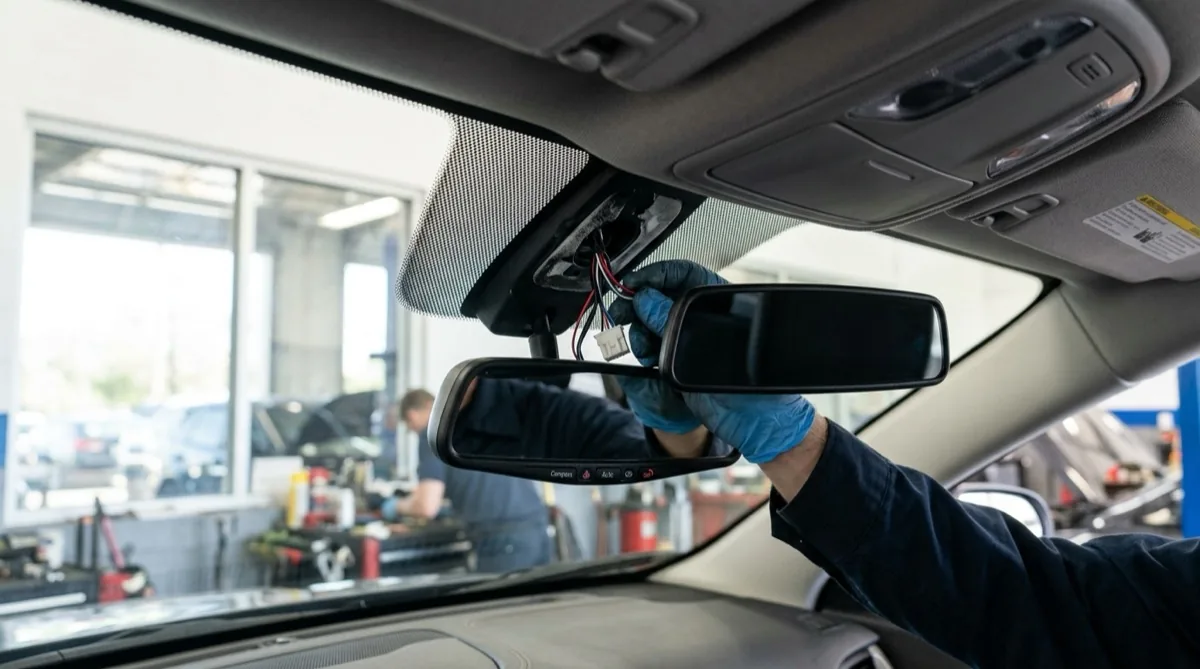
For mirrors with electronics, full replacement means disconnecting the old wiring harness (typically a single connector behind the headliner trim), removing the mirror from its mount, and plugging in the new unit. Most electronic mirrors use a twist-lock or set-screw mount rather than adhesive, so the swap itself takes 15 to 30 minutes.
When the glue-on fix will not work: if the windshield is cracked at the mounting point, if the mounting button is broken, or if the mirror housing itself is damaged. In those cases, you need a full mirror replacement rather than a reattachment.
Cost by Vehicle Type
Mirror costs vary by vehicle class because trim levels and standard feature content differ. Luxury brands include auto-dimming as standard equipment on nearly every model, while economy cars still offer basic mirrors on lower trims.
| Vehicle Type | Used Part Range | Typical Median | Notes |
|---|---|---|---|
| Economy sedan (Civic, Corolla, Sentra) | $31-$120 | $90-$103 | Basic mirrors available; auto-dim on upper trims |
| Mid-size sedan (Camry, Accord, Malibu) | $41-$250 | $90-$123 | Wide range based on feature content |
| Compact SUV (RAV4, CR-V, Tucson) | $50-$200 | $100-$140 | Most include auto-dimming |
| Full-size truck (F-150, Silverado, RAM 1500) | $40-$304 | $70-$161 | HomeLink common on upper trims |
| Full-size SUV (Tahoe, Yukon, Expedition) | $60-$350 | $100-$180 | Camera mirrors on newer models |
| European luxury (BMW, Mercedes) | $50-$644 | $136-$167 | Nearly all auto-dim; garage door opener standard |
European luxury vehicles carry the highest mirror costs because auto-dimming, HomeLink, and advanced driver assistance sensors are standard equipment rather than options. A BMW X5 rear view mirror with garage door opener and lane departure warning costs $136 to $233 median used, while the same mirror new from BMW runs $400 to $600+. Even the BMW X5's base mirror variant (without garage door opener) averages $194 median due to the standard electrochromatic dimming.
[INTERNAL-LINK: broader parts pricing → used auto parts price guide]
Used OEM vs Aftermarket
For rear view mirrors, used OEM from a salvage yard is typically the best value. Aftermarket options exist for basic mirrors but are limited for feature-equipped units.
Used OEM (salvage yard) provides exact-fit replacement with all original features intact. A used auto-dimming mirror from a salvage yard costs $86 to $200, while the same mirror new from the dealer runs $200 to $500. The 50 to 75 percent savings makes salvage the default choice for mirrors with electronics, where aftermarket options are scarce.
Aftermarket mirrors are widely available for basic, non-electronic units. Prices range from $50 to $120 for a basic aftermarket replacement. Quality varies significantly. Some aftermarket mirrors have loose-fitting mounts, poor glass quality, or mirror buttons that don't match the windshield mount. For a $40 to $80 basic mirror, aftermarket is a viable option. For anything with electronics, it is not.
New OEM (dealer) makes sense only when no salvage inventory exists for your vehicle. This is most common with current-model-year vehicles or mirrors with rare feature combinations. New OEM mirrors range from $150 for a basic unit to $500+ for a fully loaded mirror with camera display. Dealer labor for installation adds another $50 to $100 on top of the part cost.
Dealer vs independent shop for installation. The mirror swap itself is identical regardless of where it is done. Independent shops charge $50 to $100 for labor on a standard mirror replacement. Dealers charge $80 to $150 for the same procedure. The only reason to prefer a dealer is if the mirror requires coding or calibration tied to ADAS systems, which is rare for interior rear view mirrors but common for exterior side mirrors with blind spot monitoring.
For basic mirrors on common vehicles, an adhesive reattachment or a $40 to $70 salvage mirror is the most cost-effective path. For feature-loaded mirrors, a used OEM unit from a salvage yard saves hundreds over new.
Browse available salvage mirrors at our rear view mirror price listings.
Can You Replace a Rear View Mirror Yourself?
Rear view mirror replacement is one of the simpler DIY jobs on a car. The difficulty depends on whether your mirror has electronics.
Basic mirror (no electronics): 15 to 30 minutes. Remove the old mirror from the mounting button (twist or set screw), slide the new mirror onto the button, and tighten. No tools beyond a small Allen wrench or Torx driver. If the button needs reattaching, add the adhesive step and 24 hours of cure time.
Electronic mirror (auto-dimming, HomeLink, camera): 30 to 60 minutes. The mirror connects to a wiring harness that typically runs behind the headliner trim near the top of the windshield. Pop the connector cover, unplug the old mirror, remove it from the mount, install the new one, and plug the harness back in. No special tools needed, though a plastic trim removal tool helps avoid scratching the headliner.
No programming required. Unlike many electronic components, rear view mirrors do not need dealer programming. Auto-dimming functions work as soon as the mirror has power. HomeLink transmitters need to be re-paired with your garage door opener, but that is a button-hold procedure documented in the owner's manual, not a dealer visit.
Sourcing a used mirror from a salvage yard at the $90 to $140 median price and installing it yourself saves the entire $50 to $150 labor charge.
[INTERNAL-LINK: how to find cheap used parts → finding cheap used auto parts guide]