Replacing a pair of struts costs $460 to $900 total when you use salvage yard parts, $600 to $1,250 with new aftermarket quick struts, and $800 to $1,550 with new OEM assemblies. Every total includes two line items that are easy to overlook: $200 to $400 in labor for the pair and a $100 to $150 wheel alignment that must follow the job.
For a detailed breakdown of salvage part pricing across categories, see our used auto parts pricing guide.
A used strut assembly runs $138 median across our index of 95,928 priced salvage yard listings. That puts struts in the mid-range suspension category, more expensive than a control arm ($125 median) and comparable to a CV axle. The cost spread across vehicles is wide: a Chevy Equinox strut runs $80 median while a Ford F-150 strut hits $175, reflecting the size and complexity differences between compact crossover and full-size truck suspension.
- Pair replacement cost with used struts: $460 to $900, including two parts ($138 median each), $200 to $400 labor, and $100 to $150 alignment
- Always replace struts in pairs on the same axle. Mismatched damping causes uneven braking and handling
- Struts are not shocks. A strut is a structural component that replaces the upper control arm. A shock absorber only dampens motion. The labor and cost differ significantly
- Used strut median: $138 across 95,928 salvage yard listings, ranging from $80 (Chevy Equinox) to $175 (Ford F-150)
- Bad strut symptoms: bouncing after bumps, nose dive during braking, fluid leaking from the strut body, and cupped tire wear
- DIY saves $200 to $400 in labor per pair but requires spring compressors or a quick strut assembly, plus a shop alignment afterward
What Strut Replacement Costs
Strut replacement has three cost layers: the parts, the labor to install them, and the alignment that follows. Struts are almost always replaced in pairs, so the table below shows single and pair pricing side by side.
| Scope | Used Part(s) | Aftermarket New | OEM New | Labor | Alignment | Total (Used) | Total (Aftermarket) |
|---|---|---|---|---|---|---|---|
| Single strut | $80–$175 | $150–$350 | $250–$500 | $100–$200 | $100–$150 | $280–$525 | $350–$700 |
| Pair (one axle) | $160–$350 | $300–$700 | $500–$1,000 | $200–$400 | $100–$150 | $460–$900 | $600–$1,250 |
| All four | $320–$700 | $600–$1,400 | $1,000–$2,000 | $350–$700 | $100–$150 | $770–$1,550 | $1,050–$2,250 |
New aftermarket "quick strut" or "complete strut" assemblies come with the spring, mount, and bearing pre-assembled. They cost more than a bare strut cartridge but eliminate the need for spring compressors during installation, which reduces labor time by 20 to 30 minutes per strut.
For comparison, RepairPal estimates strut replacement at $700 to $900 per pair, which reflects new OEM parts at dealer labor rates. Independent shops using salvage parts bring that number down by 40 to 50 percent.
*Part pricing source: PartPriceGuide.com analysis of 95,928 salvage yard listings, August 2026. Labor rates based on independent shop rates of $95 to $150 per hour.*
Single, Pair, or All Four
Always replace in pairs on the same axle. A new or rebuilt strut on one side and a worn strut on the other create uneven damping. During hard braking, the side with the stronger strut transfers weight differently than the weak side, which can pull the vehicle and extend stopping distance. The same imbalance shows up in cornering, where the vehicle leans more toward the worn side.
Front pair only is the most common job. Front struts wear faster than rears because they handle steering loads, braking forces, and a larger share of the vehicle's weight. On most sedans and crossovers, front struts show symptoms 20,000 to 30,000 miles before the rears.
All four makes sense when the vehicle has 80,000 or more miles and the rear struts are original. At that mileage, the rears are past their service life even if they are not yet showing obvious symptoms. Doing all four at once saves the second alignment fee ($100 to $150) and often earns a labor discount from the shop.
Rear only is uncommon but happens on vehicles where the rear struts fail first due to heavy cargo loading, frequent towing, or a rear suspension design that carries disproportionate load. Some SUVs with self-leveling rear suspension fall into this category.
Strut vs Shock Absorber
Struts and shock absorbers both control spring oscillation, but they are not interchangeable. The distinction matters because it changes the replacement cost, labor time, and which vehicles use which component.
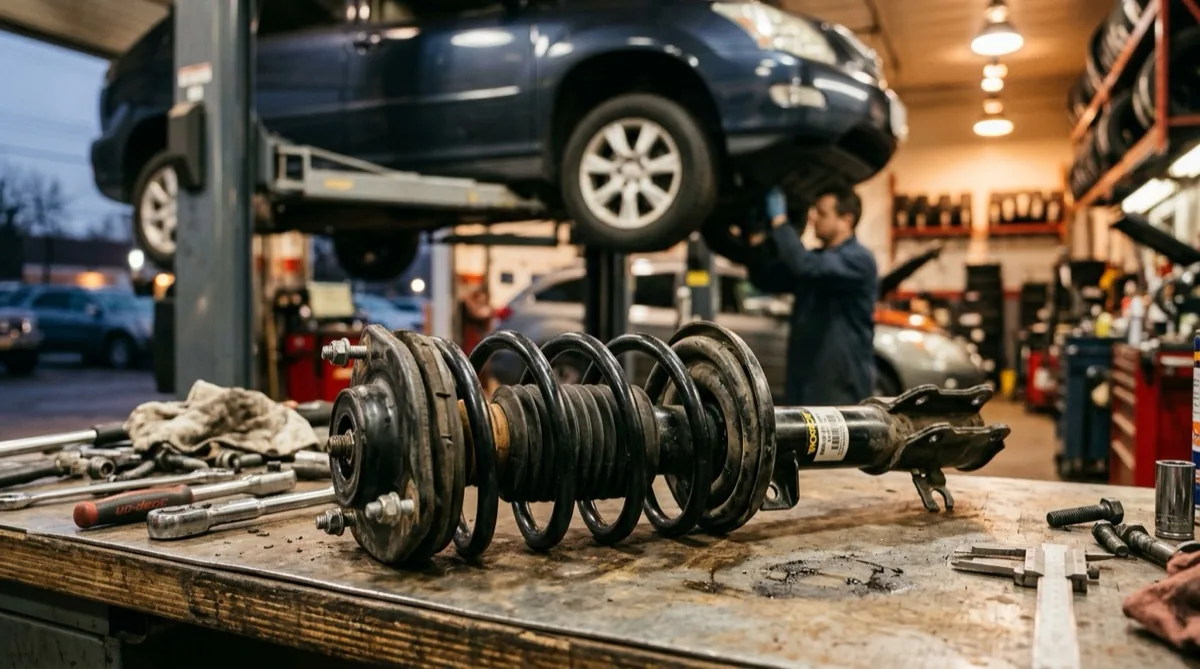
A strut is a structural suspension member. It replaces the upper control arm, serving as both the damper and the upper pivot point for the steering knuckle. The coil spring wraps around the strut body, and the top mount connects to the strut tower in the vehicle body. Removing a strut means disconnecting it from the knuckle, compressing or removing the spring, and unbolting the top mount. This is more labor-intensive than a shock swap.
A shock absorber is a damper only. It bolts between the frame and the axle or control arm, with the spring mounted separately. Removing a shock is two bolts (top and bottom) and takes 15 to 30 minutes per unit. No spring compression, no knuckle disconnection, and usually no alignment required afterward.
| Feature | Strut | Shock Absorber |
|---|---|---|
| Structural role | Yes, replaces upper control arm | No, damper only |
| Spring location | Wrapped around the strut body | Mounted separately |
| Alignment needed after replacement | Yes | Usually no |
| Typical labor per pair | $200–$400 | $80–$160 |
| Common on | Front of most cars, crossovers, minivans | Rear of trucks, body-on-frame SUVs |
If your vehicle uses shocks rather than struts, expect lower labor costs because the job is simpler and alignment is typically not required.
Bad Strut Symptoms
Struts degrade gradually, so the symptoms build over thousands of miles. Many drivers adapt to the worsening ride without realizing the struts have worn past their effective range.
Excessive bouncing after bumps. A healthy strut stops spring oscillation within one to one and a half cycles after a bump. If the vehicle continues bouncing two or three times, the internal valving has weakened. The classic "bounce test" (pushing down hard on a fender corner and releasing) still works as a quick check: more than one rebound means the strut is worn.
Nose dive during braking. Worn front struts allow the front end to dip excessively under braking. This shifts weight forward aggressively, reduces rear tire grip, and increases stopping distance. At highway speeds, this can add several feet to your braking distance.
Fluid leaking from the strut body. Struts use hydraulic fluid internally to create damping resistance. A wet, oily streak running down the outside of the strut tube means the seal has failed. Once the fluid leaks out, the strut loses damping ability entirely. A slight mist of oil is normal on high-mileage struts, but a visible wet streak indicates failure.
Cupped or scalloped tire wear. When a strut cannot control the wheel's vertical movement, the tire bounces slightly with each rotation. This creates a repeating pattern of worn and unworn patches around the tire circumference, called cupping or scalloping. Replace the struts before installing new tires, because new tires will develop the same wear pattern on bad struts.
Clunking over bumps. A worn strut mount or broken internal piston can produce a metallic clunk when the suspension compresses. This symptom overlaps with worn sway bar end links and control arm bushings, so isolating the noise to the strut requires a visual inspection on a lift.
Vehicle feels unstable in crosswinds or on uneven roads. Struts keep the tires planted on the road surface. When they lose damping, the vehicle feels floaty or wanders on highway on-ramps, in gusty wind, and on roads with surface irregularities.
If your vehicle also shows pulling and uneven tire wear, check the control arm replacement cost guide, because worn control arm bushings can mimic strut symptoms.
Cost by Popular Model
Part prices below are median used strut prices from our salvage listing index. Labor estimates assume a $95 to $150 per hour independent shop rate. All totals include a $100 to $150 alignment and reflect pair replacement.
| Vehicle | Used Part (Median) | Listings | Pair Labor | Alignment | Estimated Pair Total |
|---|---|---|---|---|---|
| Chevy Equinox | $80 | 2,308 | $180–$320 | $100–$130 | $440–$610 |
| Toyota Camry | $125 | 1,238 | $200–$360 | $100–$130 | $550–$740 |
| Honda Civic | $128 | 3,164 | $200–$360 | $100–$130 | $556–$746 |
| Honda Accord | $150 | 2,083 | $200–$380 | $100–$140 | $600–$820 |
| Ford F-150 | $175 | 2,247 | $220–$400 | $100–$150 | $670–$900 |
The Chevy Equinox stands out as one of the most affordable strut replacements. Its compact strut design and high salvage availability keep both part and labor costs low.
The Ford F-150 runs higher than the sedans for two reasons. First, truck struts are physically larger and heavier. Second, F-150 struts come in multiple variants (standard, FX4 off-road, tow package) that are not always interchangeable, which reduces the effective supply at salvage yards and pushes prices up.
Check current pricing for your exact year and make on our strut price lookup, and browse related control arm pricing if your suspension work extends beyond the struts.
Can You Replace Struts Yourself?
Yes, but the job requires more planning than a typical bolt-on part swap. The primary complication is the coil spring, which stores significant energy and must be handled safely.
Option 1: Quick strut assemblies. The easiest DIY approach is buying a complete "quick strut" or "loaded strut" assembly that comes with the spring, mount, and bearing pre-installed. You unbolt the old strut from the knuckle (two or three bolts) and the top mount from the strut tower (two or three nuts), remove the assembly as a unit, and bolt in the new one. No spring compressor needed. Quick strut assemblies cost $150 to $350 each new, which is more than a bare strut, but the reduced complexity and safety improvement make them the standard DIY choice.
Option 2: Spring transfer with compressors. If you are installing a used strut or bare new cartridge, you need to transfer the spring from the old assembly. This requires spring compressors, either a wall-mounted unit or a set of through-bolt clamp compressors. The through-bolt type is available for $30 to $50 at auto parts stores or free through loaner programs. Compress the spring, remove the top mount nut, swap the strut, and reassemble. This method works but carries real risk: a spring compressor that slips can launch the spring with enough force to cause serious injury. Use quality compressors and follow the torque sequence exactly.
Tools needed. Floor jack and jack stands, socket set (including deep sockets for the top mount nuts), torque wrench, penetrating oil, and a breaker bar for seized bolts. If transferring springs, add spring compressors to the list. Budget two to four hours for a pair depending on experience and bolt condition. Total tool investment for someone starting from scratch is $80 to $150, which pays for itself on the first job since you are saving $200 to $400 in labor.
You still need a shop alignment. Struts set the camber angle on MacPherson-style suspension. Even a direct bolt-in replacement shifts the geometry enough to cause tire wear. Budget $100 to $150 at an alignment shop after the install.
Skip the DIY if the strut tower nuts are heavily corroded, if the vehicle has air suspension or electronically controlled dampers, or if you do not have access to spring compressors and do not want to buy quick strut assemblies. Electronically controlled systems require diagnostic tools and calibration beyond a basic hand tool set.
For sourcing parts at the best price, our junkyard parts pricing guide covers what to inspect and what to expect on pricing.