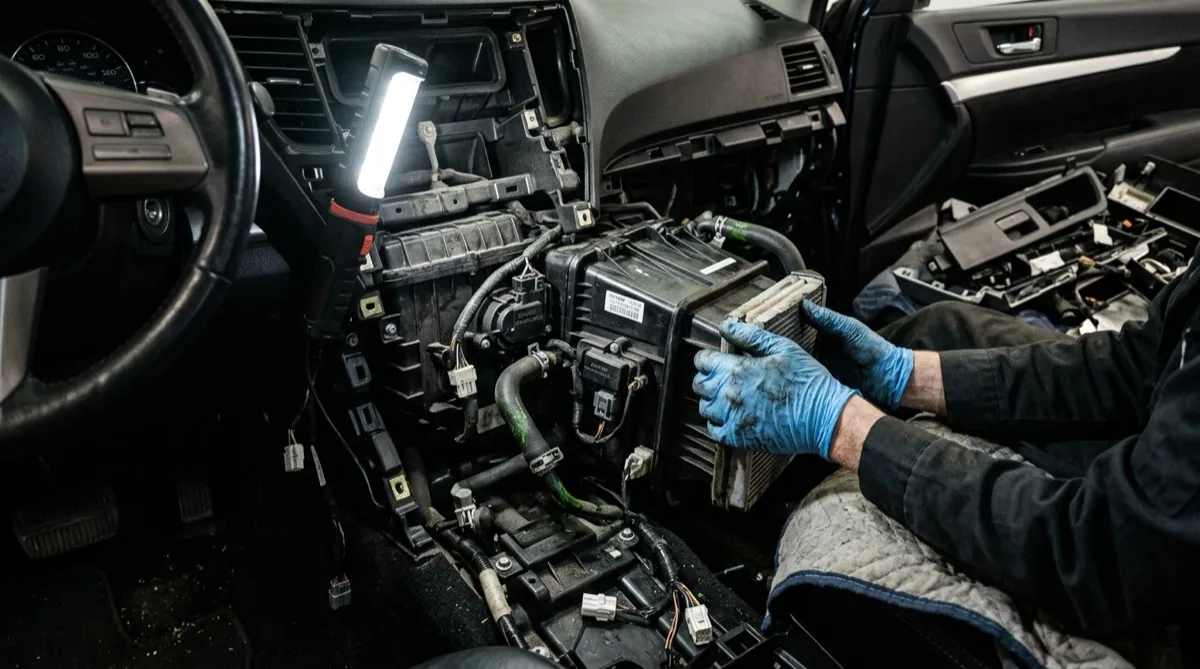
Heater core replacement costs $591 to $1,750 total at a shop, making it one of the most labor-intensive repairs on a modern vehicle. The part itself is surprisingly cheap: a used heater core runs $116 median across our salvage index, and a new aftermarket unit costs $100 to $250. Labor drives 60 to 80 percent of the bill because the dashboard must come out, partially or fully, to reach the heater box buried behind the instrument panel.
That labor-heavy ratio flips the usual calculus around used parts. On most repairs, buying a salvage component saves real money. On a heater core, the part savings are minimal, and the risk of re-doing $475 to $1,500 in labor if a used core fails makes new the better buy for nearly everyone.
- Total cost: $591-$1,750 depending on vehicle and part source, with RepairPal averaging $1,370-$1,902
- Labor is 60-80% of the bill because the dashboard must be removed, requiring 5-10 hours at $95-$150/hr
- The part is cheap: $116 median used, $100-$250 new
- New beats used on this repair because a failed used core means paying that massive labor bill a second time
- Dealers charge 25-40% more than independent shops for the same job
- Dataset: 8,571 priced used heater core listings, August 2026
What Heater Core Replacement Costs
The heater core itself is a small radiator, a flat aluminum or copper heat exchanger roughly the size of a paperback book. It is one of the least expensive cooling system components to buy. The cost problem is entirely about access.
| Cost Component | Used Part | New Part |
|---|---|---|
| Part cost | $80-$175 (median $116) | $100-$250 |
| Labor (5-10 hrs at $95-$150/hr) | $475-$1,500 | $475-$1,500 |
| Total | $591-$1,616 | $575-$1,750 |
*Part pricing source: PartPriceGuide.com analysis of 8,571 priced salvage yard listings, August 2026. Labor range based on published shop rates and RepairPal national estimates.*
Notice how the used and new totals nearly overlap. A new heater core at $250 versus a used one at $116 adds only $134 to a job that already costs $475 to $1,500 in labor. That $134 difference is the smallest it gets on any major repair, which is why part source matters less here than on almost any other job.
For a detailed breakdown, see our full junkyard pricing context guide.
Why Heater Core Replacement Is So Expensive
The heater core sits inside the HVAC housing behind the dashboard, typically centered behind the instrument panel near the firewall. There is no shortcut to reach it. On most vehicles, the repair follows this sequence:
- Drain the cooling system and disconnect the heater hoses at the firewall
- Remove the dashboard partially or fully, including the instrument cluster, center console, glove box, and trim panels
- Disconnect electrical connections for airbags, climate controls, wiring harnesses, and sometimes the steering column
- Remove the HVAC housing (the plastic box that holds the heater core, evaporator, and blend doors)
- Swap the heater core inside the housing
- Reassemble everything in reverse order, refill coolant, and bleed the system
Steps 2 through 4 account for the overwhelming majority of the labor. The actual core swap, step 5, takes minutes. A technician who has done the job on a specific model before can get through it in 5 to 6 hours. A first-timer or a vehicle with a particularly buried setup can push past 10 hours.
This is why dealers charge 25 to 40 percent more than independent shops for the same job. At $180 per hour dealer rates versus $110 at an independent, that 8-hour job jumps from $880 to $1,440 in labor alone, a $560 difference before the part even enters the picture.
Bad Heater Core Symptoms
A failing heater core usually announces itself gradually. Here are the four symptoms that point directly to the heater core rather than another cooling system component.
Sweet Smell Inside the Cabin
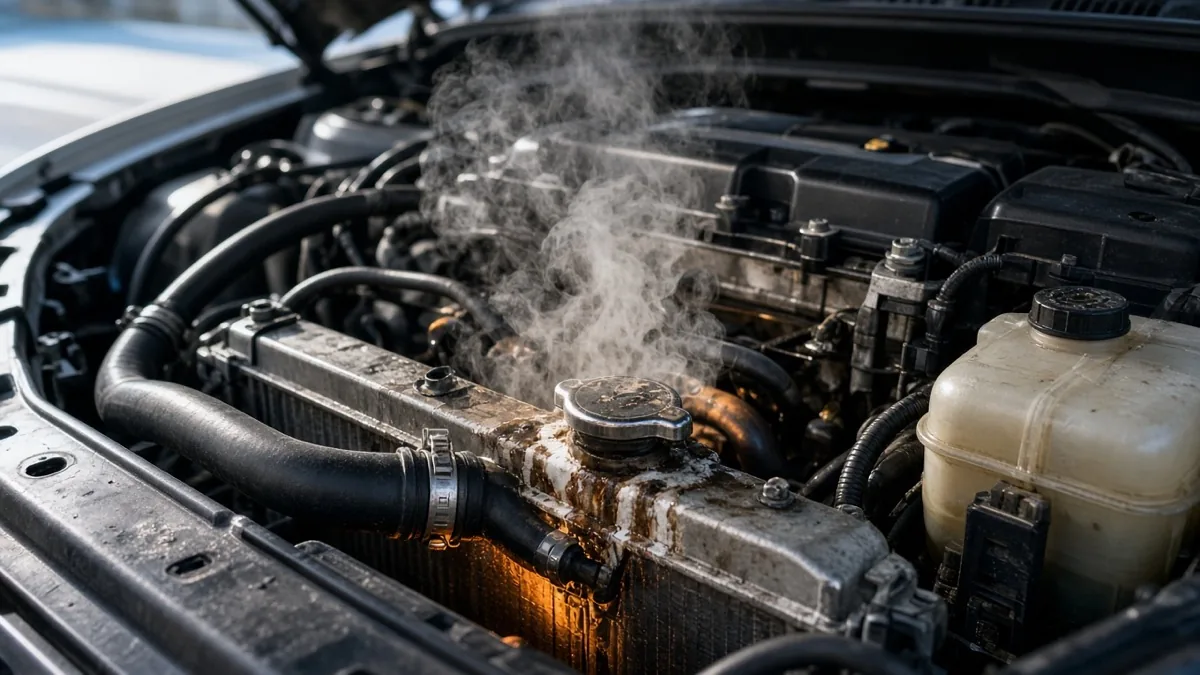
Ethylene glycol, the active ingredient in most coolant, has a distinct sweet, syrupy odor. If you smell it when the HVAC fan is running, coolant is leaking from the heater core into the air plenum and being blown into the cabin. This is the most reliable early indicator because no other component puts coolant vapor into the passenger compartment.
Fogged Windshield That Won't Clear
A leaking heater core releases moisture and coolant vapor behind the dashboard. When you turn the defrost on, the system pulls air across the leaking core and pushes that moisture-laden air directly onto the windshield. The result is a film that keeps fogging back up no matter how long you run the defroster. The film may feel slightly greasy or oily compared to normal condensation.
Wet Passenger Floor
The heater core sits above or near the passenger-side footwell in most vehicles. When it leaks, coolant drips down through the HVAC housing and pools on the floor, often under the carpet. If your passenger carpet is damp and you cannot trace it to a door seal or sunroof drain, check the coolant level. A dropping coolant reservoir combined with a wet floor is a near-certain heater core diagnosis.
For related diagnostics, see our overheating and cooling system diagnosis guide.
No Heat from the Vents
A heater core can fail without leaking. Internal corrosion or debris can clog the passages, blocking coolant flow through the core. The engine still reaches operating temperature, the thermostat opens correctly, but no hot coolant reaches the cabin heat exchanger. Both heater hoses at the firewall should feel hot when the engine is warm. If the inlet hose is hot and the outlet is cool or cold, the core is restricted.
Cost by Popular Model
Labor hours vary significantly by make and model because dashboard designs and HVAC housing layouts differ. Trucks and body-on-frame SUVs with simpler dashboards tend to run less labor than unibody crossovers and sedans with integrated climate systems.
| Vehicle | Estimated Labor | Parts (new) | Estimated Total |
|---|---|---|---|
| Toyota Camry | $570-$900 | $100-$180 | $670-$1,080 |
| Honda Accord | $665-$1,050 | $120-$200 | $785-$1,250 |
| Honda Civic | $570-$950 | $100-$180 | $670-$1,130 |
| Ford F-150 | $665-$1,050 | $130-$220 | $795-$1,270 |
| Ford Fusion | $760-$1,200 | $130-$200 | $890-$1,400 |
| Chevy Silverado 1500 | $950-$1,500 | $150-$250 | $1,100-$1,750 |
| Jeep Grand Cherokee | $760-$1,200 | $140-$230 | $900-$1,430 |
| BMW 3 Series | $1,140-$1,650 | $200-$350 | $1,340-$2,000 |
| Mercedes C-Class | $1,200-$1,800 | $250-$400 | $1,450-$2,200 |
*Labor estimates based on published flat-rate times and $95-$150/hr independent shop rates. Dealer rates add 25-40%.*
The takeaway from this table: get quotes from at least two independent shops before accepting a dealer estimate. On an 8-hour heater core job, the hourly rate difference between a $110 independent and a $180 dealer saves $560 in labor with identical work quality.
Why New Beats Used on This Part
On most auto repairs, buying a used part from a salvage yard makes clear financial sense. Heater cores are the exception, and the reason is simple math.
A new heater core costs $100 to $250. A used one costs $80 to $175, with a median of $116. The maximum savings from going used is roughly $75 to $135. Meanwhile, the labor to install either one runs $475 to $1,500.
If a used heater core fails within a year or two, you pay that labor bill again. If a new one fails, you are covered by a manufacturer warranty (typically 1 to 2 years) and the part itself is statistically less likely to develop leaks because it has not already endured years of thermal cycling and coolant exposure.
The risk calculation:
| Scenario | Part | Labor | Total | Risk |
|---|---|---|---|---|
| New heater core, single install | $100-$250 | $475-$1,500 | $575-$1,750 | Low, warranty-backed |
| Used heater core, single install | $80-$175 | $475-$1,500 | $555-$1,675 | Higher, no warranty typical |
| Used heater core, fails and re-do | $80-$175 x2 | $475-$1,500 x2 | $1,110-$3,350 | Realized |
For a detailed breakdown, see our broader used parts pricing context guide.
This logic also applies to other labor-heavy, cheap-part repairs. An AC compressor follows a similar pattern: the compressor is moderately priced, but the system must be evacuated and recharged regardless of part source, adding fixed labor cost that penalizes repeat jobs.
For a detailed breakdown, see our AC compressor cost analysis guide.